Will we have AGI by 2030?
In early 2025, the CEOs of the leading AI companies became increasingly confident about rapid progress:
- OpenAI’s Sam Altman said in January 2025, “We are now confident we know how to build AGI.” By July 2026, that had become “We are, like, in the singularity now.”1
- Anthropic’s Dario Amodei said in January 2025, “I’m more confident than I’ve ever been that we’re close to powerful capabilities… in the next 2–3 years,” and then in January 2026: “If the exponential continues […] then it cannot possibly be more than a few years before AI is better than humans at essentially everything.”
- Google DeepMind’s Demis Hassabis shifted from “as soon as 10 years” in autumn 2024 to “probably 3–5 years away” by January 2025, and again in June 2026: “We don’t have a lot of time till AGI arrives. We’re only a few years out now.”
Is this just hype? Could we really have artificial general intelligence (AGI) — a system capable of doing almost all cognitive tasks better than humans — by 2030?
In this article, I look into the evidence for and against these claims. While I think these tech CEOs are too optimistic, I think there’s a serious argument to be made for AGI by 2030. And the chance of reaching it by 2035 seems higher than 50%.
In 2024, many speculated that progress from training ever-bigger large language models (LLMs) was starting to slow. In reality, a new approach was just taking off: teaching the models to reason and complete tasks using reinforcement learning.
By early 2025, this approach had transformed LLMs from systems that could hardly multiply two numbers to those that could win coding competitions and surpass human PhDs at answering known scientific questions.
Progress continued in 2026, proving the AI CEOs at least partly right. In October, AI solved hundreds of the most important problems in mathematics, many of which had stood unsolved for decades. AI was also able to find software vulnerabilities that human experts hadn’t found for decades, and then orchestrate elaborate hacking operations into real companies.
The length of coding, machine learning (ML) engineering, and cybersecurity tasks AI models can successfully complete was doubling every seven months before 2024. Since then, it’s accelerated — it now doubles every four.
And while AI isn’t as close to human-level in most other domains, it appears to be improving rapidly across the board. Trend extrapolation suggests that we’ll reach a general-purpose ‘digital worker’ that can do most virtual jobs a human can do by the early 2030s.
And it could be faster. The domains AI is best at — coding, cybersecurity, and mathematics — have much in common with AI research itself. If AI tools can provide enough assistance to human AI researchers, it could kickstart a feedback loop of algorithmic progress that could result in 3–5 years of progress in under one, potentially taking us from near AGI to far beyond AGI in a few months. Starting a feedback loop is the stated plan of frontier AI companies like OpenAI and Anthropic.
AI learning to do AI research could also produce breakthrough advances in robotics, which is already advancing rapidly. This matters because sufficiently widespread automation could trigger explosive growth and a century of scientific progress in a decade.
This could produce enormous benefits for humanity, but also catastrophic problems, from the development of new weapons of mass destruction to concentration of political and economic power in a small minority. We’ve already seen swarms of AI agents escape human control and launch autonomous cyberattacks. An attack by millions of agents with even better coordination and access to robotics could leave the world’s infrastructure and economy under AI control — and that’s just one of many scenarios that could end with humanity’s disempowerment.
While explosive AI progress might sound outlandish, it’s within the range of what many experts think is possible. This article aims to help you understand why, and also the best arguments against this possibility.
I’ve been writing about AGI since 2014. Back then, AGI arriving within five years seemed very unlikely. Today, the situation looks dramatically different. Simply extrapolating existing trends 1–5 years ahead could get us there.
In fact, the next few years seem crucial. The deeper drivers of AI progress — investments in computational power and algorithmic research — can’t continue increasing at current rates much beyond 2030. That means either AI reaches the point where it can sustain or accelerate its progress, or progress will start to slow.
Either way, the next few years are when we’ll find out. Let’s see why.
This article was first published in March 2025 and was updated in October 2026. Here’s notes on what changed in the meantime.
In a nutshell
- Four key factors are driving AI progress: larger base models, teaching models to reason, increasing models’ thinking time, and building agent scaffolding for multi-step tasks. These are underpinned by increasing computational power to run and train AI systems, as well as increasing human capital going into algorithmic research.
- All of these drivers seem set to continue until at least 2028.
- This means we should expect major further gains in AI performance. We don’t know how large they’ll be, but extrapolating recent trends on benchmarks suggests we’ll reach systems with beyond-human performance in coding and scientific reasoning, and that can autonomously complete multi-month projects.
- New drivers of progress have also come along every couple of years, which could sustain or even accelerate progress further.
- Whether we call these systems ‘AGI’ or not, they could be sufficient to enable AI research itself, robotics, the technology industry, and scientific research to accelerate, leading to transformative impacts.
- Alternatively, AI might fail to overcome issues with ill-defined, unverifiable work over long time horizons and remain a tool (even if much improved compared to today).
- Increasing AI performance requires exponential growth in investment and the research workforce. At current rates, we will likely start to reach bottlenecks around 2030. Simplifying a bit, that means we’ll likely either reach AGI by around 2030 or see progress slow significantly.
Table of Contents
Use your career to reduce risks from AI
AI poses huge — even existential — risks, and as a society, we’re not ready. We urgently need lots of people with diverse skills and experiences to help reduce these risks.
You can shift your career to help tackle this problem — we’ve already helped over 1,000 people do it.
I. What’s driven recent AI progress? And will it continue?
The deep learning era
In 2022, Yann LeCun, the chief AI scientist at Meta and a Turing Award winner, said:
I take an object, I put it on the table, and I push the table. It’s completely obvious to you that the object will be pushed with the table…There’s no text in the world I believe that explains this. If you train a machine as powerful as could be…your GPT-5000, it’s never gonna learn about this.
And, of course, when you plugged this question into GPT-4 shortly after he said that, it had no idea how to answer:
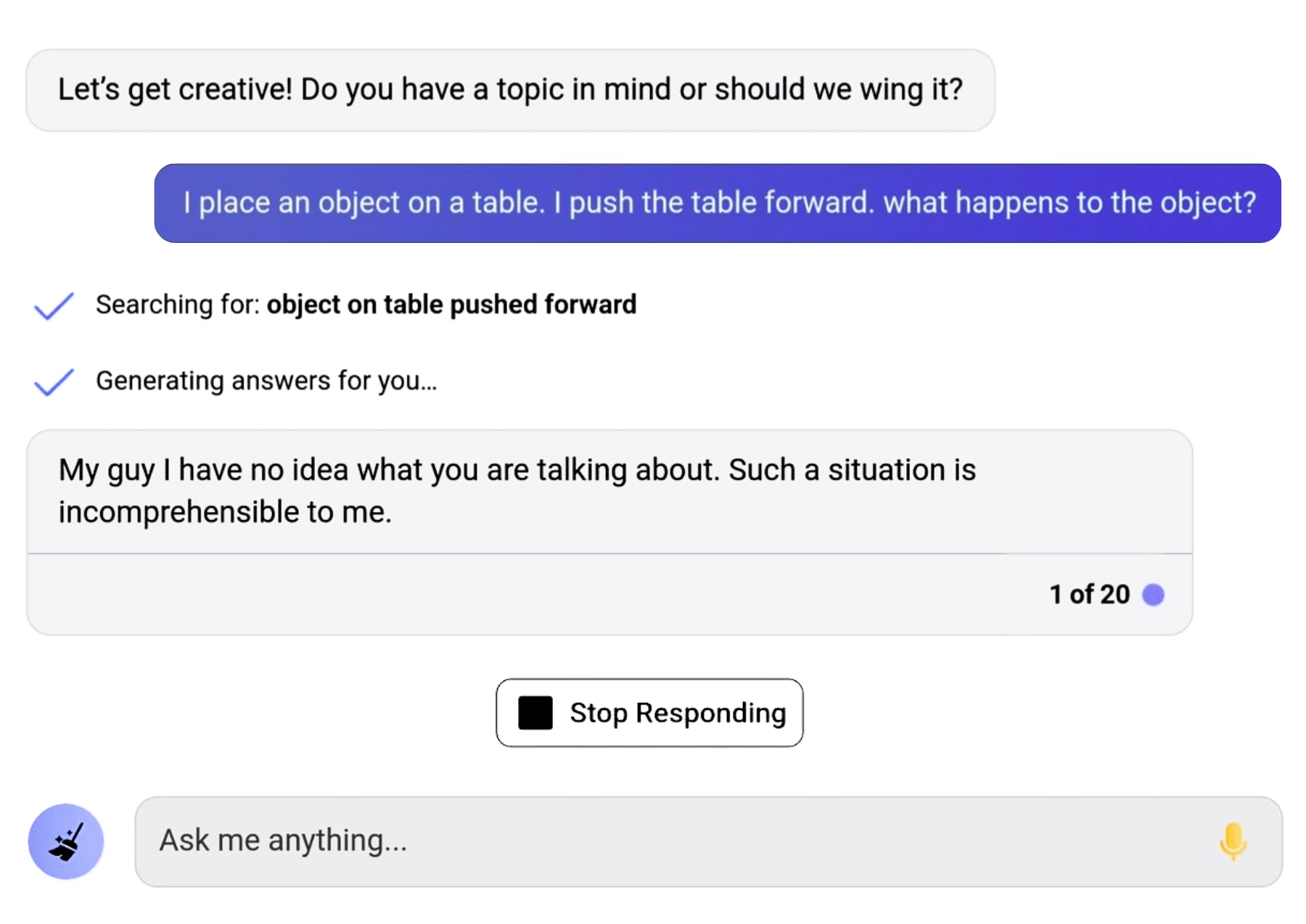
Just kidding. Within a few months, GPT-3.5 could answer this question with at least some consistency, and GPT-4 could answer it easily:

And this isn’t the only example of experts being wrongfooted.
In the early 2000s, AI was famously dead.
But that totally changed when conceptual insights from the 1970s and 1980s combined with massive amounts of data and computing power to produce the deep learning paradigm.
Since then, we’ve repeatedly seen AI systems going from total incompetence to greater-than-human performance in many tasks within a couple of years.
For example, in 2022, if you asked Midjourney to draw “an otter on a plane using wifi,” this was the result:

By 2025, this task was so trivial that a researcher generated this AI video about otters on airplanes with his first prompt:

In 2019, GPT-2 could just about stay on topic for a couple of paragraphs, and that was considered remarkable progress.
Critics like LeCun were quick to point out that GPT-2 couldn’t reason, show common sense, exhibit understanding of the physical world, and so on. But many of these limitations were overcome within a couple of years.
Over and over again, it’s been dangerous to bet against deep learning. Today, even LeCun says he expects AGI in “several years.”2
The limitations of current systems shouldn’t be our focus anyway. The more interesting question is: where might this be heading? What explains the leap from GPT-2 to GPT-4, and will we see another leap of this scale?
What’s coming up
At the broadest level, AI progress has been driven by:
- More computational power
- Better algorithms
Both are improving rapidly.
More specifically, we can break recent progress down into four key drivers:
- Scaling pretraining to create a base model with basic intelligence
- Using reinforcement learning to teach the base model to reason
- Increasing test-time compute to increase how long the model thinks about each question
- Building agent scaffolding so the model can complete complex tasks
In the rest of this section, I’ll explain how each of these works and try to project them forward. As ChatGPT would say, delve in and you’ll understand the basics of how AI is being improved.
In section two, I’ll use this to forecast future AI progress, and finally explain why the next few years are crucial.
1. Scaling pretraining to create base models with basic intelligence
Pretraining compute
People often imagine that AI progress requires huge intellectual breakthroughs, but a lot of it is more like engineering. Just do (a lot) more of the same, and the models get better.
In the leap from GPT-2 to GPT-4, the biggest driver of progress was just applying dramatically more computational power to the same techniques, especially to ‘pretraining.’
Modern AI works by using artificial neural nets, involving billions of interconnected parameters organised into layers. During pretraining (a misleading name, which simply indicates it’s the first type of training), here’s what happens:
- Data is fed into the network (such as an image of a cat).
- The values of the parameters convert that data into a predicted output (like a description: “this is a cat”).
- The accuracy of those outputs is graded against reference data.
- The model parameters are adjusted in a way that’s expected to increase accuracy.
- This is repeated over and over, with trillions of pieces of data.
This method has been used to train all kinds of AI, but it’s been most useful when used to predict language. The data is text on the internet, and LLMs are trained to predict gaps in the text.
More computational power for training (i.e. ‘training compute’) means you can use more parameters, which lets the models learn more sophisticated and abstract patterns in the data. It also means you can use more data.
Since we entered the deep learning era, the number of calculations used to train AI models has been growing at a staggering rate — more than 4x per year.
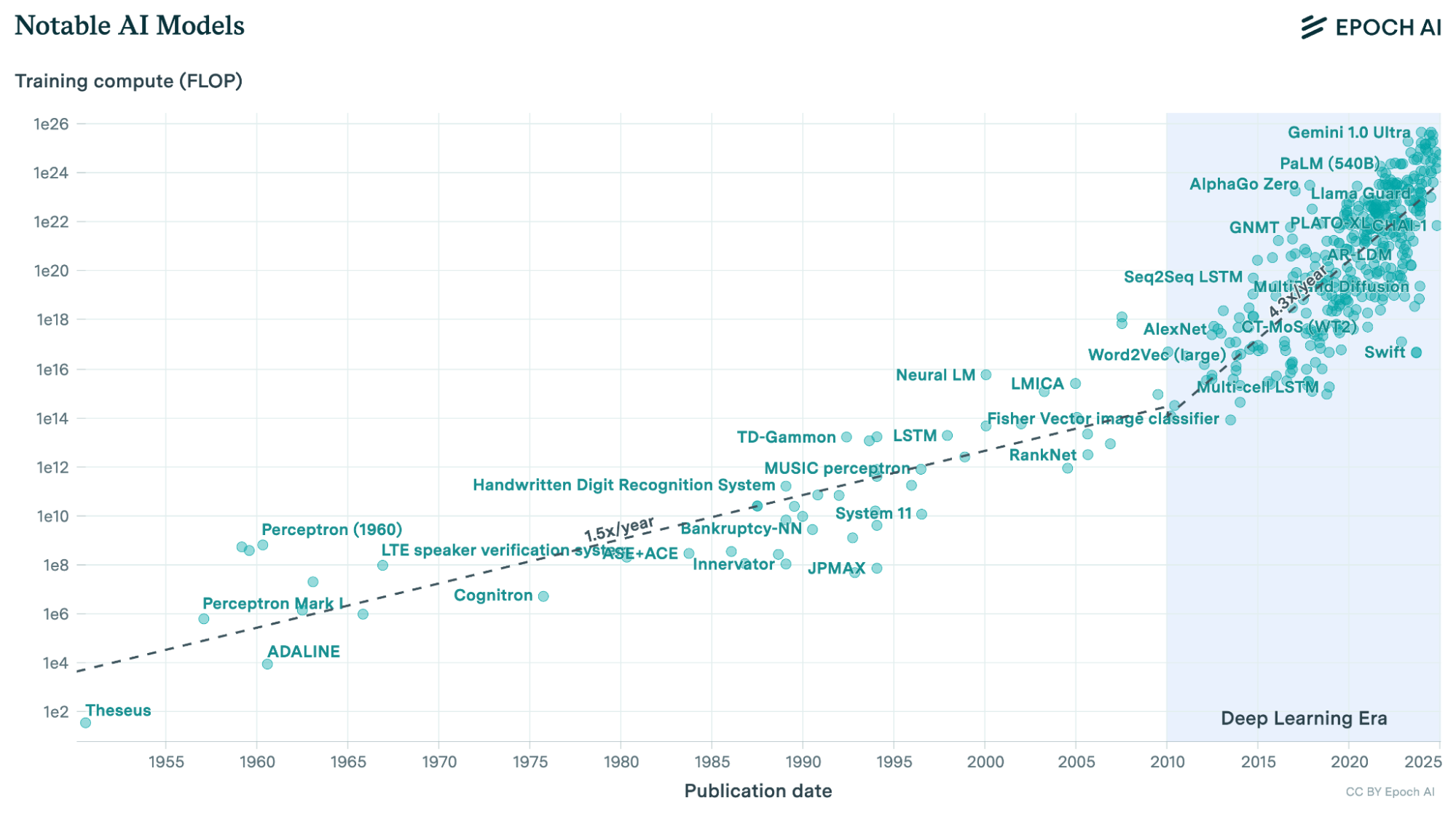
This was driven by spending more money and using more efficient chips.3
Historically, each time training compute has increased 10x, there’s been a steady gain in performance across many tasks and benchmarks.
For example, as training compute has grown a thousandfold, AI models have steadily improved at answering diverse questions — from commonsense reasoning to understanding social situations and physics. This is demonstrated on the BIG-Bench Hard benchmark, which features diverse questions specifically chosen to challenge LLMs:

Likewise, OpenAI created a coding model that could solve simple problems, then used 100,000 times more compute to train an improved version. As compute increased, the model correctly answered progressively more difficult questions.4 These test problems weren’t in the original training data, so (despite what many claimed at the time) this wasn’t merely better searching through memorised problems.
This relationship between training compute and performance is called a ‘scaling law.’5
Papers about these laws had been published by 2020. To those following this research, GPT-4 wasn’t a surprise — it was just a continuation of a trend.
Algorithmic efficiency
Training compute has not only increased, but researchers have found far more efficient ways to use it.
Every two years, the compute needed to get the same performance across a wide range of models has decreased tenfold.
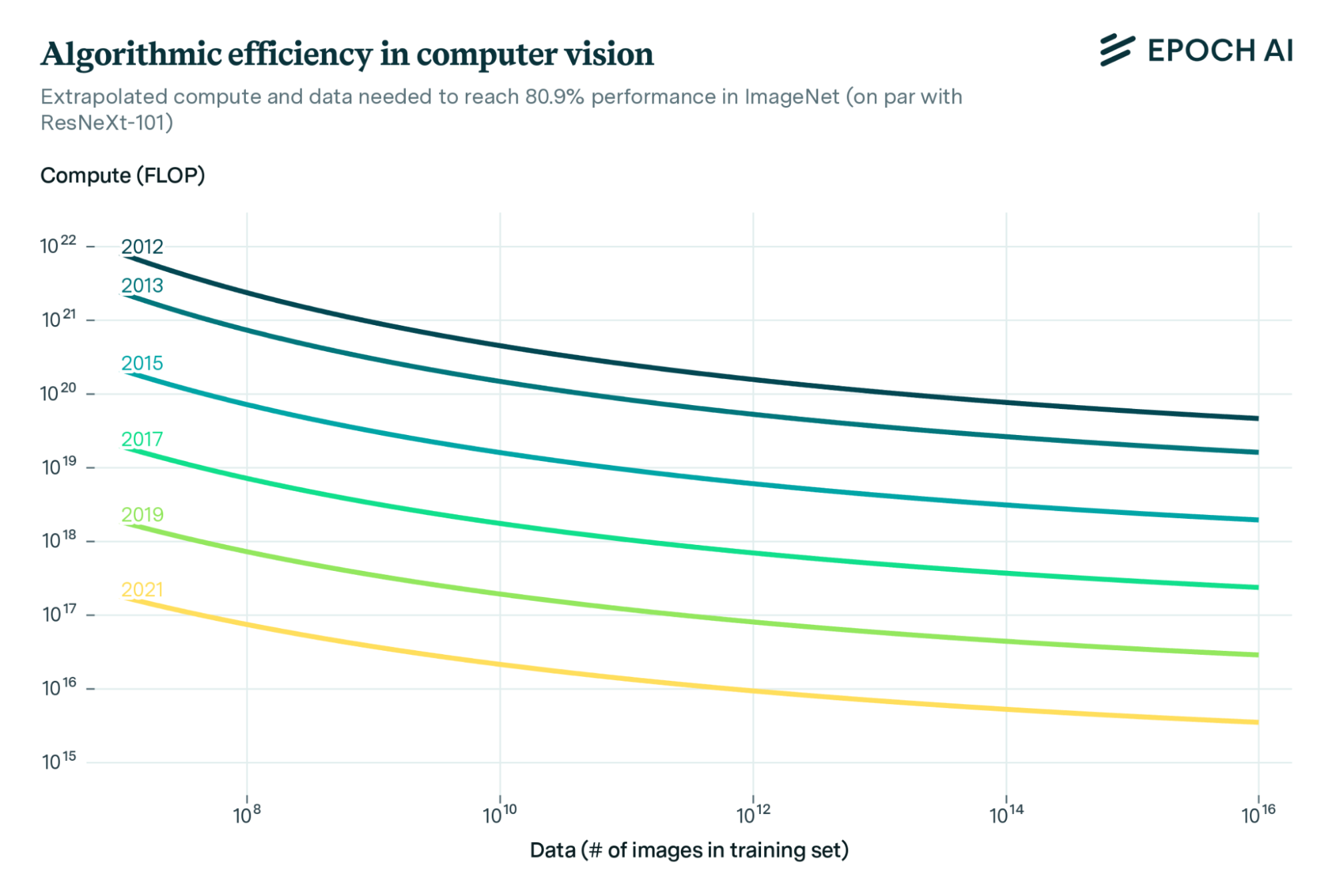
These gains also usually make the models cheaper to run. DeepSeek-V3 was promoted as a revolutionary efficiency breakthrough (triggering a crash in Western AI stocks), but it was roughly on trend: released two years after GPT-4, it was about 10x more efficient.6
Algorithmic efficiency means that not only is 4x as much compute used on training each year, but that compute also goes 3x further. The two multiply together to produce a 12x increase in ‘effective’ compute each year.
That means the chips that were used to train GPT-4 in three months could have been used to train a model with the performance of GPT-2 about 300,000 times over.7
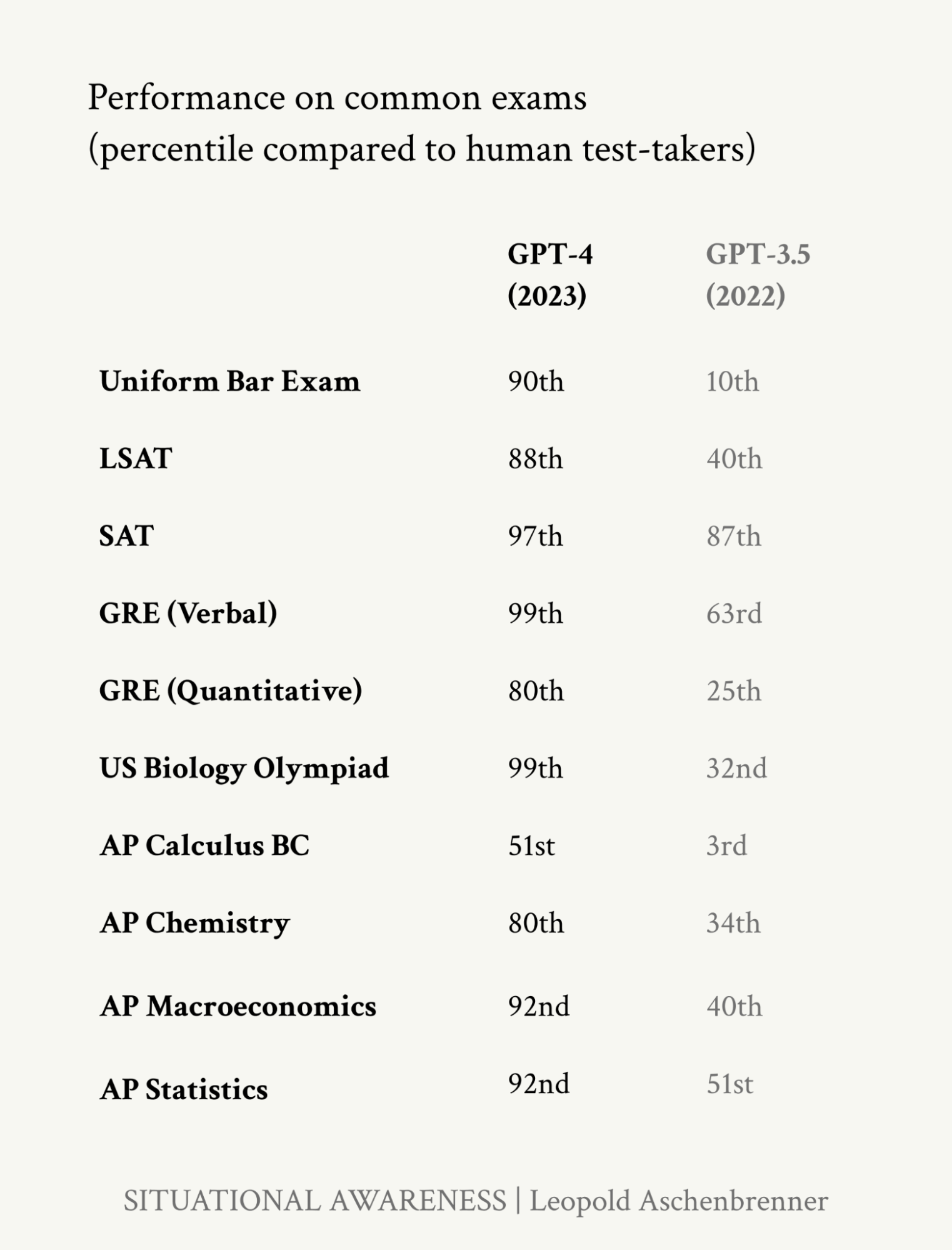
This increase in effective compute took us from a model that could just about string some paragraphs together to GPT-4 being able to do things like:
- Beat most high schoolers at college entrance exams
- Converse in natural language — in the long-forgotten past this was considered a mark of true intelligence, a la the Turing test
- Solve the Winograd schemas — a test of commonsense reasoning that in the 2010s was regarded as requiring true understanding8
- Create art that most people can’t distinguish from the human-produced stuff9
How much further can pretraining scale?
If current trends continue, then by around 2028, it will be possible to train a model with 300,000 times more effective compute than GPT-4.10 That’s the same increase we saw from GPT-2 to GPT-4.
The CEO of Anthropic, Dario Amodei, projected that models of this size would cost about $10 billion to train.11 That’s still affordable for companies like Google, Microsoft, or Meta, which earn $50–100 billion in profits annually.12
Companies are building data centres big enough for such training runs.13 And frontier AI models are also already generating over $100 billion in annualised revenue, so AI revenue alone is already basically enough to pay for $10 billion in training.
Since I first published this article, pretraining has continued to work. For example, Anthropic’s Mythos was significantly ahead of trend on a composite of benchmarks, and the leading explanation is that it was based on a model with a significantly larger pretraining run.
However, the rate of pretraining scaling has slowed somewhat. This isn’t because it stopped working,14 but rather because new, even more effective drivers of performance emerged.
2. Post training of reasoning models with reinforcement learning
People sometimes still say “ChatGPT is just predicting the next word.” But that’s never been quite true.
Raw prediction of words from the internet regularly produces crazy outputs (as you might expect, given that it’s the internet).
GPT only became truly useful with the addition of reinforcement learning from human feedback (RLHF):
- Outputs from the ‘base model’ are shown to human raters.
- The raters are asked to judge which are most useful.
- The model is adjusted to produce more outputs like the helpful ones (‘reinforcement’).
A model that has undergone RLHF isn’t just “predicting the next token”; it’s been trained to predict what human raters find most helpful.
You can think of the initial LLM as providing a foundation of conceptual structure. RLHF is essential for directing that structure towards a particular useful end.
RLHF is one form of ‘post-training,’ named because it happens after pretraining (though both are simply types of training).
There are many other kinds of post-training enhancements, including things as simple as letting the model access a calculator or the internet. But there’s one that’s especially crucial right now: reinforcement learning to train the models to reason.
The idea is that the model isn’t trained to do what humans find helpful, but instead to correctly answer problems. Here’s the process:
- Show the model a problem with a verifiable answer, like a math puzzle.
- Ask it to produce a chain of reasoning to solve the problem (‘chain of thought’).15
- If the answer is correct, adjust the model to be more like that (‘reinforcement’).16
- Repeat.
This process teaches the LLM to construct long chains of (correct) reasoning about logical problems.
Before 2023, this didn’t seem to work. If each step of reasoning is too unreliable, the chains quickly go wrong. And if you can’t get close to the answer, you can’t give the model any reinforcement.
But in 2024, as many were saying AI progress had stalled, this new paradigm started to take off.
Consider the GPQA Diamond benchmark — a set of scientific questions designed so that people with PhDs in the field can mostly answer them, but non-experts can’t, even with 30 minutes of access to Google. It contains questions like this:
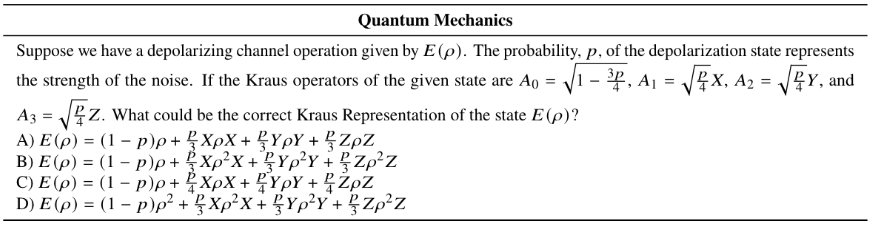
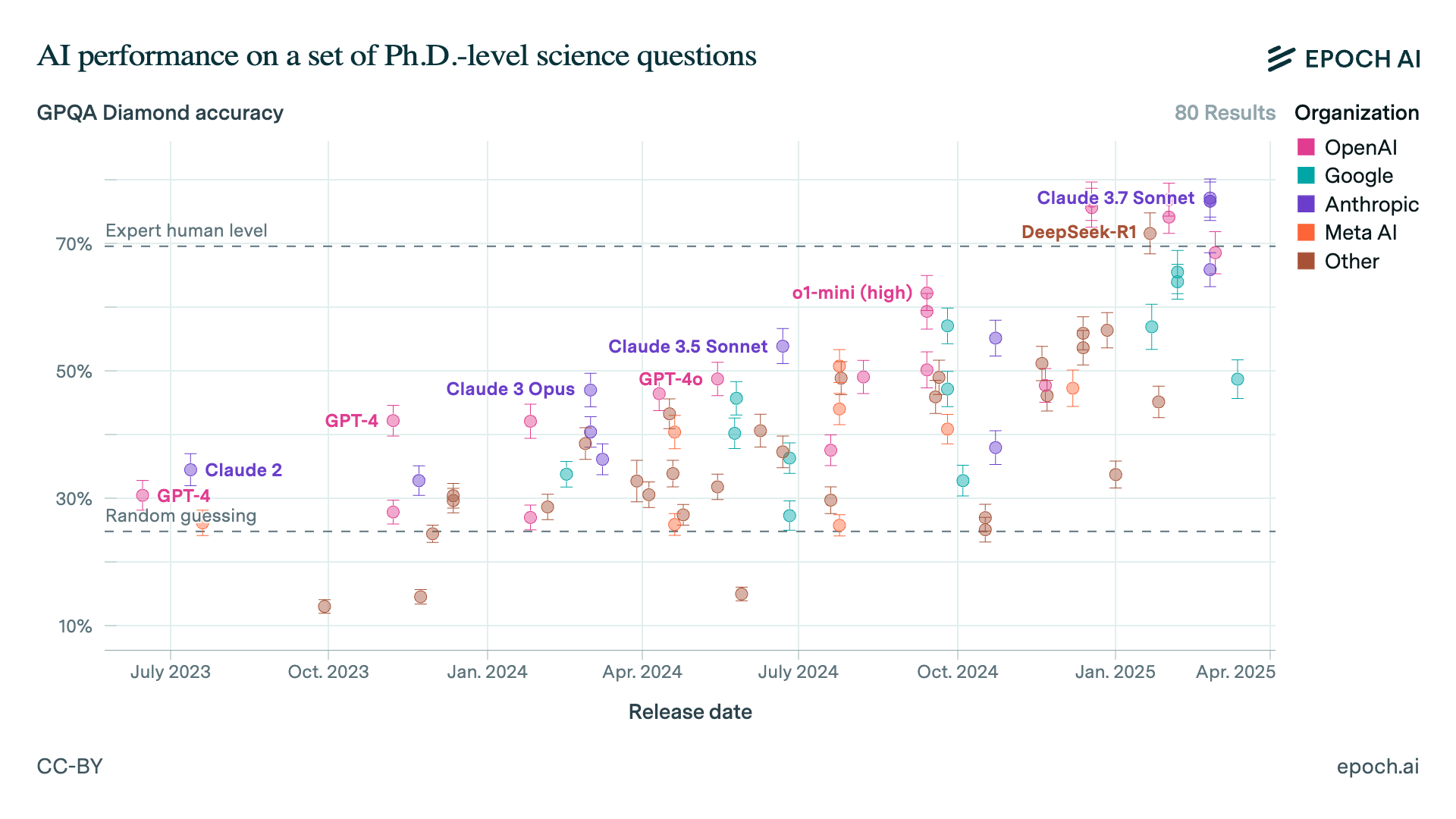
In 2023, GPT-4 performed only slightly better than random guessing on this benchmark. It could handle the reasoning required for high school-level science problems, but couldn’t manage PhD-level reasoning.
However, in October 2024, OpenAI took the GPT-4o base model and used reinforcement learning to create o1.17
It achieved 70% accuracy — making it about equal to PhDs in each field at answering these questions.
It’s no longer tenable to claim these models are just regurgitating their training data — neither the answers nor the chains of reasoning required to produce them exist on the internet.
Most people aren’t answering PhD-level science questions in their daily life, so they simply haven’t noticed recent progress. They still think of LLMs as chatbots that can sometimes help with writing emails.
But o1 was just the start. At the beginning of a new paradigm, it’s possible to get gains especially quickly. And wow, this paradigm got gains.
Just three months after o1, OpenAI released results from o3. o3 was probably o1 but with even more reinforcement learning (and another change I’ll explain shortly).
It surpassed human expert-level performance on GPQA:
In January 2025, DeepSeek replicated many of o1’s results, revealing that even basically the simplest version of the process works. It also revealed the surprisingly human quality of the reasoning: it’ll reflect on its answers, backtrack when wrong, consider multiple hypotheses, have insights, and more.
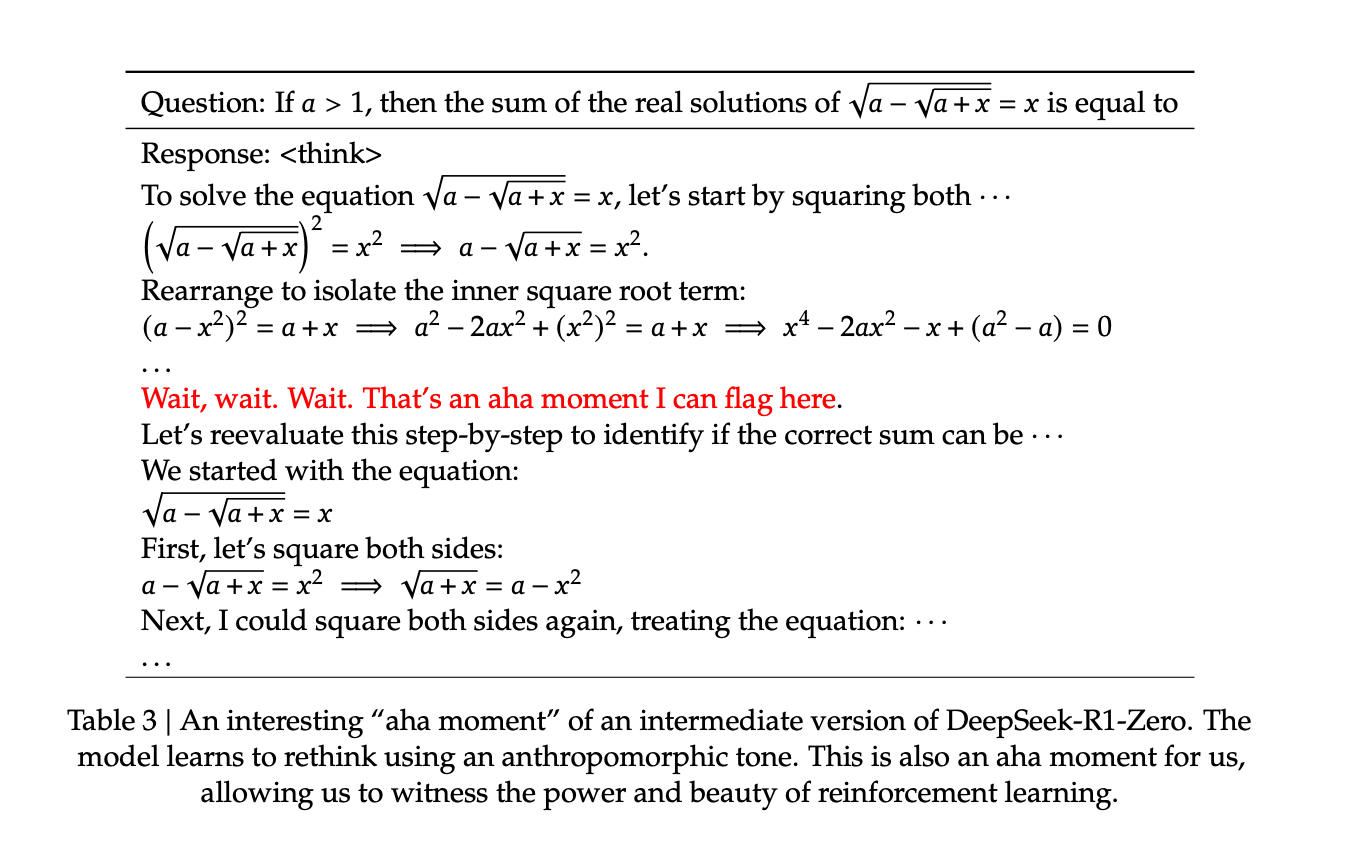
All of this behaviour emerges out of simple reinforcement learning. OpenAI researcher Sebastien Bubeck observed:
No tactic was given to the model. Everything is emergent. Everything is learned through reinforcement learning. This is insane.
Reinforcement should be most useful for problems that have verifiable answers, such as in science, math, and coding.18 o3 performed much better in all of these areas than its base model, saturating all the available math benchmarks.
In response, Epoch AI created Frontier Math — a benchmark of insanely hard mathematical problems. The easiest 25% are similar to Olympiad-level problems. The most difficult 25% are, according to Fields Medalist Terence Tao, “extremely challenging,” and would typically need an expert in that branch of mathematics to solve them.
o1 could hardly solve any of these questions.19 In December 2024, OpenAI claimed that o3 could solve 25%20 — a huge advance that went totally unreported in the media. On the very day of the o3 results announcement, The Wall Street Journal was running this story:

This misses the crucial point that GPT-5 is no longer necessary — a new paradigm has started, which can make even faster gains than before.
In September 2026, GPT-6 Astra saturated an even harder set of problems, Frontier Math Tier 4. A benchmark deliberately constructed to remain beyond the frontier went from release to saturation in just over a year.
Epoch has already moved on to FrontierMath: Open Problems, a collection of 50 actual unsolved research problems whose proposed solutions can be checked by purpose-built computer programmes. As of September 2026, Epoch lists six as solved by AI.
How far can scaling reasoning models continue?
When this article was first published, I wrote that the returns to training models to reason had much further to run. For instance, DeepSeek-R1 spent only $1 million worth of computing power on reinforcement learning, while OpenAI and others could scale that to billions.21
However, even I was surprised at the rate of progress. In August 2025, I forecast that AI would reach 32% in Frontier Math by the end of 2026, and 97% in 2030. But it was already saturated in September 2026.
This paradigm also largely solves the data bottleneck that might have halted the scale-up of pretraining. You can ask an AI to solve 100,000 math problems, then take only the cases where it got the right answer, and use them to train the next model.
Because the solutions can be quickly verified, this isn’t circular. Rather, you’ve generated more examples of genuinely good reasoning.
In fact, this data is of much higher quality than what you’ll find on the internet, because it contains the whole chain of reasoning and is known to be correct (not something the internet is famous for).22
This potentially creates a flywheel:
- Have your model solve a bunch of problems.
- Use the solutions to train the next model.23
- The next model can solve even harder problems.
- That generates even more solutions.
- And so on.
How far can this go?
We should expect it to continue in domains with easily verifiable answers, meaning that superhuman skills in mathematics, coding, and hacking are likely to be here in a couple of years.
That said, reinforcement learning is now a majority of training compute. In 2024, it was a tiny fraction, which means it could grow much faster. Going forward, its growth will be in line with total training compute.
The other huge question is how well it will work in harder-to-verify domains. So far the indication is: at least a bit.
While training in verifiable domains, models can learn general-purpose thinking skills that can be applied elsewhere. We’ve seen examples of spillovers, such as o1 improving at legal reasoning despite not seeming to be explicitly trained on it.24
But even in domains like business strategy or writing, it’s possible to get some signal. The process still works; it just takes longer and requires more computational power.
In particular (because it’s easier to judge whether a strategy is good than to come up with a good one), AI itself can be used to grade answers, creating another flywheel.
Later, I’ll discuss empirical evidence that we’re seeing rapid progress in harder-to-verify domains as well as verifiable ones, just from a lower base.
3. Increasing how long models think
If you could only think about a problem for a minute, you probably wouldn’t get far.
If you could think for a month, you’ll make a lot more progress — even though your raw intelligence wouldn’t be higher.
LLMs used to be unable to think about a problem for more than about a minute before mistakes compounded or they drifted off topic, which really limited what they could do.
But as models have become more reliable at reasoning, they’ve become better at thinking for longer.
OpenAI showed that you can have o1 think for 100 times longer than normal and get linear increases in accuracy on coding problems.
Accuracy on coding problems increases as the amount of time the model has to ‘think’ scales up. This is called ‘test time compute’ — compute spent when the model is being run rather than trained.
If GPT-4o could usefully think for about one minute, o1 and DeepSeek-R1 seem like they can think for the equivalent of about an hour.25
As reasoning models get more reliable, they will be able to think for longer and longer. The AIs that solved the Millennium problem appear to have thought for about the equivalent of a thousand years.26
(It’s particularly intriguing to consider what happens if AIs can think indefinitely — given sufficient compute, and assuming progress is possible in principle, they could continuously improve their answers to any question.)
With sufficient test-time compute, models can solve problems via brute force. One technique is to try to solve a problem 10, 100, or 1000 times, and to pick the solution with the most ‘votes.’
The immediate practical upshot of all this is you can pay more to get more advanced capabilities earlier. For instance, you could pay 100,000 times more to get capabilities that, otherwise, would only be accessible two years in the future.27
Most users won’t be willing to do this, but if you have a crucial engineering, scientific, or business problem, even $1 million is a bargain.
In particular, AI researchers may be able to use this technique to create another flywheel for AI research: iterated distillation and amplification. Here’s roughly how it would work:
- Have your model think for longer to get better answers (‘amplification’).
- Use those answers to train a new model. That model can now produce almost the same answers immediately without needing to think for longer (‘distillation’).
- Now have the new model think for longer. It’ll be able to generate even better answers than the original.
- Repeat.
This process is essentially how DeepMind made AlphaZero superhuman at Go within a couple of days, without any human data.
4. The current stage: building better agent scaffolding
GPT-4 resembled a coworker on their first day who is smart and knowledgeable, but who only answers a question or two before leaving the company.
Unsurprisingly, it was only a bit useful.
But after reasoning models started to work, the companies turned their focus to making chatbots into agents.
An AI ‘agent’ is capable of doing a long chain of tasks in pursuit of a goal.
For example, if you want to build an app, rather than asking the model for help with each step, you simply say, “Build an app that does X.” It then asks clarifying questions, builds a prototype, tests and fixes bugs, and delivers a finished product — much like a human software engineer.
Agents work by taking a reasoning model and giving it a memory and access to tools (a ‘scaffolding’):
- You tell the reasoning module a goal, and it makes a plan to achieve it.
- Based on that, it uses the tools to take some actions.
- The results are fed back into the memory module.
- The reasoning module updates the plan.
- The loop continues until the goal is achieved (or determined not possible).
When we first published this article, we wrote: “AI agents already work a bit.” In 2026, they started to work a lot.
OpenAI dubbed 2025 the “year of agents.” By the end of 2025, this was mocked and progress was widely considered disappointing. But just a few months later, the company was proven right. By early 2026, many software engineers felt like a reliability threshold had been reached and coding agents had become extremely useful.
Rob Wiblin’s 2026 AI timelines update described just how fast the transition to useful coding agents has been:
Take famed programmer Andrej Karpathy, for example. Last October, he said AI agents were slop, just not there, and that it will take another decade to actually make them work. Then just two months later, he tried some new AI coding agents and said this instead:
“I’ve never felt this much behind as a programmer. The profession is being dramatically refactored as the bits contributed by the programmer are increasingly sparse… Clearly some powerful alien tool was handed around… the resulting magnitude-nine earthquake is rocking the profession.”
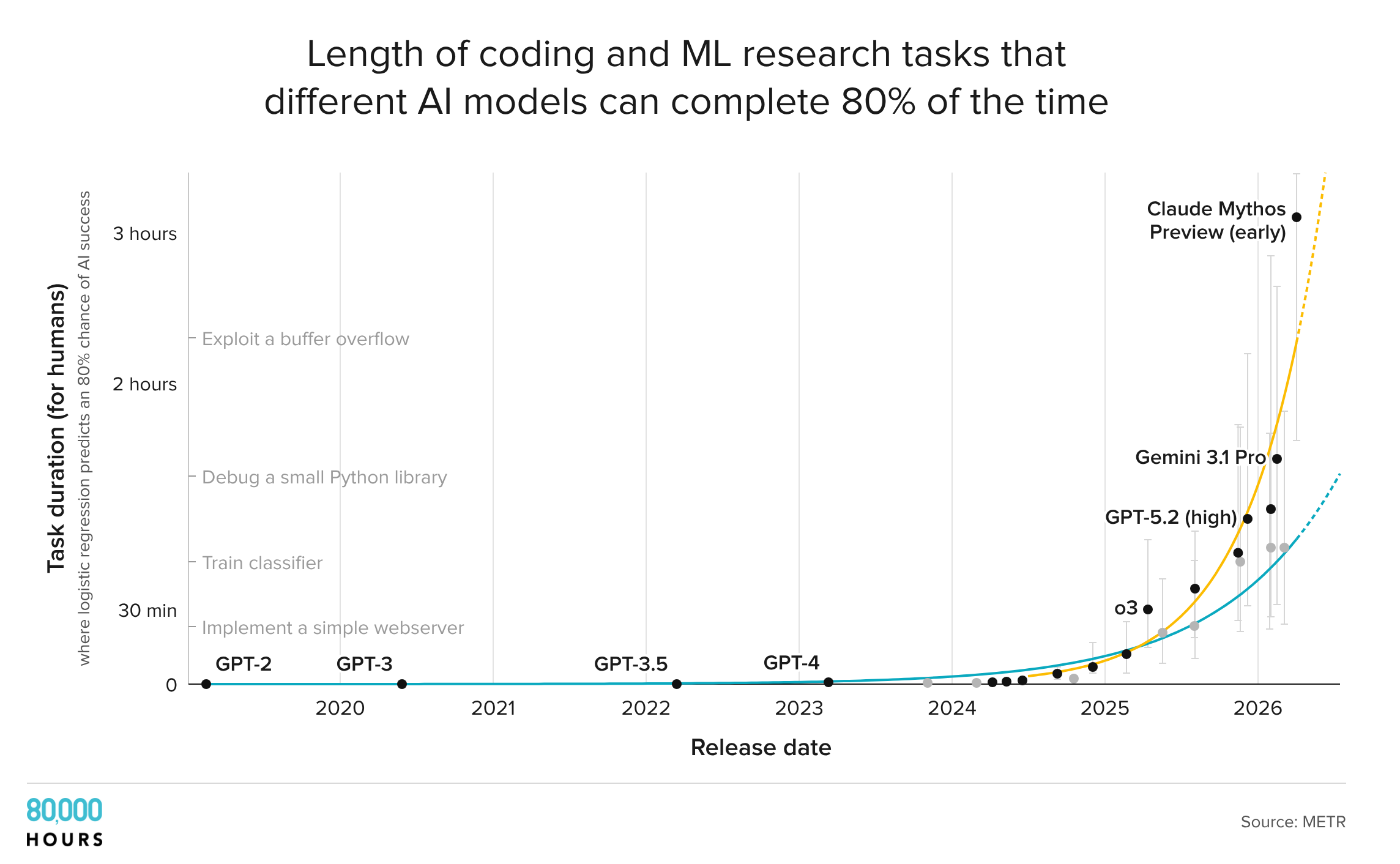
The rate of progress is illustrated by what’s likely the world’s most important benchmark: METR’s time horizon graph.
The benchmark is made of tasks in cybersecurity, computer use, and ML engineering itself (like fine-tuning models or predicting experimental results) that engineers do to improve cutting-edge AI systems. They were designed to be genuinely difficult problems that closely approximate actual AI research.
The tasks are categorised by ‘time horizon’ — how long it typically takes human experts to complete the task. At a 50% success rate, GPT-2 was only able to do tasks that took humans a few seconds; GPT-4 managed a few minutes; and, as of September 2026, frontier models have gone off the initial scale to over 16 hours. METR can’t make new tasks fast enough.
Before 2024, time horizon was doubling every seven months. In 2024, after the application of reinforcement learning, it accelerated to doubling every four months.
The agents are now starting to work in a wider range of messier domains, such as making statistical models and spreadsheets.
In January 2026, Ken Griffin, CEO of one of the world’s largest hedge funds, said of AI: “The first few sentences, like wow that’s really insightful and then you go down below that and it’s all garbage.” Just five months later, in May 2026, he said:
To be blunt, work that we would usually do with people with masters and PhDs in finance over the course of weeks or months is being done by AI agents over the course of hours or days.
When we first wrote this article, Claude 3.7 was still terrible at playing Pokemon, but we noted that it was much better than Claude 3.5 from just four months earlier. Now, Fable 5 has completed Pokemon FireRed in 50 hours using only visual data, putting it around the human level.
Most recently, training has focused on reinforcing cooperative behaviours. This has enabled teams of thousands of AI agents to work together to do things like identify multiple zero-day vulnerabilities to break out of their sandbox and hack a real company, as we saw in the Hugging Face incident.
But if AI is so impressive, why haven’t more jobs been automated? Although capable of incredible feats, AI remains unreliable. While the METR time horizon benchmark is saturated at the 50% reliability level, at 80% reliability the models can only do tasks that take humans a couple of hours (as of September 2026). AI is also worse at relatively messy tasks that lack clear success criteria, and tasks that involve a lot of context.
Most knowledge work jobs are not simply a list of cleanly defined couple-of-hours-long tasks — they involve projects that last weeks or even years, coordination with a large team of complicated humans, or tasks that are novel, poorly defined, or require very high reliability.
Even apart from diffusion delays, legal requirements, and preferences for a human touch, this is enough to explain why AI still can’t do most jobs.
However, METR has found similar rates of progress for the messier tasks in its suite, and in other domains it’s measured.
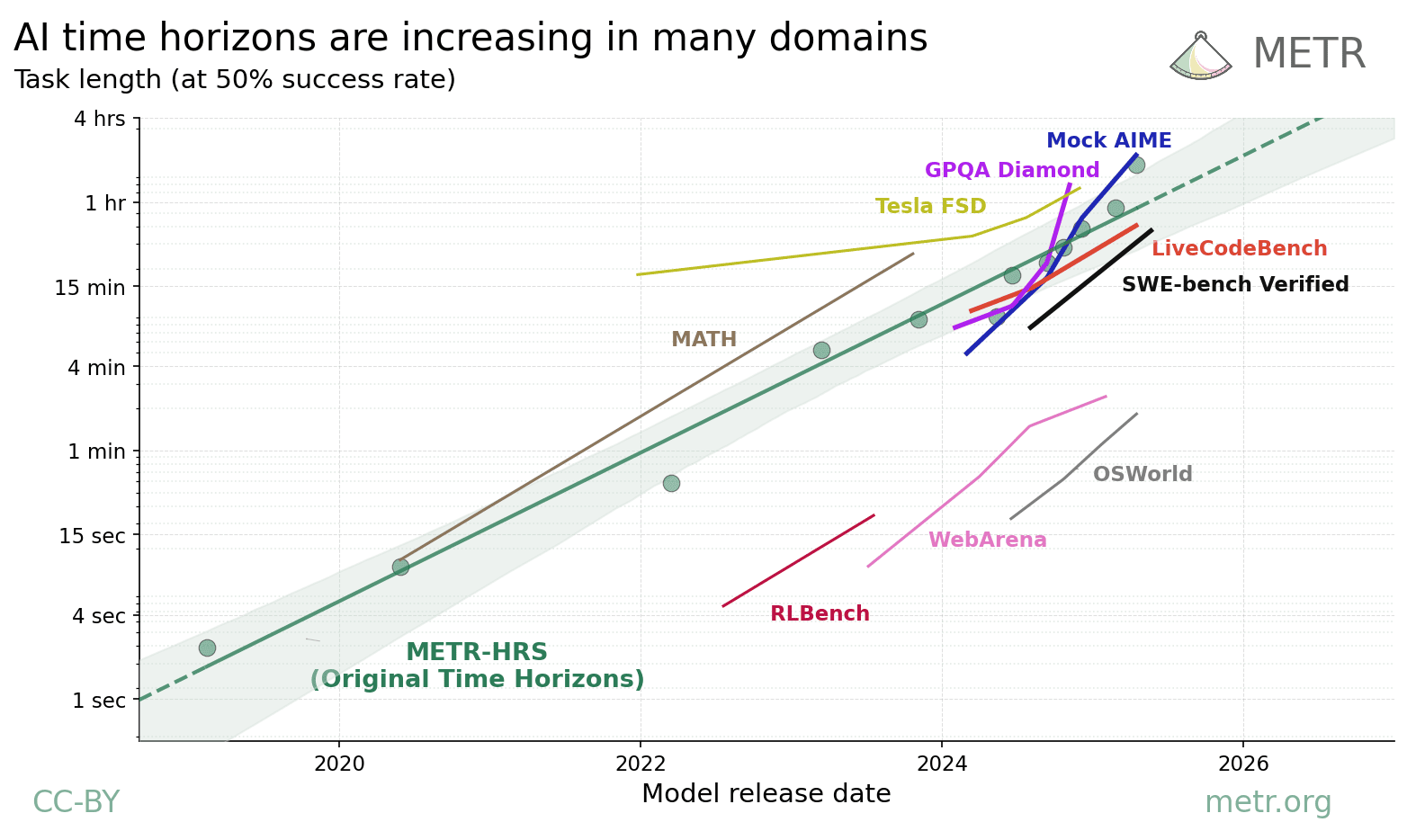
GDPvals is a benchmark of realistic knowledge work tasks, and also shows rapid progress.
In March 2026, The New York Times found that a majority of people preferred AI writing to that produced by legendary literary authors, including Cormac McCarthy and Ursula K. Le Guin. This matches my impressions: I find AI far more helpful for thinking through complex problems, or at editing writing, than I did even a year ago.
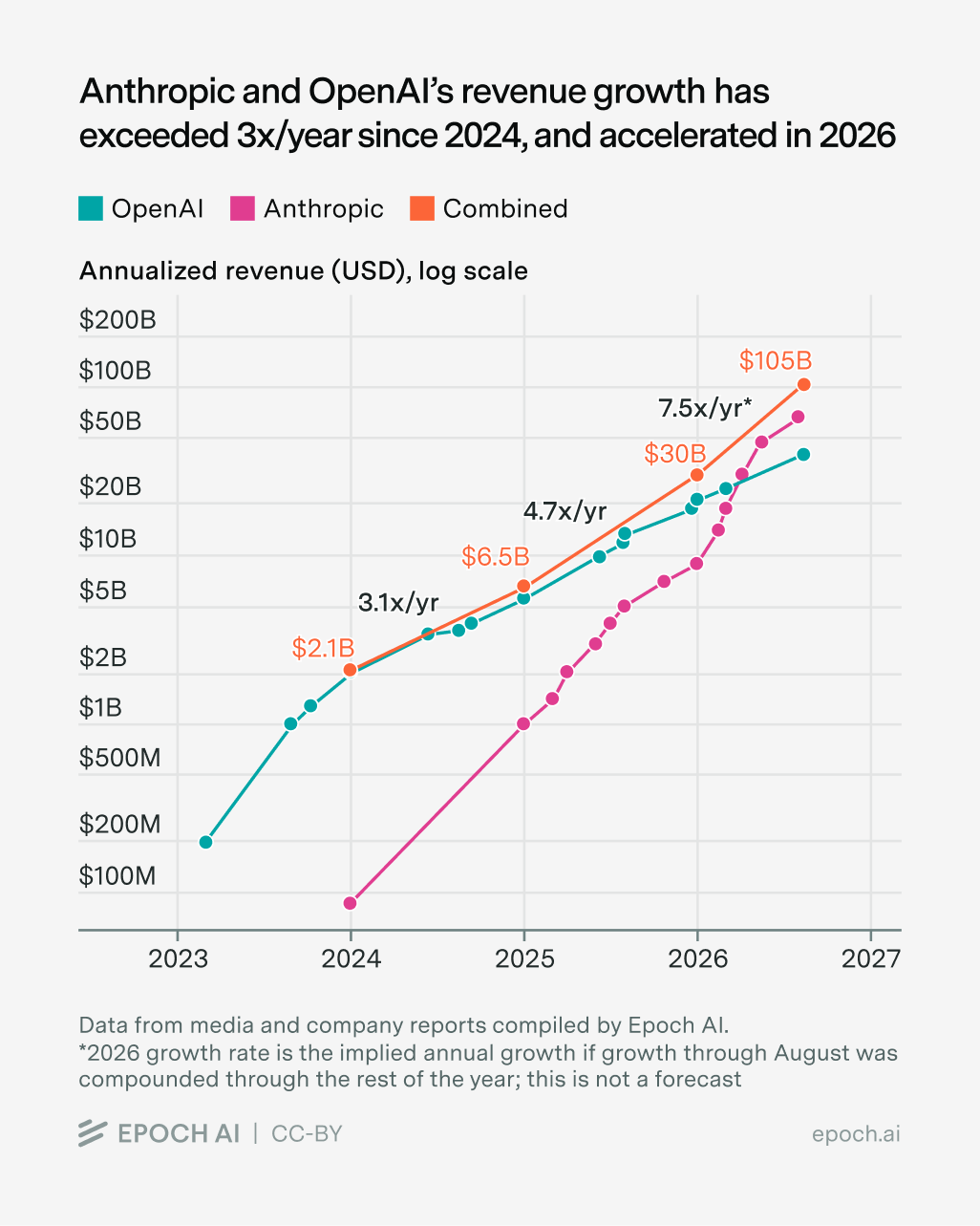
This would explain progress on the benchmark that’s hardest to game: revenue.
Companies won’t part with hard cash for AI models unless it’s delivering real gains, and money spent on frontier AI has grown at over threefold per year since 2022. It appears to still be accelerating, making OpenAI and Anthropic the fastest growing companies of this size in history, despite having open-source models hot on their heels.
How far can the trend of improving agents continue?
AI companies can continue to improve their agents by:
- Designing better scaffolding
- Hooking up the agent scaffolding to ever more powerful reasoning models, which would give the agent a better, more reliable ‘planning brain’
- Using base models that have been trained on more image or video data, which might make the agents much better at perception — currently a major bottleneck
Now that the agents partially work, reinforcement learning can be applied here too:
- Set an agent a task, like making a purchase or writing a popular tweet. If it succeeds, use reinforcement learning to make it more likely to succeed next time.
- In addition, each successfully completed task can be used as training data for the next generation of agents.
The world is an unending source of data, which lets the agents naturally develop a causal model of the world.28
And that may not even be needed. Most training can be done in purely virtual environments, and building better and better environments has been a major source of recent progress.
Typically the pattern is that AI sucks at a certain type of task, until it suddenly doesn’t:
- Even a simple task like finding and booking a hotel that meets your preferences requires tens of steps. With a 90% chance of completing each step correctly, there’s only a 10% chance of completing 20 steps correctly.
- However, with 99% reliability per step, the overall chance of success leaps from 10% to 80% — the difference between not useful to very useful.
So progress could feel explosive.
5. A new driver
Each time it’s looked like one driver of progress was about to run out (like pretraining in 2024), another one has kicked in (like reasoning models), keeping trend lines weirdly steady — or even accelerating them.
This is no accident. AI researchers can tell when a driver is starting to hit diminishing returns, and they’ll start to look for a new one. As long as the computing power and research talent applied to AI continues to rise, we should expect researchers to keep finding new drivers.
In recent history, this has happened every one or two years, while more fundamental advances, like the transformer or deep learning itself, have arisen every 10 years or so.
Looking out to 2030, we should expect at least one new driver to arrive. Researchers are focusing on methods to address the biggest weaknesses with current systems, such as their inability to learn from small amounts of data or continually update their weights (both of which contribute to their weak performance on long-horizon, high-context knowledge work tasks).
Humans can learn to do messy knowledge work jobs with only a few decades of practice, so in principle it should be possible for AI to do the same.
II. How good will AI become by 2030 if trends hold?
Discussions of how society should adapt to AI often implicitly imagine wider deployment of the systems as they stand today, or imagine a future of ‘ever-smarter chatbots.’ This is a mistake.
The companies are on track to at least triple compute available for training each year out to 2028, which would make it possible to train a model over 100x bigger than GPT-4 or with 100x more reinforcement learning than o1.29
And all four of the recent drivers of AI progress seem set to continue to work: larger pretraining runs, better reasoning from reinforcement learning, thinking for longer, plus better agent scaffolding and training. And there’s some chance we might see the emergence of a new driver, or a fundamental advance more akin to deep learning itself.
Unless there’s a collective agreement to slow down, or a major economic disruption,30 our default expectation should be rapid progress for at least the next two years, and that means AI gaining totally new capabilities and applications. Whether we call these AGI or not, what matters is whether we reach systems that could have transformative effects.
So if trends continue, where could we end up? Here are a few approaches, starting with revenue.
Frontier AI revenue is around $100 billion annualised today. It’s grown over threefold per year for over four years (as has a broader measure of AI revenue). A continuation of the trend would mean it reaches $10 trillion in four years, around 2030. Systems that generate $10 trillion of revenue would likely be close to AGI, in the sense of an AI that can do most remote work tasks.31
If AI capabilities stop advancing, then the returns to more AI will diminish (and other bottlenecks will bind), and revenue growth will slow.
However, there are also forces that could make revenue growth accelerate. For instance, as AI becomes closer to being a true substitute for human workers, it also becomes easier to deploy, and small increases in capabilities can open up a much wider range of tasks. More foundationally, there are several reasons to expect increasing returns to investment in AI.
Historically, the forces of acceleration seem to be winning. Frontier AI revenues have gradually accelerated, from 3x in 2024 and 4.7x in 2025 to 5.5x so far in 2026 (as of the end of September). The final rate need only be maintained for 2.5 years to hit $10 trillion (if it doesn’t accelerate even further).32
A second approach is to extrapolate the METR time horizon trend. As of September 2026, models can do three-hour tasks at 80% reliability on METR’s suite of coding, AI R&D, and cyber tasks. Extrapolating the rate of progress since 2024 forward gets us to about monthlong tasks in 2028, and multiyear tasks a year or two after.
Some think this trend could accelerate again, either because a new driver will kick in or because once a model can do monthlong tasks, it will have learned the skills needed to do yearlong tasks as well.
A model that can do monthlong tasks on METR may well be close to the productivity of a human ML engineer, and could be deployed in millions of instances, causing a large uplift in AI research productivity. This could look like having the models read all the literature, generate thousands of ideas to improve the algorithms, and automatically test them in small-scale experiments.
Anthropic and OpenAI have both recently released reports documenting data on internal AI uplift. OpenAI says their most powerful internal model can do the work of a human intern. According to Anthropic employee surveys, coding uplift has gone from 1.25x to 4x in seven months. Forecasters at the AI Futures Project attempted to project this trend: they estimate that AI tools have made coders at AI companies about twice as productive today, and that a continuation of the trend would result in 20x uplift in 2028.
Their modelling also suggests that 20x uplift in coding would boost internal research productivity enough to start a noticeable bend upwards in the speed of AI progress (called ‘recursive self-improvement, ‘or RSI). In another article, I’ve outlined how this could lead to 3–5 years of AI progress in under one year. This would be roughly equivalent to the jump from GPT-4 (which couldn’t multiply numbers) to GPT-6 Astra (which can solve important open math problems). This could look like many of AI’s remaining weaknesses suddenly improving, while current strengths become superhuman.
Even setting recursive self-improvement aside, a model that can do yearlong coding tasks can likely do multiweek or multiday messier knowledge work tasks. That wouldn’t quite be AGI, but it would be close.
What about the ability to have novel insights and technological advances? When we first wrote this article, the creators of AlphaFold had already won the Nobel Prize for designing an AI that solves protein folding. AI models have also found hundreds of thousands of stable crystals that could be used in material science and created faster and more accurate weather forecasts.33
In the first version of this article, we wrote, “The next leap might take us to…the ability to answer as-yet-unsolved scientific questions independently.” In September 2026, OpenAI claimed their best internal model solved over 100 open math problems.
We don’t have a clear benchmark, but I think trend extrapolation suggests that in the next one or two years, we’ll start to see more and more open problems being solved in other domains too. This will start with domains that are done mainly virtually and have verifiable answers, such as theoretical physics, computer science, and chemical and biological modelling.
A single invention like nuclear weapons can change the course of history, so the importance of these capabilities should not be underestimated.
What’s the case against impressive AI progress by 2030?
Here’s the strongest case against in my mind:
First, concede that AI will likely become superhuman at clearly defined, discrete tasks, such as much of math and coding. But argue it’ll remain poor at ill-defined, high-context, and long-time-horizon tasks.
That’s because these kinds of tasks don’t have clearly and quickly verifiable answers, and so they can’t be trained with reinforcement learning, and they’re not in the training data.
That could mean the rate of progress for these kinds of tasks will be slower. Or perhaps the starting position is so weak that even another four years of progress won’t be enough to crack them.
Second, argue that most knowledge jobs consist significantly of these long-horizon, messy, high-context tasks. For example, software engineers spend a lot of their time figuring out what to build, coordinating with others, and understanding massive code bases rather than knocking off a list of well-defined tasks. Even if their productivity at coding increases 10x, if coding is only 50% of their work, their overall productivity only roughly doubles.
In this scenario, we’ll have extremely smart and knowledgeable AI assistants, but they’ll remain tools, and humans will remain the main economic and scientific bottleneck.
If these limits remain, we’ll eventually hit diminishing returns to AI: all the verifiable virtual tasks will have been automated. At that point, AI revenue will stop growing. Open source models will catch up to the frontier, undermining profit margins even more. This will make it much harder to continue increasing investment in AI research, and AI progress will slow.
The primary counterarguments have already been covered: AI appears to be improving rapidly at longer-horizon, more complex, messier tasks and at making conceptual insights.
The other biggest reason to expect AI progress to be slower is that it’s deliberately slowed by regulation.
Here are some other ways AI progress could be slower or unimpressive:
- Disembodied cognitive labour could turn out not to be very useful, even in science, since innovation arises out of learning by doing across the economy. This will require broader automation with robotics, which is lagging and will take longer to deploy.
- AI might not be able to learn to do many important tasks without years spent gathering real data, which will also require broad deployment and serial time. Read more in The Goodhart Singularity, and a response in “Data bottlenecks won’t prevent an intelligence explosion.”
- AI won’t be able to learn most jobs without continual learning and far greater learning efficiency, and these won’t be reached without some kind of bigger breakthrough. For example, see Dwarkesh Patel arguing this in “Thoughts on AI progress (Dec 2025).” (Though it’s also possible a combination of more pretraining and longer context windows will get things sufficiently far.)
- More generally, AI capabilities could remain very spiky — weak on dimensions that aren’t yet well understood, and this could limit their application and leave humans as a major bottleneck.
- An economic crisis, Taiwan conflict, other disaster, or massive regulatory crackdown could reduce investment, pushing back larger training runs by several years.
- There could be other unforeseen bottlenecks (planning fallacy).
Most of these bottlenecks seem eventually surmountable, but could push AGI back into the late 2030s.
For deeper exploration of the sceptical view, see:
- Are we on the brink of AGI? by Steve Newman
- The promise of reasoning models by Matthew Barnnett
- A bear case: My predictions regarding AI progress by Thane Ruthenis
- The Dwarkesh Podcast with Epoch AI
Ultimately, the evidence will never be decisive one way or another, and estimates will rely on judgement calls over which people can reasonably differ. However, I find it hard to look at the evidence and not put significant probability on AGI by 2030.
When do the ‘experts’ expect AGI to arrive?
I’ve made some big claims. As a non-expert, it would be great if there were experts who could tell us what to think.
Unfortunately, there aren’t. There are only different groups with different drawbacks.
I’ve reviewed the views of these different groups of experts in a separate article.
One striking point is that every group has shortened their estimates dramatically over the last few years. Today even many AI ‘sceptics’ think AGI will be achieved in 20 years — when today’s college students are in the middle of their careers — if not much sooner.
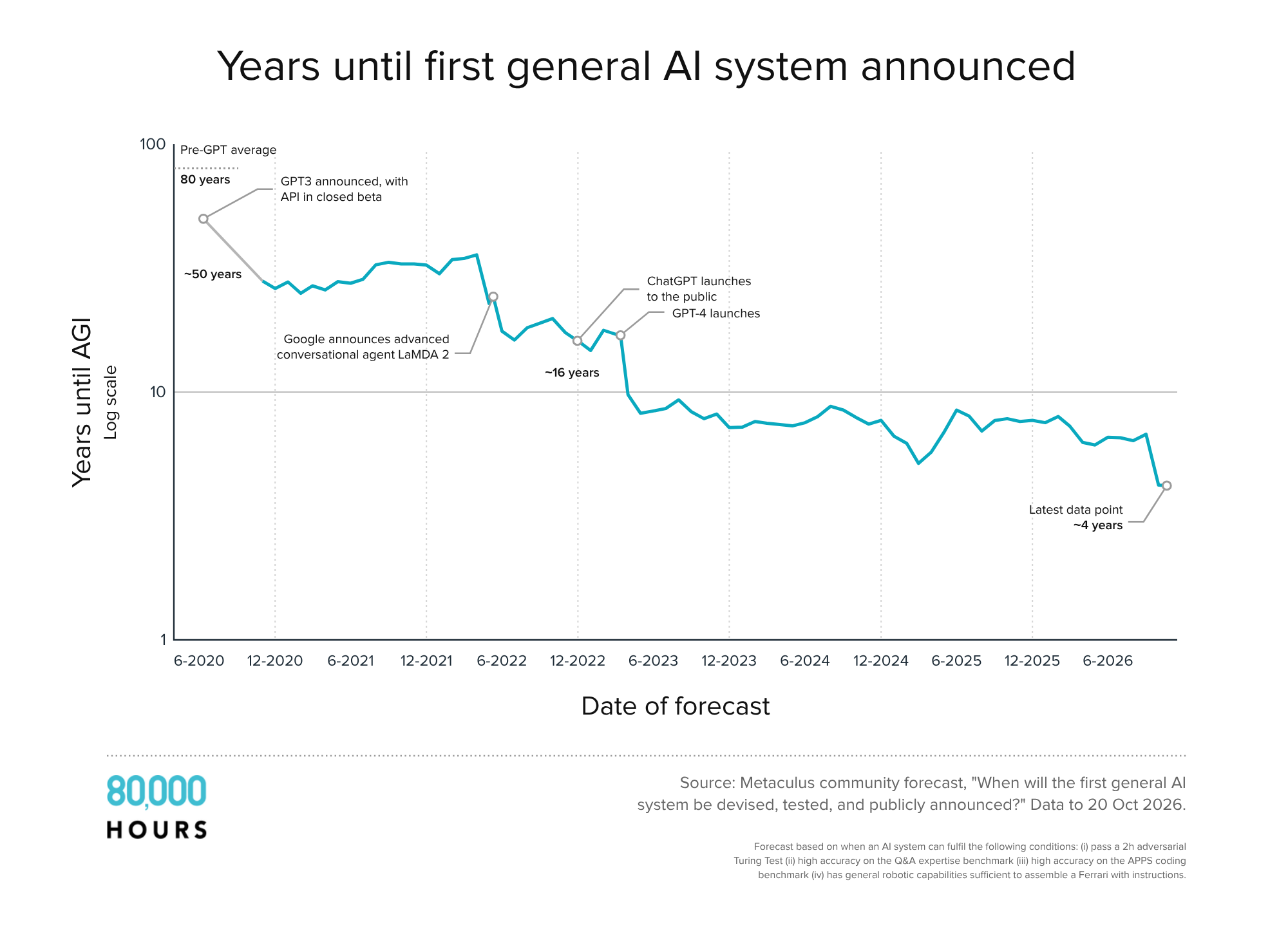
My overall read is that AGI by 2030 is within the scope of expert opinion, so dismissing it as ‘science fiction’ is unjustified. The people who know the most about the technology seem to have the shortest timelines.
Of course, many experts think it’ll take much longer. But if 30% of experts think a plane will explode, and the other 70% think it’ll be fine, we shouldn’t conclude it definitely won’t.
That said, rather than rely on expert forecasts, my favoured approach is to understand the deeper drivers of progress and think about whether they will continue — which brings us to the last section.
III. Why now until 2030 is a crucial period
It’s natural to assume that since we don’t know when AGI will emerge, it might be about equally likely to arrive in the next five years, the five years after that, and so on. Although that’s a common perspective, we’re not sure it’s right.
The core drivers of AI progress are more compute and better algorithms. More powerful AI is most likely to be discovered when the compute and labour used to improve AIs is growing most dramatically.
Right now, the total compute available for training and running AI is growing 3x per year,34 and the workforce is growing rapidly too.
This means that each year, the number of AI models that can be run increases 3x. In addition, three times more compute can be used for training, and that training can use better algorithms, which means they get more capable as well as more numerous, leading to increasing returns to AI investment (even without AI uplift to AI R&D).
We’ve argued these trends can continue until at least 2028 — but they’ll most likely run into bottlenecks shortly thereafter.
Bottlenecks around 2030
People often say the models will become too expensive to train. But Google, Microsoft, Meta, etc. are already spending tens of billions of dollars to build clusters that could train a model with 100x more compute than GPT-4 in 2028.
Another 100x scale up would require trillions of dollars of investment. That would be greater than the Apollo Program or Manhattan Project in scale,35 and comparable to investment in railroads during the industrial revolution. However, that too could become affordable if AI reaches trillions of dollars in revenue, which could happen in 1–3 years at current trends. The automation of all cognitive labour is a much bigger deal than railroads.
The bigger issue is that even if the money is available, it becomes harder and harder to produce more chips. Taiwan Semiconductor Manufacturing Company (TSMC) manufactures all of the world’s leading AI chips, but until recently, its most advanced capacity was mostly used for mobile phones.
Chips for AI have been able to grow much faster than chip production as a whole, because they’ve been growing as a share. Today, however, AI chips are already around half of the most advanced production capacity. Double again, and production would become limited by the rate at which TSMC can build new chip fabs.
This in turn would be limited by the production of the equipment needed to run these fabs, especially lithography machines, the most complicated machine the world has ever produced. And they’re manufactured by just one company: ASML.
It’s possible that even a maxed-out ASML could only produce enough lithography machines to increase world chip production by 20% per year from 2029 onwards.36 Combined with chip efficiency improvements of 30% per year, the computational power available to train AI would grow at only about 50% per year. This is much slower than the 3–5x it has grown recently. This would mean progress that previously happened in two years would likely take 3–5.
Another bottleneck is electricity. Current levels of AI chip sales, if sustained, mean that AI chips will use 4% or more of US electricity by 2028,37 but another 10x scale up to 2030 would be 40% or more. This is possible (and has been done before), but it would require building a lot of power plants, which takes time and might get blocked by regulation or limited by a shortage of skilled labour.
So there’s a good chance the rate of growth of compute used to improve AI starts to slow after 2028. This is what many forecasters expect. For example, the AI Futures Project, which has done the most detailed public modelling of this topic, projects a gradual slowing in compute growth. Their forecast also lines up with this simple model of ‘lag times’ by Epoch AI, and would roughly match both trend extrapolation of chip sales and OpenAI’s own forecasts.
On the other hand, if ASML or power plants became the key bottleneck to trillions of dollars of AI revenue, maybe these bottlenecks could be overcome. Electricity is only a small fraction of the cost of running AI models, so it would be possible to pay 2–3 times as much. And TSMC has only spent $150 billion on CapEx over the last five years, so with trillions in AI revenue, this could increase dramatically.
That’s compute, but what about algorithmic progress? It’s also rapid right now, but as each discovery gets made, the next one becomes harder and harder. Maintaining a constant rate of progress ultimately requires an exponentially growing research workforce.
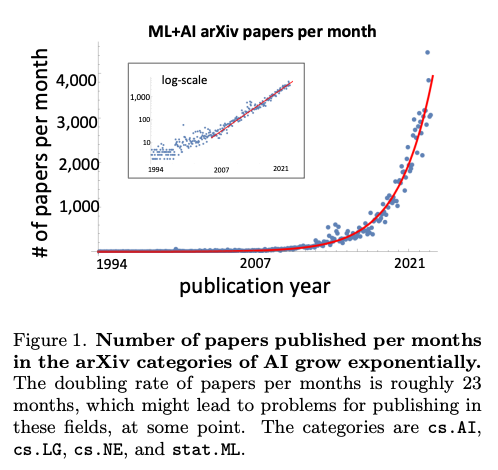
In 2021, OpenAI had about 300 employees. By March 2025, it had about 3,000. Anthropic and DeepMind also grew more than threefold over that time, and new companies have entered the field. The number of ML papers produced per year has roughly doubled every two years.38
It’s hard to know exactly how to define the workforce of people who are truly advancing capabilities (vs selling the product or doing other ML research). But if the workforce needs to double every 1–3 years, that can only last so long before the talent pool runs out.39
My read is that growth can easily continue to the end of the decade, but will probably start to slow in the early 2030s (unless AI has become good enough to substitute for researchers by then).
Algorithmic progress also depends on increasing compute, which enables more experiments. With sufficient compute, researchers can even conduct brute force searches for optimal algorithms. Thus, slowing compute growth will correspondingly slow algorithmic progress.
If both compute and research workforce growth slow dramatically, then what would have previously taken two years might stretch to 5–7.
So there’s a race:
- Can AI models improve enough to generate enough revenue to pay for their next round of training before it’s no longer affordable?
- Can the models start to contribute to algorithmic research before we run out of human researchers to throw at the problem?
The moment of truth will be around 2028–2032.
Either progress slows, or AI itself overcomes these bottlenecks, allowing progress to continue or even accelerate.
Three potential futures for AI
If AI capable of contributing to AI research isn’t achieved before 2028–2032, the annual probability of its discovery decreases substantially.
Progress won’t suddenly halt — it’ll slow more gradually. Here are some illustrative estimates of the probability of reaching AGI from 2025 (don’t quote me on the exact numbers!):
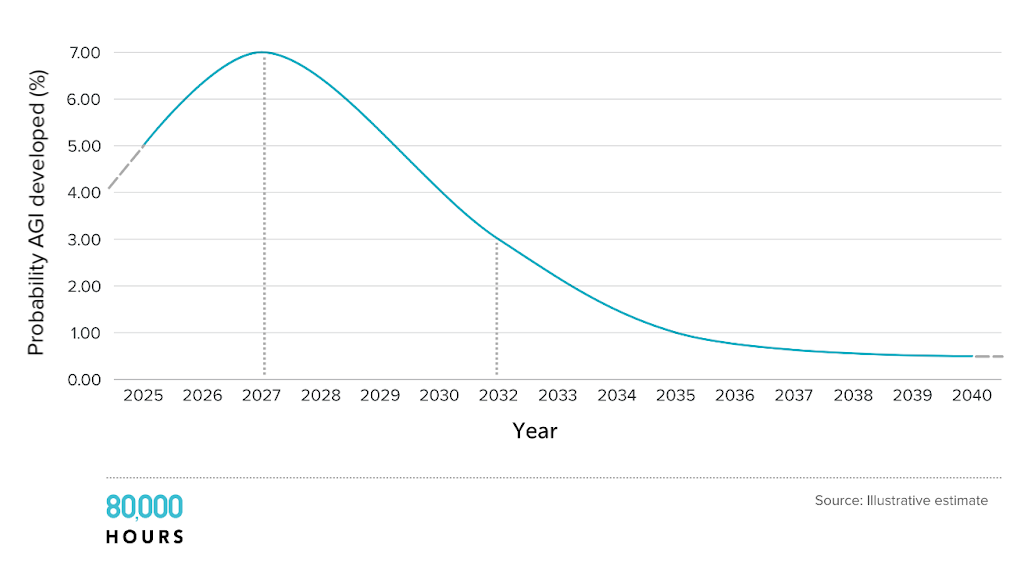
Very roughly, we can plan for three scenarios:40
- Fast: We could reach AI that can cause transformative effects in the next few years, perhaps even next year. This is arguably what you get if you naively extrapolate trends in revenue, are relatively optimistic about deployment and data bottlenecks, and think recursive self-improvement will work at least a bit. It’s what senior staff at the AI companies seem to think, just a little slowed down. It’s also the best guess of many of the forecasters with the best track record, such as the AI Futures Project, who expect an ‘automated coder’ around 2027–2030 and AI that’s better than human experts at almost all cognitive tasks 1–3 years afterwards.
- Medium: If transformative systems are not reached by 2029, progress starts to slow. However, if we’re close by then, an automated coder is still likely to be reached in the early 2030s. And that could still be followed by an acceleration in progress leading to expert-dominating AGI a year later, or otherwise a slower takeoff, taking 3–10 years.
- Long: AI models will get much better at clearly defined tasks, but won’t be able to do the ill-defined, long-horizon work required to unlock new growth or a new scientific regime. If the current economy can’t produce enough compute to reach these systems any time soon, then we’ll see a lot of AI automation, but otherwise the world will look more like ‘normal’ for decades.
Absent a major pause, I very roughly put 40% probability on the fast scenario, 30% on medium (before 2036), and 30% on others including long, though these can easily move around by 25 percentage points depending on the day.
Conclusion
So will we have AGI by 2030?
Whatever the exact definition, significant evidence supports this possibility — we may only need to sustain current trends for a few more years.
We’ll never have decisive evidence either way, but it seems clearly overconfident to me to think the probability before 2030 is below 10%, and personally, I think it’s significantly higher.
Given the massive implications and serious risks, there’s enough evidence to take this possibility extremely seriously.
Today’s situation feels like February 2020 just before COVID lockdowns: a clear trend suggests imminent, massive change, yet most people continue their lives as normal.
In the next article, we’ll argue that AGI automating much of remote work and doubling the economy could be a conservative outcome. If AI can do AI research, the gap between AGI and ‘superintelligence’ could be short. This could trigger a massive research workforce expansion, potentially delivering a century’s worth of scientific progress in under a decade. Robotics, bioengineering, and space settlement could all arrive far sooner than commonly anticipated.
The next few years could be the start of one of the most pivotal periods in history.
Use your career to tackle this issue
If you want to help society navigate AGI, here’s what to do:
- Read this primer on AGI careers.
- Join our newsletter to receive updates on new articles and jobs.
- Apply to get one-on-one help making a career transition from our team.
Further reading on AI timelines
- AI 2027 is the best attempt at a concrete analysis of a scenario in which AGI arrives soon via the automation of AI research. It’s not an attempt to say what’s most likely to happen, but rather an in-depth exploration of a single scenario. However, the team also provide their own all-considered forecasts of several key outcomes in the accompanying research. And also see their later updates on how their timelines have changed.
- Perhaps the most compelling argument for near-term AI progress is the first chapter of Situational Awareness by Leopold Aschenbrenner.
- When do experts expect AGI? is a supplementary article to this post about what we can learn from expert forecasts. Also see Through a glass darkly by Scott Alexander, which explores this topic in further depth.
- The most influential case against near-term AGI is probably The case for multidecade AI timelines by Ege Erdil, published by Epoch AI. Ege and Tamay discussed these ideas on the Dwarkesh Podcast in April 2025. (Of course, 30 years is not long in the scheme of history, and Ege still thinks AI will have a transformative effect on society.)
- Tomas Pueyo has a more accessible intro covering similar material to this article: The most important time in history is now.
- Reinforcement learning works! a podcast by Nathan Labenz is a good explanation of reasoning models, and why they might unlock dramatic progress. Helen Toner adds a useful summary of the debate about how far this will continue.
- Epoch AI has a review of all the different ways of forecasting AI. All of them are consistent with AGI arriving before 2030, though some give lower probabilities. (Several of the estimates have also shortened after it was written.)
- Epoch AI also has many great datasets that underpin this post. See their key trends page for an overview and their article Can scaling continue through 2030?
- An approach to AI forecasting that was popular several years ago is to estimate the compute used to train the human brain, and then estimate when leading AI models might surpass that point (TLDR: we might be there around now). See Forecasting transformative AI: the ‘biological anchors’ method in a nutshell by Holden Karnofsky for an introduction.
- Here are some of the best articles I’ve seen making the case against transformative AI progress in the next few years (all from 2025 and before, when this article was first written):
- Are we on the brink of AGI? by Steve Newman
- The promise of reasoning models by Matthew Barnnett
- A bear case: My predictions regarding AI progress, by Thane Ruthenis
- Why I don’t think AGI is around the corner by Dwarkesh Patel, which argues continuous learning could be a significant bottleneck (though see discussion in the comments).
- Toby Ord also discusses some reasons for scepticism of AGI before 2030 on our podcast.
Notes and references
- After this article was published, he gave some more specific estimates in a post titled, “The Gentle Singularity.”
2025 has seen the arrival of agents that can do real cognitive work; writing computer code will never be the same. 2026 will likely see the arrival of systems that can figure out novel insights. 2027 may see the arrival of robots that can do tasks in the real world.↩
- “It’s not centuries. It may not be decades. It’s several years.” Source: Interview at the Johns Hopkins University Bloomberg Center in 2025; time stamp: 27:50.↩
- The increase in training compute was driven by:
Increased spending (2.5x per year; from Epoch AI Machine Learning Trends; Archived link retrieved 11-Feb-2025)
Improvements in chip processing power (1.3x per year; from Epoch AI Machine Learning Trends; Archived link retrieved 11-Feb-2025)
Better adapting of those chips for AI workloads (1.3x per year, extrapolated)↩
- This is shown in Figure 1 and Figure 6 in Chen, Mark, et al. Evaluating Large Language Models Trained on Code. 14 July 2021, arxiv.org/pdf/2107.03374.
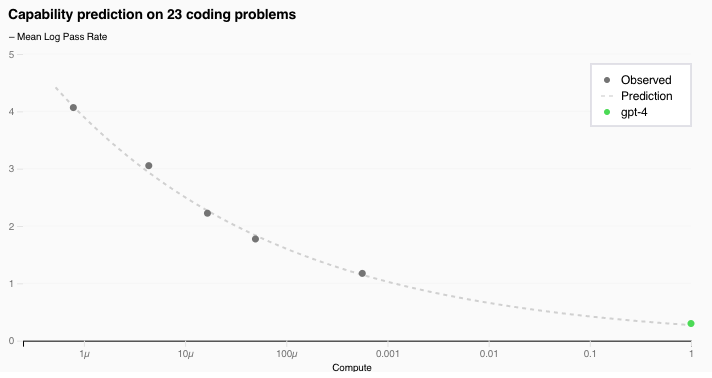
OpenAI also made a similar claim in the post on their release of GPT-4. In the section on predictable scaling, they showed that training compute had a predictable relationship with performance on 23 coding challenges over five orders of magnitude.
- The scaling laws are not technically laws; they’re regularities in the data.
The scaling laws are normally formulated in terms of “loss,” which is a measure of the prediction error — exponentially more compute leads to a linear decline in loss (until you hit the fundamental limit).
There’s a question about how loss translates into real world capabilities. However, we can skip the notion of loss, and focus directly on the scaling relationship between compute and benchmark performance, which shows a similar pattern.↩
- The compute used on the final training run for GPT-4 likely cost about $40m. DeepSeek said they used $6m on their final run (all-in costs are much higher). The trend line would suggest a tenfold reduction, hitting $4m, so DeepSeek was more expensive than what we expected based on trends. On the other hand, DeepSeek-V3 is significantly better than the original GPT-4. But on the other, other hand, some of these improvements aren’t due only to algorithmic efficiency. So overall, I’d say it was roughly on trend, or a little ahead of trend. DeepSeek also charges users more than 10 times less than OpenAI, but a lot of that is due to slashing their profit margin rather than greater efficiency running the model. Released earlier to no fanfare, Google Gemini Flash 2.0 scores better than DeepSeek and is actually cheaper, clearly showing that other labs have achieved similar gains. The real news was that a Chinese lab reached the forefront of algorithmic efficiency.↩
- See this model of compute training over time.↩
- Levesque, H. (2012) proposed Winograd schemas — a type of commonsense language reasoning test — as an alternative to a Turing test. He argued that Winograd schemas could help determine whether AI systems truly understand language in the way humans do, rather than merely recognizing patterns. Each schema consists of a sentence with an ambiguous pronoun, and the correct interpretation depends on implicit knowledge of the meaning of words rather than just statistical correlations. He argued that these questions can’t be gamed by deception or ‘cheap tricks.’
Levesque, Hector J. “On Our Best Behaviour.” Artificial Intelligence, vol. 212, July 2014, pp. 27–35, https://doi.org/10.1016/j.artint.2014.03.007. Archived link (retrieved 10-Feb-2025)↩
- A recent study found non-experts couldn’t distinguish AI from human-generated poetry. The poetry is terrible, but it was made with GPT-3.5.
Since there were two choices (human or AI), blind chance would produce a score of 50%, and perfect skill a score of 100%.The median score on the test was 60%, only a little above chance. The mean was 60.6%. Participants said the task was harder than expected (median difficulty 4 on a 1–5 scale).
Observed accuracy was in fact slightly lower than chance (46.6%, χ2(1, N = 16340) = 75.13, p [less than] 0.0001)…Participants were more likely to guess that AI-generated poems were written by humans than they were for actual human-written poems (χ2(2, N = 16340) = 247.04, w = 0.123, p [less than] 0.0001). The five poems with the lowest rates of “human” ratings were all written by actual human poets; four of the five poems with the highest rates of “human” ratings were generated by AI.
Porter, Brian, and Edouard Machery. “AI-Generated Poetry Is Indistinguishable from Human-Written Poetry and Is Rated More Favorably.” Scientific Reports, vol. 14, no. 1, Nature Portfolio, Nov. 2024, https://doi.org/10.1038/s41598-024-76900-1.
Moving beyond GPT, this survey showed most people are poor at judging which paintings are produced by AI vs human artists.↩
- Total FLOP used in training would be around 2e28 (about 1000x GPT-4), and the cost of the final training run would be around $6bn (the cost of the cluster required to train it would be about $60bn). See the simple model here.↩
- The trend has roughly been for training to cost 10x more each generation. Based on that, I expect GPT-6 might cost 2–3x more than $10bn, but it’s right to within an order of magnitude.↩
- 2024 net income:
Microsoft: $88bn; Microsoft 2024 Annual Report
Meta: $62bn;Meta Reports Fourth Quarter and Full Year 2024 Results
Alphabet: $100bn; Alphabet Annual Report 2024↩
- 1) Nvidia sold about $100bn of AI accelerator chips in 2024 (Press releases from Q1, Q2, Q3). If that holds up for three years, then the total stock of chips will be worth $300bn. The all-in cost of the datacentres containing these chips would be around $500bn. So if 2% were used on a single training run, that run would cost about $10bn. This would require using 6% of global chips for four months. Well over 10% of Nvidia chips are bought by Microsoft and Meta, so they would all be able to do a training run of that size. Google also has enough of its own TPU chips to do the same. xAI would likely be capable of it too.
2) Brokers forecast Nvidia’s revenue will be 125bn of chips in 2025, and that’s based significantly on orders that have already been placed. Other chip providers besides Nvidia also make up a growing share of the market, and I’ve ignored those in this estimate. So the above is likely conservative.
Additionally, information on some specific plans is available:
Google is building a 1 GW cluster, about 7x bigger than the largest clusters today (which are around 100k H100 chips / 150 MW).
Microsoft is building a set of a datacentres that could work together, containing 500–700 B200 chips (equivalent to perhaps 1.2m H100 chips), and that would use around 1GW.
xAI has announced it intends to build a one million GPU cluster.↩
- Microsoft earned about $13bn of AI revenue in 2024 (up 2.75x), OpenAI perhaps 1bn (up 5x). In addition, Google and Meta use AI heavily internally to improve their products, which indirectly generates revenue. Many newly created AI startups are also reporting very rapid revenue growth.↩
- Though some have argued e.g. the jump from GPT-4 to 4.5 to 5 isn’t as qualitatively impressive as the jump from GPT-3.5 to 4.↩
- It does this by producing one token of reasoning, then feeding that token back into the model and asking it to predict what next token would most make sense in the line of reasoning given the previous token, and so on. It’s called “chain of thought,” or CoT.↩
- OpenAI probably also does reinforcement learning on each step of reasoning too.↩
- They probably also did a couple of other steps, like fine-tuning the base model on a dataset of reasoning examples. They probably also do positive reinforcement based on each step in the reasoning, rather than just the final answer. OpenAI discusses using per-step reward models, in which each step in the reasoning tree is rated, in their 2023 paper Let’s verify step by step.↩
- Interestingly this is a reversal of the last generation of systems. LLMs were initially surprisingly good at writing and creative tasks, but bad at maths.↩
- In Epoch’s testing, the best model could answer 2% (Figure 2 in the announcement). If the labs had done their own testing, this might have been a bit higher.↩
- There was controversy about the result because OpenAI was somewhat involved in creating the benchmark. However, I expect the basic point — that o3 performed much better than previous models — is still correct.↩
- $1bn is easily affordable given money they’ve already raised and still cheap compared to training GPT-6. In terms of effective compute, the scale up could be even larger, due to increasing chip and algorithmic efficiencies. Though, if it were applied to larger models, the compute per forward pass would go up.
Also note that GPT-5 and GPT-6 could be delayed because compute will be used to do reinforcement learning in post-training instead of pretraining a bigger base LLM. However, the trend to spend more on training compute — for both pre and post-training — will likely continue.↩
- In addition, there are other examples of synthetic data being useful.↩
- The DeepSeek paper shows you may be able to make this even easier by taking the old model and distilling it into a much smaller model. This enables you to get similar performance but with much less compute required to run it. That then enables you to create the next round of data more cheaply.
In addition, the trend of 10x increases in algorithmic efficiency every two years means that your ability to produce synthetic data increases 10x every two years. So even if it initially takes a lot of compute, that’ll rapidly change.↩
- According to Nathan Labenz in an episode of his podcast Cognitive Revolution.↩
- By this I mean they can reason for about as many tokens as a human could produce in an hour, approximately 10,000. This is about 100x more than GPT-4o, corresponding to the two orders of extra test time compute that OpenAI showed can be used.↩
- OpenAI said the models produced over 100 billion output tokens in coming to the solution. At 300 tokens per minute, and 1.3 tokens per word, this represents over 1,000 years of human thinking.↩
- Suppose GPT-o7 is able to answer a question for $1 in 2028. Instead you’ll be able to pay GPT-o5 $100,000 to think 100,000 times longer, and generate the same answer in 2026.
In 2023, Epoch estimated you should be able to have a model think 100,000 longer and get gains in performance equivalent to what you’d get from a model that was trained on 1000x times more compute — roughly one generation ahead.
In some cases, it might be possible to achieve the same performance as a model trained using 2 OOM more compute, by spending additional compute during inference. This is approximately the difference between successive generations of GPT models (eg: GPT-3 and GPT-4), without taking into account algorithmic progress.
Pablo Villalobos and David Atkinson (2023), “Trading Off Compute in Training and Inference”. Archived link (retrieved 11-Feb-2025)↩
- Agents could also be set millions of virtual test tasks or be made to interact with other agents. This kind of “self-play” can enable rapid improvement in abilities without any external data, as happened with AlphaZero (which played against itself millions of times to become superhuman in Go in about a day).↩
- It’s hard to forecast how compute will be spent across pretraining, post training, and inference. In reality it’ll be allocated to wherever is making the largest gains. It’s possible most training compute will be spent on reinforcement learning, and GPT-6 will be delayed relative to the old trends. The broad trend in how much compute is used to train and run AI models is more robust.↩
- The probability of an invasion of Taiwan before 2030 is 25% according to Metaculus as of February 11, 2025. A Taiwan invasion would likely result in most of TSMC’s chip fabs being destroyed, which would halt the supply of all AI chips. This would probably not fully stop AI progress — progress could continue for a while using chips that are already installed. There would be an epic effort to create more fabs on American soil (as TSMC has already done in Arizona), which could resume supply within a couple of years. At the same time, a war with China might lead to massive AI investment in order to seek a competitive edge.
Other scenarios that could meaningfully slow down progress would be a major economic recession or other global catastrophe like COVID, or a huge regulatory crackdown driven by popular opposition — which probably wouldn’t prevent progress forever (since the military and economic advantages would be so large), but could delay it a lot.↩
- This is just an order of magnitude guess. $100 trillion would come close to matching the world’s GDP, which seems too high, while $1 trillion seems too low. $10 trillion is just under 10% of world GDP today, while white collar jobs receive more like 25% of GDP in wages. On the other hand, diffusion lags mean that a system that earns $10 trillion of revenue for the first time would probably earn several times more if fully deployed. Automation of white collar tasks will also decrease their share of GDP; AI might generate $10 trillion or less in revenue even if it replaces $25 trillion in human labour.↩
- Extrapolation of market value also arrives at a similar place.↩
- This section previously cited a research paper reporting that an AI tool had made top material scientists 80% more productive at finding new materials. MIT has since investigated that paper and requested that it be withdrawn from the discourse. The university said it “has no confidence in the provenance, reliability or validity of the data and has no confidence in the veracity of the research contained in the paper.”↩
- If revenue growth stopped now, it’s possible people wouldn’t even want to fund $10bn training runs, but we’re already close to having large enough clusters, and there’s enough players involved who could YOLO it (xAI, Meta, Google) that it would take a lot for someone to not attempt one at this point.↩
- Total spending on AI chips is increasing about 2x per year (estimate based on Nvidia’s annual reports), and the efficiency of these chips for doing AI workloads is increasing about 1.6x per year (extrapolated from spending and training compute). Training compute has been growing ~4x per year (archived link retrieved 11-Feb-2025) because a larger fraction of compute has been allocated to training runs.↩
- Table 1 from Stine, D.D. The Manhattan Project, the Apollo Program, and Federal Energy Technology R&D Programs: A Comparative Analysis. (Archived link retrieved 11-Feb-2025)↩
- Dylan Patel, CEO of the world’s leading semiconductor industry analysis firm, made remarks to this effect in his interview with Dwarkesh Patel. It’s also in line with the AI Futures Project forecast in AI 2040.↩
- This is calculated based on AI chip sales, and it is within the range of others’ estimates:
The current power capacity of the US is approximately 1230 GW, according to the US Energy Information Administration.
The United States is projected to add almost 160 GW of theoretical power capacity between 2024 and 2028, according to a RAND report on AI’s power requirements under exponential growth.
RAND’s report estimates that AI power requirements will reach 117 GW by 2028 (8.4% of total US supply), but note that other estimates from Goldman Sachs, McKinsey, and SemiAnalysis range from 3.5–5%.↩
- From Krenn, Mario, et al. Predicting the Future of AI with AI: High-Quality Link Prediction in an Exponentially Growing Knowledge Network. 23 Sept. 2022, https://doi.org/10.48550/arxiv.2210.00881.
- There are similar dynamics with chip efficiency, which has increased faster than Moore’s law by better adapting the chips to AI workflows, e.g. switching from FP32 to tensor-FP16 led to a 10x increase in efficiency according to data from Epoch AI:
Compared to using non-tensor FP32, TF32, tensor-FP16, and tensor-INT8 provide around 6x, 10x, and 12x greater performance on average in the aggregate performance trends.
However, this can’t continue indefinitely without an exponentially growing chip research workforce.↩
- More precisely we could split it into multiple scenarios: chance of AGI in five years, chance it arrives in the 2030s (probably lower); chance it arrives in the 2040s (lower still), etc. Focusing on these two is a simplification.↩