

How to make a difference: Part 4 How to choose which world problem to focus on

Table of Contents
If you want to make a difference with your career, one place to start is to ask which global problems most need attention. Should you work on education, climate change, poverty, AI risk, or something else?
When I was 16, the problem I was most interested in was climate change. I stumbled across blogs with debates between climate scientists and sceptics. From there, I discovered the Intergovernmental Panel on Climate Change (IPCC), an attempt to sum up the scientific consensus on the issue. I found it shocking. How could the world be doing so little about a problem that was so obvious?
I put up posters around my school summarising the IPCC’s latest report, which I’m sure the other kids found very convincing. Later, I volunteered to do an environmental audit of that same school, a document filled with complex diagrams outlining how the buildings could be redesigned. After I left, the headmaster wrote to say, “We’ve started an organic garden” — which wasn’t quite the impact I was hoping for.
Although I was passionate, my interest in climate change didn’t come from much detailed analysis. Rather, I just happened to come across it because it’s what people were talking about, and it appealed to me because it was sciency and I was geeky. Here I am at a climate rally around age 16 (though looking about 12):

Like me, most people never take the time to reflect on the global problems most in need of attention. Instead, they end up working on whichever issue grabs their attention first. The problem with this is there’s no guarantee you’ll happen to be grabbed by the problems that are most important. Worse, you’re most likely to encounter the problems that everyone is already talking about, and as we’ll see, that means they’re probably not the highest-impact ones.
So, how can you avoid this mistake? At 80,000 Hours, we worked with the Global Priorities Institute at Oxford to develop three simple questions you can ask to figure out which problems are most pressing, i.e. the areas where an extra year of work will have the greatest impact.1 Using these to direct your time towards tackling more pressing problems is the single biggest thing you can do to increase your impact.
You can use these steps to compare areas you could enter (e.g. pandemic prevention vs global health), or if you’re already committed to an area, you can compare projects within that area (e.g. research into malaria or HIV).
Reading time: 10 minutes, or see our short video instead. If you just want to see which problems we think are most pressing, skip to the next article. You can also see the technical detail behind the framework.
The bottom line:
How to choose which world problem to work on
To choose a world problem to work on, look for one that is:
- Big in scale: How many people does this problem affect? How severely and for how long?
Neglected: How many people and resources are already dedicated to tackling this problem? Is it overlooked by markets, governments, or people in general?
Solvable: How easy would it be to make progress on this problem? Are there evidence-backed solutions, new solutions to test, or ‘hits-based’ solutions that would make a huge difference if they work?
The most pressing world problems likely score well across all three dimensions — or excel dramatically on one. You can see how we apply this framework in our list of the most pressing world problems.
Question 1. Is this problem large in scale?
In 2005, a BBC journalist wrote:
The nuclear power stations will all be switched off in a few years. How can we keep Britain’s lights on? […] unplug your mobile-phone charger when it’s not in use.
This so annoyed David MacKay, a professor of physics at Cambridge University, that he decided to find out exactly how bad leaving your phone charger plugged in really was.
He plugged a charger into his watt meter. Zero watts. He plugged in two. Still zero. Eventually, he plugged in:
three phone chargers, the laptop computer’s power supply, the charger for a pocket PC and a battery-charger for four AA batteries. Finally, the meter registered power! One Watt.
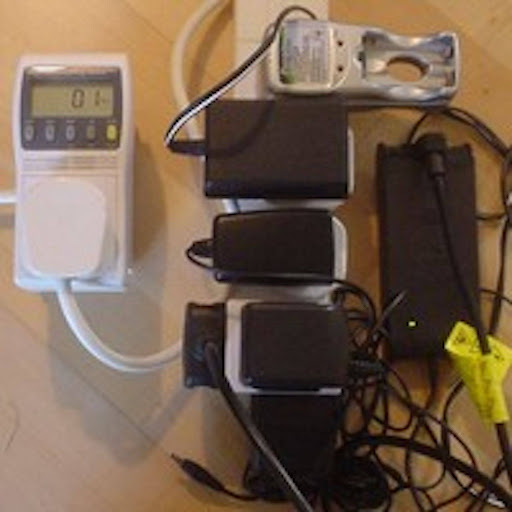
From this, MacKay estimated that if no mobile phone charger were ever left plugged in again, British people would shave off at most 0.01% of their energy use. Even if entirely successful, the BBC’s suggestion would have had no notable effect. MacKay added it would’ve been like “trying to bail out the Titanic with a tea strainer.”
These efforts could have been devoted to changes that would have 1,000 times as much impact on climate change, such as installing home insulation.2 Even now, 20 years later, people looking to save energy continue to make lightweight suggestions that have little effect on energy consumption, whether that’s plastic bags, turning off lights, or buying organic.3
One reason for this is we tend to assess the importance of different social problems using our intuition. But research has shown that we’re bad at intuitively assessing differences in scale, a bias that’s called ‘scope neglect.’
The most famous study to document this effect found people were willing to pay around the same amount to save 2,000 birds from oil spills as they were to save 200,000 — even though the latter is objectively 100 times better.4
In order to avoid scope neglect, we need to use numbers when we make comparisons, even if they’re only rough. Based on our definition of impact in part 2, we can see that the scale of a problem depends on:
- The number of people affected
- The size of the effects per person
- The length the effects last in time
Scale is important because the effect of an intervention on a problem is often proportional to the size of that problem. Launch a campaign that ends 10% of the phone charger problem and you achieve very little. Launch a campaign that persuades 10% of people to install home insulation and you achieve a lot.
Develop a cure for a disease that affects one million people, and you have 100 times the impact of developing a cure for a disease that affects 10,000. All else equal, it’s better to work on the bigger problem.
Question 2. Is this problem neglected?
In a previous article, we saw that in rich countries there are plenty of doctors, making it harder for an extra doctor to make a big contribution. This is just one example of a broader phenomenon.
When you pick fruit from a tree, you start with those that are easiest to reach: the proverbial low-hanging fruit. But when they’re gone, it becomes harder and harder to get a meal. It’s the same with helping others. When very few people have worked on a problem, there are generally lots of opportunities to make progress. As more and more work is done, it becomes harder and harder for an additional person to make an impact. The returns to effort look a bit like this:
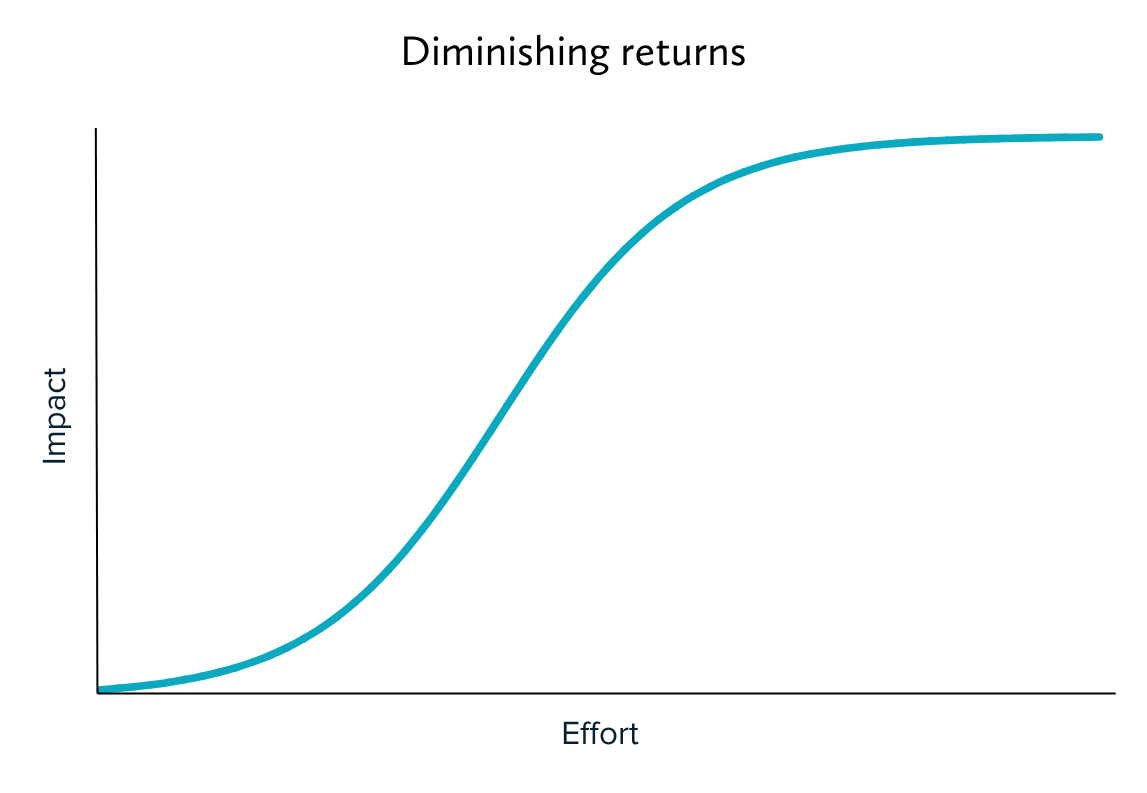
This phenomenon is called diminishing returns. We can see it play out with real organisations. Malaria Consortium will first send treatments to the regions where malaria is most common but medicine is in shortest supply. But, as they raise more money, they will need to send treatments to regions where malaria is less common, which won’t save as many lives as earlier funding. It also plays out over time. Over the last couple of decades, as the best opportunities have been taken, the cost of saving a life appears to have increased.5
It’s not just about health. In the paper “Are Ideas Getting Harder to Find?”, four economists show diminishing returns in a wide variety of fields, including the output of research into crop yields, the number of experiments required to maintain medical progress, and the number of researchers needed to keep shrinking semiconductor chips.
As more ideas are discovered in each of these fields, it becomes harder and harder to find the next one.
In fact, it’s plausible the relationship between impact and effort plays out similarly to the relationship between happiness and income that we’ve already seen.6 That means if two problems are similar in scale, but one receives 10 times more resources than the other, it will be roughly 10 times harder to make progress on it.7
Here’s an interesting implication: the problems your friends have been talking about lately are likely to be the problems that are already receiving the most attention. Instead, the most pressing problems — those where you can have the greatest impact — are probably in areas you’ve never considered.
We all know about the fight against cancer, but what about parasitic worms? It doesn’t make for such a good charity music video, but these tiny creatures have led to 1 billion people worldwide being infected with Neglected Tropical Diseases, causing ongoing fever, horribly swollen limbs, and blindness.8
These conditions are far easier to treat than cancer, but we never hear about them because they very rarely affect rich people. An important rule of thumb to remember: if you’re going to raise awareness of an issue, pick one that everyone isn’t already aware of.
Which kinds of problems are likely to be neglected? People can feel strongly for the suffering of particular individuals, even when they don’t know them. Consider the case of “Baby Jessica,” a girl who fell into a well in Texas in 1987. The story attracted huge media attention and donations of over $700,000 were raised in support. But, at the same time, the number of children who die every day due to malaria would fill a jumbo jet, yet this is rarely remarked upon.9 It’s really the case that “one life saved is a miracle, a million lives saved is a statistic.”10
The issues that tend to get the most support will usually be those that pull most intensely at our heart strings — where there are relatable victims we can see in the news, or that affect people immediately around us. In contrast, more abstract or distant issues will receive less attention.
Since people want to look good in front of their peers, we should also expect them to favour issues that are already popular, rather than those that are controversial or weird. People are also bad at reasoning about low-probability events, and rarely prepare for novel disasters, buying earthquake insurance after the earthquake has hit, not before.
Finally, we should expect the most neglected problems to involve the groups least protected by our current system, such as animals, or future generations, as we’ll see shortly.
Instead of getting swept up in current trends, seek out problems that other people are missing. Ask yourself questions like:
- How many people have heard of this issue?
- Are people unfairly biased against working on it?
- Does the problem affect groups who aren’t protected by our current political and economic system?
Most importantly, try to estimate how many resources have been devoted to the problem. This is the most objective measure of how neglected it is.
Following this advice can be harder than it seems, because it means standing out from the crowd, and maybe looking a little weird. Here you need to ask yourself: is your goal looking normal or actually helping people?
Question 3. Is this problem solvable?
Scared Straight is a US government programme which takes kids who have committed misdemeanours, shows them what life in jail is like, and tries to ‘scare’ them back onto the straight and narrow. The scheme was implemented in over 30 US states and copied in at least five other countries. It was also made into an award-winning 1978 documentary and a 2011 TV series which broke ratings records.
Unfortunately, there was one problem. Scared Straight probably caused young people to commit more crimes. Those who went through the programme did commit fewer crimes than they had previously, meaning it superficially looked like it worked. But the decrease was smaller than the decrease for similarly troubled young people who didn’t go through.
No-one knows exactly why. Maybe the kids thought jail didn’t seem so bad, or wound up admiring the criminals they met. But multiple studies have concluded with the same result.
The effect was so significant that the Washington State Institute for Public Policy estimated that each $1 spent on Scared Straight caused more than $200 worth of social harm from increased crime.11
Some attempts to do good make things worse. Many more simply fail to have an impact. As David Anderson of the Coalition for Evidence-Based Policy puts it:
Of [social programmes] that have been rigorously evaluated, most (perhaps 75% or more), including those backed by expert opinion and less-rigorous studies, turn out to produce small or no effects, and, in some cases negative effects.
This suggests that if you choose a charity to get involved in without looking at the evidence that underpins it, there’s a good chance you’ll have no impact at all. (Read more about whether it’s fair to say most social programmes don’t work.)
It’s extremely hard to tell which programmes are going to be effective ahead of time. Don’t believe us? Try our 10-question quiz, and see if you can guess what’s effective:
The quiz asks you to guess which social interventions work and which don’t. We’ve tested it on hundreds of people, and they hardly do better than chance.
What’s more, even among the interventions that do work, there are huge differences in how effective the best are compared to the worst. We’ll discuss this data for global health in the next part of the guide, but we’ve found similar data in other areas, including education and climate change.
So, before you choose a problem to work on, ask yourself:
- Is there a way to make progress on this problem that is supported by rigorous evidence?
- If not, is there a way to test a promising but unproven intervention that could help solve this problem?
- Is there an intervention with a small but realistic chance of making a massive impact, such as getting a new policy passed?

The final point is important. While many interventions don’t work, that doesn’t mean you should only do things that have a rigorous evidence base. That would rule out any sort of research or advocacy, since their effects can’t be measured ahead of time, even though historically they have been some of the most powerful ways to make a difference.
Just as venture capitalists invest in 10 companies with the hope that one has huge returns, 10 people can try different ways to make a huge dent in a problem, with the hope one succeeds. We call this a ‘hits-based approach,’ and so long as the upside and chances of success are high enough, it can trump more tried-and-tested ways of having an impact.
So what are the most pressing world problems?
You probably won’t find a problem that does brilliantly on all three questions. Rather, look for the problem that does best on balance. A problem could be worth tackling if it’s extremely big and neglected, even if it seems hard to solve.
Roughly speaking, the three factors multiply together. If you can find a problem that’s 10 times bigger, or 10 times more neglected, then, holding everything else equal, an additional person working on it will have 10 times the impact.12
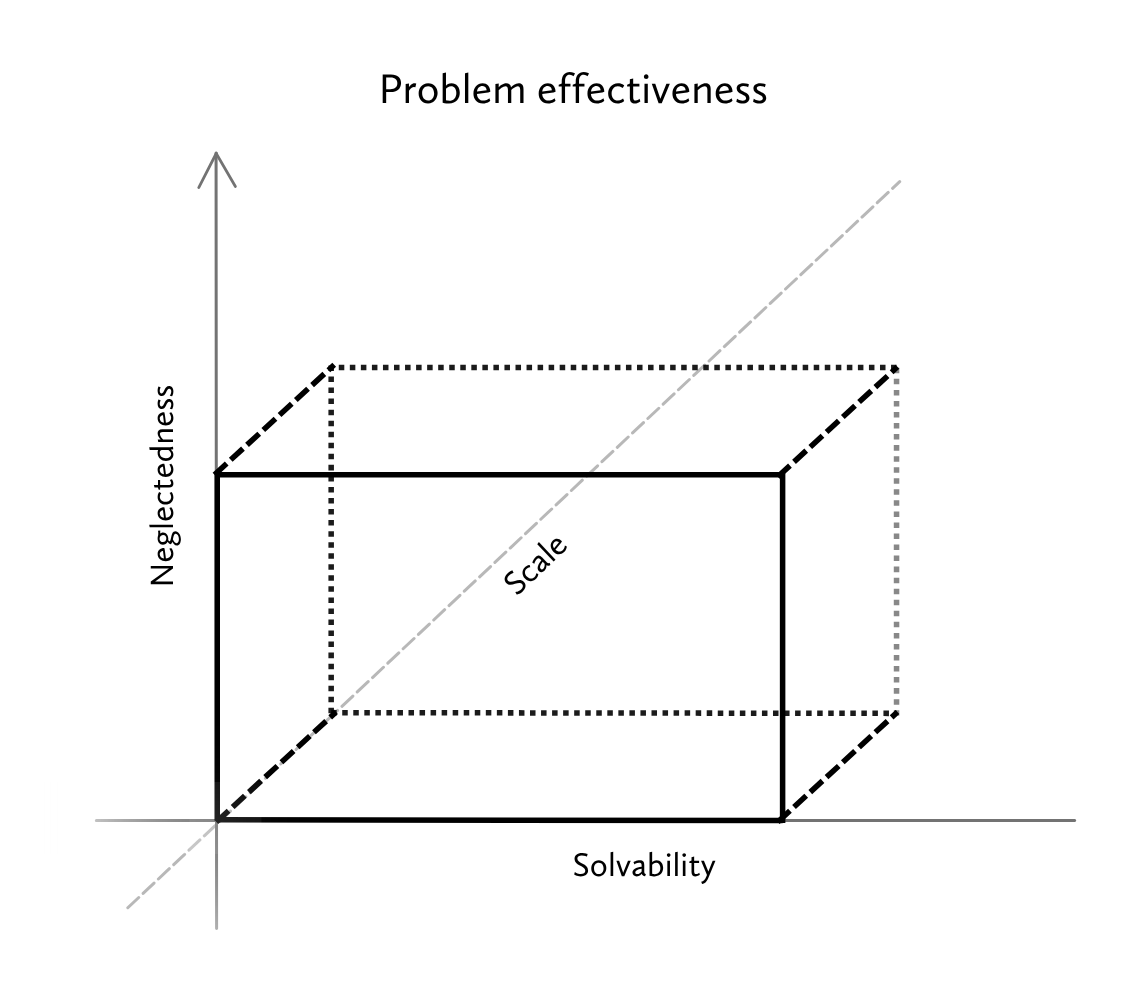
In practice, not everything is equal, and you also need to consider the specific roles that are available to you, and your fit with them — a theme we’ll return to later.
But for now, what are the biggest world problems that no-one is talking about and are possible to solve?
Put into practice
Take two problems you’re interested in working on, and try to make a rough comparison based on the three questions. Getting a good answer would involve doing some research, but for now, make a rough guess given what you already know.
- Which seems bigger in scale? Imagine the problem was entirely solved (or, if that seems impossible, imagine 10% of the problem were solved). How many people would benefit, how much by, and how long would the benefits last? Don’t try to be precise; within a factor of 10 is enough. Also consider indirect benefits: would progress on this problem unlock progress on other problems?
Which seems more neglected? Try to roughly estimate the number of people and amount of funding directed to the problem. Also consider how many years people have been working on it (e.g. there’s been a movement reducing the risk of nuclear war since the 1950s, but efforts to reduce AI risk are much more recent). You can also ask whether there are reasons why markets, governments, and other people interested in doing good aren’t already making progress on this problem.
Which seems easier to make progress on? If investment into this problem were doubled, how much of the problem would you expect to be solved? Try to identify the best ways to help, consider how likely they are to work, and how cost effective they’d be. Sometimes it’s possible to find highly evidence-based interventions, but in other cases it may be better to try your luck with a ‘hits-based’ approach.
Have a greater positive impact with your career
Join our newsletter to receive a free copy of our new career guide, weekly high-impact job opportunities, and updates on our research.
We’ll never share your email, and you can unsubscribe in one click.
Notes and references
- The Global Priorities Institute was an interdisciplinary research centre at the University of Oxford. It conducted foundational research to inform the decision-making of individuals and institutions seeking to do as much good as possible. It used the tools of multiple academic disciplines (especially philosophy and economics) to explore the issues at stake. The Global Priorities Institute closed in July 2025.↩
- Using the power consumption estimates from MacKay’s 2009 book Sustainable Energy — Without the Hot Air, adding home insulation saves over 900 times more energy than unplugging chargers when not in use.
Heating an uninsulated detached house takes about 53 kWh per day, while adding loft and wall insulation reduces that by 44% or around 23 kWh per day (MacKay 142). Assuming a single house contains 2.5 people, then insulation saves 23/2.5 = 9.2 kWh per person per day.
If unplugging phone chargers when they’re not in use reduces personal energy consumption by under 0.01 kWh per day, then adding home insulation is 920 times more important. It can also cut your heating bill by 44%, so you will probably save money over the long term too, depending on the cost of getting the insulation installed.↩
- Organic farming uses less energy input, but also produces less per unit of land, making its overall effect on climate change unclear. Our World in Data concluded:
Across all food types, there is no clear winner when it comes to greenhouse gas emissions. Results vary strongly depending on food type, although most lie close to a ratio of one (where differences in impact between the systems are relatively small). Based on average values, we might conclude that to reduce greenhouse gas emissions, we should buy organic pulses and fruits, and conventional cereals, vegetables, and animal products. In general, the greenhouse gas emission sources of organic and conventional systems tend to cancel each other out. Conventional systems produce greenhouse gases through synthetic fertilizer production and application, which is largely balanced by the higher emissions of nitrous oxide (a strong greenhouse gas) from manure application
While lighting accounts for roughly 6% of household electricity use, residential electricity represents just 38% of total electricity consumption, and electricity itself comprises only 21% of overall energy consumption — making domestic lighting a mere 0.5% of total energy use. That means even if no one used lights at home ever again, it would only reduce energy consumption by 0.5%. Moreover, the energy efficiency of lighting has been increasing dramatically.
International Energy Agency. “United States – electricity.” International Energy Agency, web.archive.org/web/20260124072443/https://www.iea.org/countries/united-states.
Ritchie, Hannah. “Is organic really better for the environment than conventional agriculture?” Our World in Data, August 2017, ourworldindata.org/is-organic-agriculture-better-for-the-environment.
U.S. Energy Information Administration. “How much electricity is used for lighting in the United States?” U.S. Energy Information Administration, 15 March 2024, web.archive.org/web/20260105174245/https://www.eia.gov/tools/faqs/faq.php?id=99.↩
- The evidence for this bias is discussed in more depth in Effective Altruism and the Human Mind: The Clash between Impact and Intuition.↩
- In the 1990s, childhood vaccinations were underfunded. The Disease Control Priorities project estimated that expanding vaccination coverage in Sub-Saharan Africa during the 2000s would have saved a life for about $300 in 2025 dollars. By contrast, today’s cheapest life-saving programmes — such as antimalarial medicines — cost around $3,000 per life saved, making past programmes roughly 10 times more cost effective. Today there are no obvious opportunities for individual donors to fund childhood vaccinations, because these opportunities have been largely taken by organisations like Gavi.
Brenzel, Logan, et al. “Vaccine-preventable diseases.” Disease Control Priorities in Developing Countries, edited by Dean T. Jamison et al., 2nd ed., The World Bank; Oxford University Press, 2006, pp. 389–412.
GiveWell. “How much does it cost to save a life?” GiveWell, April 2024, givewell.org/how-much-does-it-cost-to-save-a-life.↩
- That returns are diminishing has strong theoretical support and is widely assumed by experts. It also matches the empirical evidence I’ve seen.
This said, increasing returns can sometimes apply, especially within organisations, or when an issue is still extremely small (<100 people working on it). But in general when it comes to broad areas, rather than organisations, we expect diminishing returns to be the norm.
It’s harder to know the exact shape of the relationship, but logarithmic seems most plausible, and is most widely used. There’s also some theoretical arguments for why the relationship should be logarithmic in particular (though it’s also possible that returns diminish even faster, or slightly slower).
One complication is the timeframe for the relationship. Malaria nets only last for two years, so there’s a logarithmic relationship between spending within a single two-year period (where more nets are sent to populations where there’s less malaria, so don’t achieve as much). For problems like developing a malaria vaccine, which requires a one-off solution, what’s relevant are the resources spent over the entire history of research into the question.
Cotton-Barratt, Owen. “Cost-effectiveness of research: Overview.” Future of Humanity Institute, 2014, web.archive.org/web/20250624045922/https://www.fhi.ox.ac.uk/cost-effectiveness-of-research-overview.↩
- If there’s a logarithmic relationship between impact and investment, then doubling investment into a problem creates the same amount of progress. If one problem receives $1 billion per year, and another problem receives $10 billion per year, then doubling investment into the first costs $1 billion and doubling it into the second costs $10 billion. But both would lead to the same proportional amount of traction (e.g. solving 10% of the problem).↩
- From the Centers for Disease Control and Prevention:
Neglected Tropical Diseases are a group of parasitic and bacterial diseases that cause substantial illness for more than one billion people globally. Affecting the world’s poorest people, NTDs impair physical and cognitive development, contribute to mother and child illness and death, make it difficult to farm or earn a living, and limit productivity in the workplace. As a result, NTDs trap the poor in a cycle of poverty and disease.
Centers for Disease Control and Prevention. “Neglected tropical diseases (NTDs).” Centers for Disease Control and Prevention, 2018, web.archive.org/web/20180914020919/https://www.cdc.gov/globalhealth/newsroom/topics/ntds/index.html. Accessed 14 September 2018.↩
- In 2021, more than 400,000 children under five years old died from malaria, or about 1,200 per day. A standard Boeing 747 can accommodate around 500 passengers.
Boeing. 747-400/-400ER airplane characteristics. Boeing, December 2002, boeing.com/content/dam/boeing/v2/airports/acaps/747-400_Rev_F.pdf.
Roser, Max. “Malaria was common across half the world — since then it has been eliminated in many regions.” Our World in Data, 2019.↩
- A twist on a truism attributed anecdotally to Stalin.↩
- A meta-analysis by the Campbell Collaboration, a leading evaluator of the effectiveness of social policies, concluded “that programs like ‘Scared Straight’ are likely to have a harmful effect and increase delinquency relative to doing nothing at all to the same youths.”
A review of American social programmes made a cost-benefit analysis, concluding that for every dollar invested in the programme there were $203 in harms, mostly from increased crime and high school attrition.
This estimate seems a little too pessimistic, but even so, it looks like the programme was a huge waste of resources.
Aos, Steve, et al. Benefits and costs of prevention and early intervention programs for youth: Summary report. Washington State Institute for Public Policy, September 2004.
Petrosino, Anthony, et al. “‘Scared Straight’ and other juvenile awareness programs for preventing juvenile delinquency.” Campbell Systematic Reviews, vol. 1, no. 1, 2005, pp. 1–62, doi.org/10.4073/csr.2004.2.↩
- This is true given the formal definition of the factors that we use. Read more in our framework for comparing global problems.↩