

Grantmaking for AI safety

Disclosure: This review includes interviews with staff at Coefficient Giving. Coefficient is 80,000 Hours’ primary funder, and my former employer.
Review status
Based on an in-depth investigation
Table of Contents
In 2017, donors gave around $9 million to fund AI safety work.
In 2025, a single funder, Coefficient Giving, gave over $400 million.1 In 2026, it plans to spend over $1 billion, and it’s only the largest of many funders.
The growth isn’t over: AI companies are likely to fuel a new wave of philanthropy. Nan Ransohoff estimates that Anthropic staff and the OpenAI Foundation could represent $37–100 billion in annual philanthropic spending once those companies go public.2 If even a small fraction of this goes towards AI safety (a concern for hundreds of people at both companies), the field will have billions of additional dollars to spend each year.
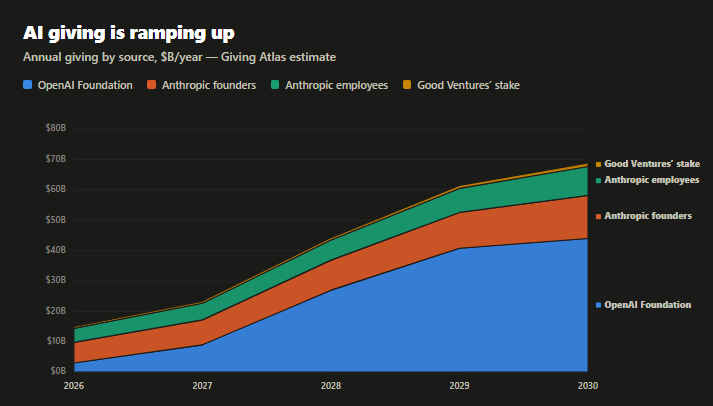
That money could change how the world prepares for the rise of transformative AI — but only if it reaches impactful projects. Coefficient’s grantmakers routinely report that staff capacity limits how much they give. We’ve heard the same from other major funders. To seize the coming opportunity, AI safety will need dozens of new grantmakers. If you become one of them, you could direct tens or hundreds of millions of dollars towards highly impactful projects.
Why work on grantmaking for AI safety?
The rise of transformative AI may create dire challenges for humanity. As Luke Muehlhauser, a managing director at Coefficient, puts it:
This pace of technological change is unprecedented, and the world is not prepared. Very little of the commercial, government, and nonprofit infrastructure we need to respond to these transformative changes has been built.
To create this infrastructure, we’ll need skilled founders with good ideas. But good ideas don’t get funded automatically: someone has to bet on the right combination of idea + team. In the startup world, that’s a venture capitalist. In the nonprofit world, it’s a grantmaker.
Much like the best VCs, the best grantmakers go beyond funding; they also use their experience to help grantees improve their plans and make important connections. This takes a rare set of skills: domain expertise, an eye for talent, and the strategic judgment to find the essential features of a complex proposal. Sometimes, they’ll devise a proposal themselves, and look for someone who can make it happen.
Most organisations on our job board are largely funded by grants. So are we. A specific person had to review and sign off on all of those grants. It’s not the most high-profile job, but without it, AI safety would be a fraction of its current size. The field is a chaotic mix of researchers, wonks, and founders, working across hundreds of projects; grantmakers are in a unique position to see the big picture, and to shape strategy for the field as a whole.
Here’s more on why we recommend grantmaking:
There simply aren’t enough grantmakers
It’s hard to know exactly how much philanthropic funding has gone into AI safety. But our best guess is that the total was under $5 billion as of mid-2026.3
If Nan Ransohoff is right, the field could see that much funding every year once corporate giving kicks off in earnest. But even if annual giving only doubles from its 2026 levels, that will still create demand for dozens of new grantmakers. We were inspired to write this profile because several funders told us they were worried about finding enough people to manage the oncoming tide.4
Your work can have extremely high leverage
VCs and grantmakers make similar bets: startups and nonprofits can both multiply the value of their funding. Coefficient Giving, one of the world’s largest grantmakers, aims to generate at least a 2,000x “social return on investment” (SROI) — meaning that every dollar it spends helps people over 2,000 times as much as a dollar given to someone earning $50,000 a year.
Coefficient has already given over $6 billion to causes that it judged to be above that bar.5 For example, it was the first major philanthropic supporter of David Baker (who later won the Nobel Prize for his work on protein design), and organised a fund that drastically increased global philanthropic spending to mitigate lead poisoning. And there are many other cases where grants generated massive SROI — like the Rockefeller Foundation’s support for agricultural research that enabled the Green Revolution, or Katharine McCormick’s funding for contraceptive research that led to the birth control pill.6
While AI safety grants are often hard to judge, much of the field’s most influential work (from AI 2027 to METR’s task completion graph to the campaign that stopped a moratorium on state-level AI regulations) relies on philanthropic support. So do the capacity-building projects that made the field’s growth possible (from the MATS fellowship to BlueDot Impact). If you read mainstream news coverage of an alarming development in AI, you’ll probably see a quote from someone whose work is grant-supported.7
Grants also help people develop skills they’ll eventually use elsewhere. When governments began to worry about the impact of transformative AI, they set up AI safety institutes — which meant finding hundreds of people with technical governance experience who would choose public service over lucrative corporate jobs. Unsurprisingly, many of those people came from the nonprofit sector, and originally built their experience through grant-supported fellowships or research programmes.
What about marginal impact?
You might accept that grants can be very impactful, but still question the value of additional grantmakers. Would you make a difference on the margin, or would your chosen projects attract funding even without you?
The second isn’t as likely as it seems. Philanthropy isn’t an efficient market. Many opportunities are hard to spot, and a chance that looks promising to you might otherwise go unnoticed.
That said, adverse selection is a real problem. Some proposals you find may have been passed over for good reasons, and part of your job is to work out whether that happened (and whether you agree with the funders who passed).
Even if another funder says yes eventually, they might be too late: by the time they find the project, its window of opportunity might close, or the founder might give up and take a job elsewhere. And if a project does survive the wait, it could still have had much more impact with an earlier start, especially if we don’t have much time before the advent of AGI.
Catherine Brewer, an associate program officer at Coefficient Giving, describes a case where timing mattered: Coefficient gave seed funding to a pair of researchers who were leaving a major lab, which enabled them to launch a new organisation. “Had we gone slower or had less grantmaker capacity, it’s likely this grant wouldn’t have happened; they both had other offers.”
It’s easy to assume that grantmakers spend as much as they can, with funding as the ultimate bottleneck. But that’s not true; spending is often limited by staff capacity. Here’s Luke Muehlhauser again:
As a new AI grantmaker at [Coefficient], you’d likely move >$30 million, and plausibly >$100 million, in your first year […] Because grant investigation capacity is tight, hiring one fewer grantmaker usually means those millions will just sit in an account for another year rather than being deployed.
If you deploy tens of millions of dollars that would otherwise go unspent, that buys a lot of chances to find good ideas others won’t — and a single big hit could more than pay for the rest of your bets.8
You can help your grantees do more good
Beyond the money itself, you can provide crucial advice and connections to founders who need them.
I’ve heard from grantmakers who changed a grantee’s trajectory by:
Helping them find employees, board members, or even co-founders. Alex Lawsen, a senior program officer at Coefficient, said he’d done a “decent amount of targeted headhunting, especially for board roles.” Another grantmaker once made an international trip to pitch a researcher on leaving his corporate job to help run an AI safety org — and succeeded.
Providing career advice. Lawsen noted that his job helped him learn about a wide range of organisations, which positioned him to give a “neutral, balanced perspective” to people figuring out their next steps. (Many grants in AI safety go to help individuals develop their career plans, a stage at which they’ll want advice.)
Encouraging them to be more ambitious. Julian Hazell, head of AI strategy at the Astralis Foundation, noticed that fellowships and other talent development programmes had a strong track record in AI safety, and thought the Institute for AI Policy and Strategy (IAPS) was well-placed to run one focused on practical policy skills. He suggested that IAPS branch out from research to launch a fellowship. IAPS had considered this before, but Julian’s advice and grant (from Coefficient Giving, his previous employer) tipped the scale and led them to act on the idea.
Connecting them with helpful experts. Many would-be grantees have limited experience outside their fields — picture a professor starting a pressure group or a programmer pivoting to policy. You’ll be well-positioned to spot these limitations, and you can draw from your network to connect grantees with advisors who shore up their weaknesses. One grantmaker I’ve worked with helped a first-time CEO find a performance coach to develop their professional skills; another set up media training for a researcher whose work was attracting journalists.
The job can be highly fulfilling
Here’s what I’ve heard from grantmakers about their favourite parts of the job:
You really feel the impact you make. Funding a person or project has an obvious effect on what happens next — and if the grant goes well, you can share in the excitement. Hazell: “You spend all this time evaluating someone, making a bet on them, and then they actually go do the thing. That’s really satisfying.”
There’s room for individual expression. Grantmakers — even early in their careers — have lots of flexibility and autonomy to pursue the opportunities they view as most promising. You’ll be asked to form your own views and ultimately make the call (usually with approval from senior staff) on where to allocate millions of dollars.9
The job is always changing. You’ll constantly meet new people, evaluate new proposals, and deal with new developments in your field. A single RFP might give you 500 projects to consider.
You can see the field from the inside. Alex Lawsen explained that while board membership might expose you to one organisation’s inner workings — the problems they face, the way their leaders make decisions — grantmaking could do this for 10 organisations at once: “It’s hard to overstate how unique a picture [of the field] you get from this.”
You’ll also get time with senior researchers and policy experts who don’t have major public profiles and would be hard to reach otherwise. Catherine Brewer called this “a really fun part of the job, which I underrated before joining.”
What do grantmakers actually do?
Before you fund someone, you need to find them. In most grantmaking roles, you’ll spend much of your time tracking down potential founders, not just waiting until they come to you. This could include:
- Searching for leads at conferences and other events.
- Generating ideas for projects and organisations you’d like to see, then finding people to create them. (Julian Hazell did a version of this when he realised that IAPS was well-positioned to provide policy training.)
- Writing requests for proposals (RFPs) to explain what you’d like to fund, and sharing them with as many relevant groups as you can.
- Reading the latest work in your field to spot people with interesting ideas, then asking what they’d do with a million dollars. (The actual number varies.)
After you source a proposal, you decide whether to make a grant. This entails:
- Assessing the cost-effectiveness of the grant. While back-of-the-envelope calculations (BOTECs) are common in some sectors of impact-focused grantmaking, AI safety tends to be less quantitative. Most of the time, you’ll use some combination of personal heuristics, gut feeling, conversations with your peers, and the outcome of similar grants in the past. That said, BOTECs can still help you with sub-problems, like estimating the attendance of a conference you might fund or the chance that a bill gets through Congress.
- Evaluating the people involved. Do they have the right mix of experience and ability to run the project well? Are their ideas sensible, with a clear theory of change? Would you need to supervise them closely, taking time away from other grants you could make? How should you handle negative information about them?
- Here’s an example which blends a few real-world cases: If an applicant’s last project fell apart because they screamed at their subordinates, but they went to anger management training and seem to get along with their current team, would you still apply a risk penalty to their proposal? If you did fund them, how would you monitor the situation?
- Deciding whether to impose conditions. Are you willing to make an unrestricted grant? Will you fund only a subset of the grantee’s work? Will you guarantee additional funding if they hit certain milestones? Will you fund the team, but for a separate project entirely?
You’ll get much of your information from the applicants themselves. But since they may skew the data to improve their chances, you’ll also seek out other sources, like people who worked closely with them or neutral experts who can judge their output.
Once you’ve made a grant, you’ll keep in touch with the grantee for scheduled check-ins and ad hoc advice. This is very flexible; you might talk to someone once a year, or every other week.
Beyond direct grantmaking, the job has many other responsibilities. You’ll set broad strategic priorities, keep up with developments in your field, write about your work, and answer questions from people who seek out your expertise.10
Could you be a good fit?
Skills that will help you succeed
Experience in relevant areas. To judge a proposal, you must evaluate:
- The project itself (how impactful would it be with good execution?)
- The people involved (how well do you think they’ll execute?)
On the first point, you’ll need enough background in the right area(s) to gauge a project’s potential: Does the idea make sense? Have similar projects succeeded or failed in the past? Does the proposal address the likely obstacles?
Relevant experience could include national security, technology policy, cybersecurity, machine learning, China, or many other topics in AI safety. If you’ve worked in any of our priority careers, that’s a good sign.
Good judgment about people. Being a domain expert helps you evaluate plans, but isn’t as helpful for evaluating people. That skill is harder to pin down, but here are some positive signals:
- You’ve hired people before, and they were highly successful in their roles.
- You’ve recommended contacts for jobs or introduced them to collaborators on several occasions, and seen it work out well.
- You have a history of picking the right people to build teams or partnerships, in professional or competitive settings.
Some “people judgment” involves universal traits: deciding whether a team seems competent and well-organised, or charismatic and likeable if the work demands it. Some of it requires background knowledge: evaluating a researcher’s technical chops, or whether a think tank’s founder has the right experience and bearing to make politicians take them seriously.
(One comment I’ve heard a lot: “I don’t think this person would come across well on Capitol Hill.”)
Learning new things quickly. No matter how experienced you are, grantmaking will force you to contend with new ideas and unfamiliar domains. Julian Hazell’s work has involved crash courses in:
- “Talent bottlenecks and hiring frictions in the EU.”
- “The basics of US tort law and how state supreme courts shape it.”
- “Incentives, frictions, and blockers that labs face around monitoring and tracking what their models are doing in deployment.”
Ideally, you’ll use your first research pass to generate questions for someone who knows more. Grantmakers often meet with experts who help them understand proposals and resolve uncertainties. The trouble is that your experts won’t always agree — so you’ll need enough context and judgment to figure out whose opinion you trust, or come up with the right synthesis.
Strong communication and reasoning transparency. This is important for most jobs, but a few common situations in grantmaking really emphasise it:
- Writing for colleagues, especially whoever approves your grants. Making your cruxes and the strength of your evidence explicit lets them sign off quickly, or push back for the right reasons.
- Persuading funders to support an opportunity. In some roles, you’ll need to get approval directly from your funder(s). Compared to your colleagues, they’ll typically have less context on the space and place more weight on whether a grant excites them personally (though funders vary widely on these factors). That means you’ll need to make an especially clear and legible case for each grant, drawing out what makes the work interesting without exaggerating its potential.
- Delivering feedback to people who aren’t ready to hear it. I’ve heard several stories along the lines of “I tried to tell a grantee they weren’t doing well, but they were shocked when I didn’t renew their funding. I wish I’d gotten my point across better.”
An extensive information environment. Alex Lawsen has written that a strong grantmaker can “track every adjacent effort, notice persistent gaps, compare five proposals trying to solve nearby problems, or work out which two groups should probably be talking to each other.”
This goes beyond experience: You’ll need to constantly absorb new information about the space, so that you can discover projects that might benefit from funding or recognise when a sensible-sounding idea no longer makes sense. This involves a mix of networking and reading, depending on how information flows through your part of the field.
Speed and responsiveness. Grantmaking is time-sensitive. Someone who requests funding could be choosing between their grant and a full-time job; getting back to them a week sooner might change which path they take. One grantmaker described his work as searching for whichever information might cause him to say no the fastest, so that he could focus on the strongest proposals instead of stringing along potential grantees.
Promising background experience
Apart from experience in our priority careers, it helps to have experience:
- Actually making grants, or providing other forms of support to individuals or small teams (e.g. startup investing, working at a government funding agency like DARPA or NIH)
- Helping people refine their plans in other contexts (e.g. consulting, coaching)
- Studying the landscape of AI safety, biosecurity, or related subfields, especially if you built a strong network along the way (e.g. journalism, event organising, research management)
- Evaluating AI safety work, even on an amateur basis (e.g. writing comments on LessWrong, blogging about research papers, creating BOTECs for your personal donations)
Downsides to working on grantmaking
The field can be difficult to enter. Grantmaking doesn’t have many formal training opportunities, and even entry-level roles are hard to get. Funders struggle to hire because they have high standards for who they’ll trust to make millions of dollars in grants. To quote Ollie Rodriguez (formerly of Longview Philanthropy), “grantmaking is more like a skill than a path“. To become a strong candidate, you’ll need to build experience and abilities in other positions.
High stakes beget high pressure. You can’t fund every proposal you see, but every decision has consequences. If you don’t fund a project, it might not happen; if you don’t renew a grant to an organisation, people might lose their jobs. Meanwhile, if a project you fund goes poorly, you may feel like you’ve wasted a huge amount of someone else’s money — or worse, enabled something actively counterproductive.11
Your impact is indirect. You can provide support and guidance to your grantees, but you ultimately won’t have much influence over how most of your grants perform. Some people come to miss “on-the-ground” work where their efforts have direct returns. Ironically, grantmaking also gives you many chances to notice gaps you could fill, if only you were willing to take a new job; several of my sources found this stressful.
Your work won’t be especially visible. You’ll spend a lot of time reasoning privately with your colleagues and doing sensitive research you can’t publish. This makes it hard to build a portfolio, or develop career capital that will transfer outside of AI safety. One grantmaker noted another consequence: “You’re not going to get social credit for a lot of the good stuff you do.”
You may be constrained by your funders. Grantmakers give away other people’s money. The funders you work with might override your decisions, or impose restrictions that stop you from supporting some of your favourite projects. This can happen even in longstanding relationships, as when Good Ventures stopped funding some of Coefficient’s sub-causes.12
Power dynamics distort communication. When life-changing amounts of money are involved, it’s hard to keep things honest. Applicants might stretch the truth in a proposal or flatter you with empty compliments. As one grantmaker said: “It can be hard to believe positive feedback or signals of respect, because you’re not sure how much of it comes from your position of power.”
Power also changes the way people hear your words: applicants may bend over backwards to give you what you want, even if you don’t feel strongly about a suggestion. You’ll have to communicate carefully to ensure your passing thoughts aren’t taken as conditions for funding.
Top organisations
These funders work on problems we see as top priorities.
- Coefficient Giving, the largest grantmaker working on our priority problems
- OpenAI Foundation, which has massive resources and an “AI Resilience” program focused on risk mitigation
- Effective Altruism Funds, which just opened its Transformative AI Fund
- Longview Philanthropy, which advises a number of large donors on AI, biosecurity, and nuclear weapons policy
- Founders Pledge, which recommends funding opportunities to its network of entrepreneurs
- The Astralis Foundation, which focuses on European and Asian AI policy alongside other neglected interventions
- The Future of Life Foundation, whose focuses include using AI to improve decision-making
- Lightcone Commons, which connects groups of funders with expert evaluators they’ve sourced
- Macroscopic Ventures, which works on both traditional AI governance and a few unusual initiatives (AI welfare and cooperative AI)
- Halcyon Futures, which makes investments and incubates new organisations in addition to making grants
- Sentinel Bio, which works exclusively on biosecurity (a topic that is highly relevant to risks from advanced AI)
- Schmidt Sciences, a science funder that funds occasional AI safety projects
How to enter the field
Because you can enter grantmaking from a variety of backgrounds, our strongest recommendation is to check the grantmaking roles on our job board and apply if you see a role that fits. While there’s a high bar for entry, your qualifications might be more relevant than you think — and the need is urgent.
More ideas:
- Start with a different role in the space. You’ll need a substantial base of AI safety knowledge to qualify for most grantmaking positions — the kind you’d get from actually working on a job or research project. Even a part-time role can be helpful, especially if it involves evaluating projects (e.g. cost-effectiveness researcher) or helping a grantmaker in some capacity (e.g. research or executive assistant).
- If you’re an expert on something else, build AI safety context. If you have highly relevant skills or experience — grantmaker at a major foundation, cybersecurity expert — you may be a strong candidate even without a formal background in AI safety. However, you’ll still need to know the basics. Good ways to start include courses from BlueDot Impact and our primer on helping advanced AI go well.
- Study how grantmakers operate. Funders and individual grantmakers often have blogs, mailing lists, or Twitter accounts. Some, like Effective Altruism Funds, publish reports on their funding decisions. I used to write for Coefficient, and I can testify that reading its blog would teach you a lot about its approach (and make you a stronger candidate).
- Practice thinking like a grantmaker. You probably don’t have millions of dollars to give away, but you could still challenge yourself by informally evaluating organisations or projects. For example, Michael Dickens writes about his personal giving in great detail. This kind of side project can help you grab a hiring manager’s attention.
- Another idea: Look at payout reports from Effective Altruism Funds and ask yourself how you’d evaluate some of those grants. What questions would you ask before renewing, or to gauge the impact of someone’s work?
- Look for training opportunities. We haven’t heard of many opportunities specific to grantmaking, but they do exist. Ambitious Impact’s Impactful Philanthropy programme trains people in multiple philanthropic skills (including grantmaking and advising wealthy individuals), and Constellation’s Astra Fellowship has included strategy and governance projects linked to grantmaking.
Find jobs in AI safety grantmaking
If you think you might be a good fit for this path and you’re ready to start looking at job opportunities, see our curated list of jobs open in this path:
Because we expect a surge of AI safety funding over the next few years, we think many more jobs could open up; keep an eye on this page.
Speak with us
If you think this path might be a great option for you, but you need help deciding or thinking about what to do next, our team might be able to help.
We can help you compare options, make connections, and possibly even help you find jobs or funding opportunities.
Learn more
Notes on the philanthropic situation
- AI safety is extremely bottlenecked on grantmakers, by Luke Muehlhauser (Coefficient Giving)
- The third wave of American philanthropy and There should be “general managers” for more of the world’s important problems, by Nan Ransohoff
- Podcast: Max Nadeau on recruiting founders for a new wave of AI safety nonprofits
- What should we do about all this AI money?, a conversation between Coefficient Giving CEO Alexander Berger and philanthropy critic Rob Reich
- The San Francisco strategy for animal welfare, by Itsi Weinstock, calls on the animal welfare movement to prepare for the philanthropic surge (with lots of crossover lessons for AI safety)
- The Giving Atlas, a guide to the landscape of US philanthropy
Personal reflections from grantmakers
- Julian Hazell (Astralis Foundation, Coefficient Giving)
- Alex Lawsen (Coefficient Giving)
- Jake Mendel (Coefficient Giving)
- Abbey Chaver, Trevor Levin, and Chris Bakerlee (Coefficient Giving)
- Linchuan Zhang (Effective Altruism Funds)
- Sarah Constantin (ACX Grants, Survival and Flourishing Fund)
- Michael Dickens (independent evaluator)
- Zvi Mowshowitz (independent evaluator)
Other notes on grantmaking
- How Coefficient Giving creates back-of-the-envelope calculations
- Select examples of adverse selection in longtermist grantmaking, by Linchuan Zhang
- Grantmaking is more like a skill than a path, by Ollie Rodriguez
- A conversation between the leaders of two philanthropic platforms
Acknowledgements
Thank you to Alex Lawsen, Catherine Brewer, Julian Hazell, Matt Beard, and Naina Bajekal.
Notes and references
- Coefficient shared this figure with me, though it isn’t public as of August 2026.↩
- Anthropic’s co-founders have pledged to give away 80% of their wealth, and the OpenAI Foundation controls hundreds of billions of dollars.↩
- Coefficient has given over $6 billion as of mid-2026, but more than half of that went towards other causes. No other AI safety grantmaker is even close to Coefficient’s size; this post estimates that it made up well over 50% of funding through 2024. (This wouldn’t include private grants, but as far as I could find in my own research, those are only a small slice of the pie.)
Philanthropic funding in biosecurity — the other area we focus on — is higher, on the order of $1 billion per year, but only a small fraction of that is focused on preventing pathogens that pose a catastrophic threat to humanity.↩
- For public discussion, see posts from Jake Mendel and Julian Hazell. Julian added this in our conversation: “On the default trajectory, we aren’t going to have nearly enough capacity to meet donor demand for AI safety philanthropy in the coming years, and that keeps me up at night.”↩
- The specific multiplier varies from year to year, and Coefficient only uses it for grants in global health and wellbeing (GHW), not AI safety. But because Coefficient’s mission is to “help others as much as we can“, it’s reasonable to assume that they don’t see their AI safety grants as substantially less impactful. (Otherwise, they wouldn’t make those grants.)↩
- Credit goes to Coefficient for both of these examples.↩
- See this post for more examples of impactful AI safety grantmaking.↩
- You probably won’t move $30 million as a junior grantmaker outside of Coefficient, but even a few million dollars can fund dozens of people for multiple years of work.↩
- See Alex Lawsen on the limits of deferral; even when experts know more than you about a field, you’ll be the ultimate expert on the decisions you need to make.↩
- One interviewee described helping someone choose which of two jobs to take by drawing on his experience with both organisations.↩
- It’s hard to say that any given grant was a waste: the best philanthropy tends to be hits-based, which means taking calculated risks. Grantmakers get used to grants that don’t work out. All the same, I’ve heard from some who regret certain grants, viewing them as mistaken (based on poor judgment or faulty research) or harmful (advocacy that caused a political backlash, low-quality research that discredited a promising approach).↩
- At the time, Coefficient was using its former name, Open Philanthropy.↩