#93 – Andy Weber on rendering bioweapons obsolete and ending the new nuclear arms race

COVID-19 has provided a vivid reminder of the damage biological threats can do. But the threat doesn’t come from natural sources alone. Weaponized contagious diseases — which were abandoned by the United States, but developed in large numbers by the Soviet Union, right up until its collapse — have the potential to spread globally and kill just as many as an all-out nuclear war.

For five years, today’s guest, Andy Weber, was the US’ Assistant Secretary of Defense responsible for biological and other weapons of mass destruction. While people primarily associate the Pentagon with waging wars (including most within the Pentagon itself) Andy is quick to point out that you don’t have national security if your population remains at grave risk from natural and lab-created diseases.

Andy’s current mission is to spread the word that while bioweapons are terrifying, scientific advances also leave them on the verge of becoming an outdated technology.

He thinks there is an overwhelming case to increase our investment in two new technologies that could dramatically reduce the risk of bioweapons, and end natural pandemics in the process: mass genetic sequencing and mRNA vaccines.

First, advances in mass genetic sequencing technology allow direct, real-time analysis of DNA or RNA fragments collected from all over the human environment. You cast a wide net, and if you start seeing DNA sequences that you don’t recognise spreading through the population — that can set off an alarm.

Andy notes that while the necessary desktop sequencers may be expensive enough that they’re only in hospitals today, they’re rapidly getting smaller, cheaper, and easier to use. In fact DNA sequencing has recently experienced the most dramatic cost decrease of any technology, declining by a factor of 10,000 since 2007. It’s only a matter of time before they’re cheap enough to put in every home.

Continue reading →

How to identify your personal strengths

Perhaps the most common approach to finding a good career is to identify your personal strengths, and then look for paths that match them.

This article summarises the best advice I’ve found on how to identify your strengths, turned into a three-step process. It also includes lists of personal strengths that are most commonly used by researchers (to give you a language to describe your own) and a case study.

But first, I wanted to give a warning that I think the ‘match with strengths’ approach to choosing a career seems a little overrated.

Perhaps the biggest risk is limiting yourself based on your current strengths, and ignoring your potential to develop new, more potent strengths. This risk is most pressing for younger people, who don’t yet have much data on what they’re good at – making them more likely to guess incorrectly – and have decades ahead of them to develop new strengths.

You should ask both ‘what are my strengths?’ and also ‘which strengths are worth building?’

More broadly, I’ve argued that it’s often better to take the reverse approach to match with strengths: ask what the world most needs and then figure out how you might best help with that. This orientation helps you to focus on developing skills that are both valued in the market and that can be used to solve important global problems, which is key to finding a career that’s both meaningful and personally rewarding.

Continue reading →

#92 – Brian Christian on the alignment problem

Brian Christian is a bestselling author with a particular knack for accurately communicating difficult or technical ideas from both mathematics and computer science.

Listeners loved our episode about his book Algorithms to Live By — so when the team read his new book, The Alignment Problem, and found it to be an insightful and comprehensive review of the state of the research into making advanced AI useful and reliably safe, getting him back on the show was a no-brainer.

Brian has so much of substance to say this episode will likely be of interest to people who know a lot about AI as well as those who know a little, and of interest to people who are nervous about where AI is going as well as those who aren’t nervous at all.

Here’s a tease of 10 Hollywood-worthy stories from the episode:

  • The Riddle of Dopamine: The development of reinforcement learning solves a long-standing mystery of how humans are able to learn from their experience.
  • ALVINN: A student teaches a military vehicle to drive between Pittsburgh and Lake Erie, without intervention, in the early nineties, using a computer with a tenth the processing capacity of an Apple Watch.
  • Couch Potato: An agent trained to be curious is stopped in its quest to navigate a maze by a paralysing TV screen.
  • Pitts & McCulloch: A homeless teenager and his foster father figure invent the idea of the neural net.
  • Tree Senility: Agents become so good at living in trees to escape predators that they forget how to leave, starve, and die.
  • The Danish Bicycle: A reinforcement learning agent figures out that it can better achieve its goal by riding in circles as quickly as possible than reaching its purported destination.
  • Montezuma’s Revenge: By 2015 a reinforcement learner can play 60 different Atari games — the majority impossibly well — but can’t score a single point on one game humans find tediously simple.
  • Curious Pong: Two novelty-seeking agents, forced to play Pong against one another, create increasingly extreme rallies.
  • AlphaGo Zero: A computer program becomes superhuman at Chess and Go in under a day by attempting to imitate itself.
  • Robot Gymnasts: Over the course of an hour, humans teach robots to do perfect backflips just by telling them which of 2 random actions look more like a backflip.

Continue reading →

Why I find longtermism hard, and what keeps me motivated

I find working on longtermist causes to be — emotionally speaking — hard: There are so many terrible problems in the world right now. How can we turn away from the suffering happening all around us in order to prioritise something as abstract as helping make the long-run future go well?

A lot of people who aim to put longtermist ideas into practice seem to struggle with this, including many of the people I’ve worked with over the years. And I myself am no exception — the pull of suffering happening now is hard to escape. For this reason, I wanted to share a few thoughts on how I approach this challenge, and how I maintain the motivation to work on speculative interventions despite finding that difficult in many ways.

This issue is one aspect of a broader issue in effective altruism: figuring out how to motivate ourselves to do important work even when it doesn’t feel emotionally compelling. It’s useful to have a clear understanding of our emotions in order to distinguish between feelings and beliefs we endorse and those that we wouldn’t — on reflection — want to act on.

What I’ve found hard

First, I don’t want to claim that everyone finds it difficult to work on longtermist causes for the same reasons that I do, or in the same ways. I’d also like to be clear that I’m not speaking for 80,000 Hours as an organisation.

Continue reading →

#91 – Lewis Bollard on big wins against factory farming and how they happened

I suspect today’s guest, Lewis Bollard, might be the single best person in the world to interview to get an overview of all the methods that might be effective for putting an end to factory farming and what broader lessons we can learn from the experiences of people working to end cruelty in animal agriculture.

That’s why I interviewed him back in 2017, and it’s why I’ve come back for an updated second dose four years later.

That conversation became a touchstone resource for anyone wanting to understand why people might decide to focus their altruism on farmed animal welfare, what those people are up to, and why.

Lewis leads Open Philanthropy’s strategy for farm animal welfare, and since he joined in 2015 they’ve disbursed about $130 million in grants to nonprofits as part of this program.

This episode certainly isn’t only for vegetarians or people whose primary focus is animal welfare. The farmed animal welfare movement has had a lot of big wins over the last five years, and many of the lessons animal activists and plant-based meat entrepreneurs have learned are of much broader interest.

Some of those include:

  • Between 2019 and 2020, Beyond Meat’s cost of goods sold fell from about $4.50 a pound to $3.50 a pound. Will plant-based meat or clean meat displace animal meat, and if so when? How quickly can it reach price parity?
  • One study reported that philosophy students reduced their meat consumption by 13% after going through a course on the ethics of factory farming. But do studies like this replicate? And what happens several months later?
  • One survey showed that 33% of people supported a ban on animal farming. Should we take such findings seriously? Or is it as informative as the study which showed that 38% of Americans believe that Ted Cruz might be the Zodiac killer?
  • Costco, the second largest retailer in the U.S., is now over 95% cage-free. Why have they done that years before they had to? And can ethical individuals within these companies make a real difference?

Continue reading →

Rob Wiblin on how he ended up the way he is

Today we put out an interview with our Head of Research, Rob Wiblin, on our podcast feed.

The interviewer is Misha Saul, a childhood friend of Rob’s who he has known for over 20 years. While it’s not an episode of our own show, we decided to share it with subscribers because it’s fun, and because it touches on personal topics that we don’t usually get to cover in our own interviews.

They cover:

  • How Rob’s parents shaped who he is (if indeed they did)
  • Their shared teenage obsession with philosophy, which eventually led to Rob working at 80,000 Hours
  • How their politics were shaped by growing up in the 90s
  • How talking to Rob helped Misha develop his own very different worldview
  • Why The Lord of the Rings movies have held up so well
  • What was it like being an exchange student in Spain, and was learning Spanish a mistake?
  • Marriage and kids
  • Institutional decline and historical analogies for the US in 2021
  • Making fun of teachers
  • Should we stop eating animals?

Continue reading →

#90 – Ajeya Cotra on worldview diversification and how big the future could be

You wake up in a mysterious box, and hear the booming voice of God:

“I just flipped a coin. If it came up heads, I made ten boxes, labeled 1 through 10 — each of which has a human in it.

If it came up tails, I made ten billion boxes, labeled 1 through 10 billion — also with one human in each box.

To get into heaven, you have to answer this correctly: Which way did the coin land?”

You think briefly, and decide you should bet your eternal soul on tails. The fact that you woke up at all seems like pretty good evidence that you’re in the big world — if the coin landed tails, way more people should be having an experience just like yours.

But then you get up, walk outside, and look at the number on your box.

‘3’. Huh. Now you don’t know what to believe.

If God made 10 billion boxes, surely it’s much more likely that you would have seen a number like 7,346,678,928?

In today’s interview, Ajeya Cotra — a senior research analyst at Open Philanthropy — explains why this thought experiment from the niche of philosophy known as ‘anthropic reasoning’ could be relevant for figuring out where we should direct our charitable giving.

Some thinkers both inside and outside Open Philanthropy believe that philanthropic giving should be guided by ‘longtermism’ — the idea that we can do the most good if we focus primarily on the impact our actions will have on the long-term future.

Continue reading →

Rob Wiblin on self-improvement and research ethics

Today on our podcast feed, we’re releasing a crosspost of an episode of the Clearer Thinking Podcast: 022: Self-Improvement and Research Ethics with Rob Wiblin.

Rob chats with Spencer Greenberg, who has been an audience favourite in episodes 11 and 39 of the 80,000 Hours Podcast, and has now created this show of his own.

Among other things they cover:

  • Is trying to become a better person a good strategy for self-improvement?
  • Why Rob thinks many people could achieve much more by finding themselves a line manager
  • Why interviews on this show are so damn long
  • Is it complicated to figure out what human beings value, or actually simpler than it seems?
  • Why Rob thinks research ethics and institutional review boards are causing immense harm
  • Where prediction markets might be failing today, and how we could tell.

You can get the interview in your podcasting app by either subscribing to the ‘80,000 Hours Podcast’, or Spencer’s show ‘Clearer Thinking’.

You might also want to check out Spencer’s conversation with another 80,000 Hours researcher: 008: Life Experiments and Philosophical Thinking with Arden Koehler.

Continue reading →

#89 – Owen Cotton-Barratt on epistemic systems & layers of defence against potential global catastrophes

From one point of view academia forms one big ‘epistemic’ system — a process which directs attention, generates ideas, and judges which are good. Traditional print media is another such system, and we can think of society as a whole as a huge epistemic system, made up of these and many other subsystems.

How these systems absorb, process, combine and organise information will have a big impact on what humanity as a whole ends up doing with itself — in fact, at a broad level it basically entirely determines the direction of the future.

With that in mind, today’s guest Owen Cotton-Barratt has founded the Research Scholars Programme (RSP) at the Future of Humanity Institute at Oxford University, which gives early-stage researchers the freedom to try to understand how the world works.

Instead of you having to pay for a masters degree, the RSP pays you to spend significant amounts of time thinking about high-level questions, like “What is important to do?” and “How can I usefully contribute?”

Participants get to practice their research skills, while also thinking about research as a process and how research communities can function as epistemic systems that plug into the rest of society as productively as possible.

The programme attracts people with several years of experience who are looking to take their existing knowledge — whether that’s in physics, medicine, policy work, or something else — and apply it to what they determine to be the most important topics.

It also attracts people without much experience, but who have a lot of ideas. If you went directly into a PhD programme, you might have to narrow your focus quickly. But the RSP gives you time to explore the possibilities, and to figure out the answer to the question “What’s the topic that really matters, and that I’d be happy to spend several years of my life on?”

Continue reading →

Where’s the best place to volunteer?

We talk a lot about where to donate, but people also often ask us about where is best to volunteer.

This is not something we’ve researched, but here are some quick notes on the topic.

First we’ll discuss some ways in which volunteering can be overrated and not as impactful as it first seems. But then we’ll go through how volunteering can be impactful in some circumstances, especially if you’re trying to explore an area and build career capital, or are applying a particular skill you’ve developed.

One problem with volunteering is that volunteers need to be managed. If untrained volunteers use up the time of trained managers, it’s easy for them to cost the organisation more than the value they add to it. The reason many volunteering schemes persist is that volunteers are more likely to donate in the future. For instance, when FORGE cut their volunteering scheme to be more effective, they inadvertently triggered a big drop in donations.

This also explains why many volunteering schemes involve unskilled work, like yard work or serving food — the aim of the scheme is just to get people involved, rather than directly have an impact. If you’re skilled, it makes more sense to find a way to use those skills to do good, either by applying those skills to a pressing issue, or by using them to earn money and donate to pay other people to do the unskilled work.

Continue reading →

College advice

College advice illustrated by a campus library

Here is some tentative college advice about how to choose an undergraduate course, and what to do once you start studying. It’s based on our general knowledge and the experiences of people we’ve advised. We haven’t yet done in-depth research into this area, so our views could easily change.

Priorities

Clarify what you want to get out of college. Four common priorities include:

  1. Studying – so you can get good grades or learn useful skills
  2. Social – many people meet their most important friends and romantic partners through their college network
  3. Preparing for your future career through work, side projects, or research
  4. Generally learning about yourself and the world

On preparing for your future career, you’re right at the start — so it usually makes sense to focus mainly on exploring promising future career options and building flexible career capital, rather than pursuing a single option (unless you’ve already identified something that seems clearly best). We discuss how to do that below.

It’s worth asking yourself how much you want to focus on each of these priorities, or whether you want to prioritise something else.

It can help to make some guesses about potential longer-term career options to help inform this. For instance, if you’re interested in research, then getting good grades is important to get into graduate school. We discuss how much time to spend studying below.

Continue reading →

#88 – Tristan Harris on the need to change the incentives of social media companies

In its first 28 days on Netflix, the documentary The Social Dilemma — about the possible harms being caused by social media and other technology products — was seen by 38 million households in about 190 countries and in 30 languages.

Over the last ten years, the idea that Facebook, Twitter, and YouTube are degrading political discourse and grabbing and monetizing our attention in an alarming way has gone mainstream to such an extent that it’s hard to remember how recently it was a fringe view.

It feels intuitively true that our attention spans are shortening, we’re spending more time alone, we’re less productive, there’s more polarization and radicalization, and that we have less trust in our fellow citizens, due to having less of a shared basis of reality.

But while it all feels plausible, how strong is the evidence that it’s true? In the past, people have worried about every new technological development — often in ways that seem foolish in retrospect. Socrates famously feared that being able to write things down would ruin our memory.

At the same time, historians think that the printing press probably generated religious wars across Europe, and that the radio helped Hitler and Stalin maintain power by giving them and them alone the ability to spread propaganda across the whole of Germany and the USSR. And a jury trial — an Athenian innovation — ended up condemning Socrates to death. Fears about new technologies aren’t always misguided.

Tristan Harris, leader of the Center for Humane Technology, and co-host of the Your Undivided Attention podcast, is arguably the most prominent person working on reducing the harms of social media, and he was happy to engage with Rob’s good-faith critiques.

Continue reading →

Career planning series: how to plan your high-impact career

If you want a career that’s both fulfilling and impactful, but are feeling unsure what to do, we’ve created this series to help you make a plan.
The series will help you apply everything we’ve learned about career planning, drawing from academic research on decision making and our experience giving career advice to over 1,000 people.

It’s designed to be helpful no matter which issues you want to work on or what your skills are, and whether you’re still a student or have been in a job for years.

If you read the whole thing, you’ll have considered the most important questions about your career, made a career plan you can feel confident in, and given yourself the best possible chance of finding work that’s satisfying and makes a real difference.

Career planning isn’t necessarily an easy (or a particularly short) process. But you have 80,000 hours of working time in your life, so if you’re lucky enough to have options for how to spend that time, it’s worth really thinking about how to spend it best.

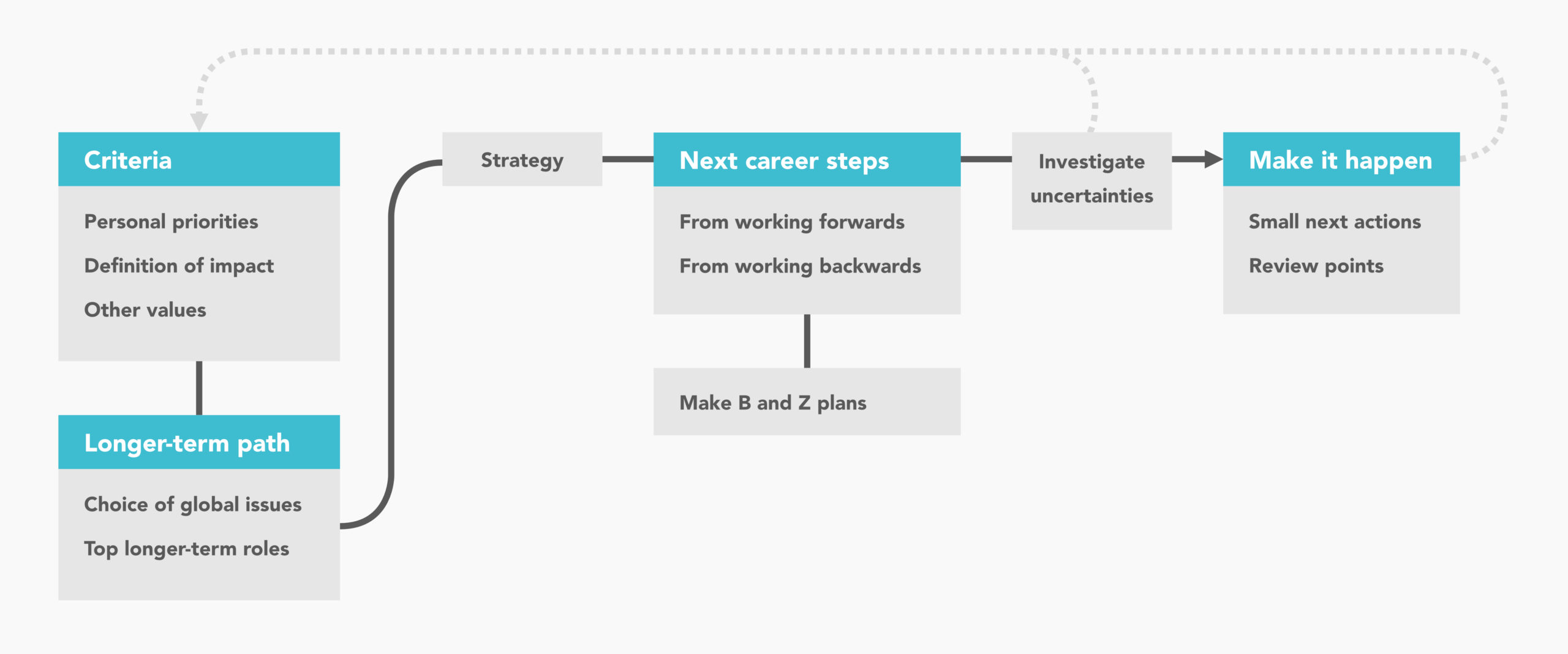
And here’s how the stages fit together

You might also be interested in

Continue reading →

Benjamin Todd on what the effective altruism community most needs (& how to analyse replaceability)

In the last ’80k team chat’ with Ben Todd and Arden Koehler, we discussed what effective altruism is and isn’t, and how to argue for it. In this episode we turn now to what the effective altruism community most needs.

According to Ben, we can think of the effective altruism movement as having gone through several stages, categorised by what kind of resource has been most able to unlock more progress on important issues (i.e. by what’s the ‘bottleneck’). Plausibly, these stages are common for other social movements as well.

  • Needing money: In the first stage, when effective altruism was just getting going, more money (to do things like pay staff and put on events) was the main bottleneck to making progress.
  • Needing talent: In the second stage, we especially needed more talented people being willing to work on whatever seemed most pressing.
  • Needing specific skills and capacity: In the third stage, which Ben thinks we’re in now, the main bottlenecks are organizational capacity, infrastructure, and management to help train people up, as well as specialist skills that people can put to work now.

What’s next? Perhaps needing coordination — the ability to make sure people keep working efficiently and effectively together as the community grows.

Ben and I also cover the career implications of those stages, as well as the ability to save money and the possibility that someone else would do your job in your absence.

Continue reading →

#87 – Russ Roberts on whether it’s more effective to help strangers, or people you know

If you want to make the world a better place, would it be better to help your niece with her SATs, or try to join the State Department to lower the risk that the US and China go to war?

People involved in 80,000 Hours or the effective altruism community would be comfortable recommending the latter. This week’s guest — Russ Roberts, host of the long-running podcast EconTalk, and author of a forthcoming book on decision-making under uncertainty and the limited ability of data to help — worries that might be a mistake.

I’ve been a big fan of Russ’ show EconTalk for 12 years — in fact I have a list of my top 100 recommended episodes — so I invited him to talk about his concerns with how the effective altruism community tries to improve the world.

These include:

  • Being too focused on the measurable
  • Being too confident we’ve figured out ‘the best thing’
  • Being too credulous about the results of social science or medical experiments
  • Undermining people’s altruism by encouraging them to focus on strangers, who it’s naturally harder to care for
  • Thinking it’s possible to predictably help strangers, who you don’t understand well enough to know what will truly help
  • Adding levels of wellbeing across people when this is inappropriate
  • Encouraging people to pursue careers they won’t enjoy

These worries are partly informed by Russ’ ‘classical liberal’ worldview, which involves a preference for free market solutions to problems, and nervousness about the big plans that sometimes come out of consequentialist thinking.

Continue reading →

If you care about social impact, why is voting important?

Could one vote — your vote — swing an entire election? Most of us abandoned this seeming fantasy not too long after we learned how elections work.

But the chances are higher than you might think. If you’re in a competitive district in a competitive election, the odds that your vote will flip a national election often fall between 1 in 1 million and 1 in 10 million.

That’s a very small probability, but it’s big compared to your chances of winning the lottery, and it’s big relative to the enormous impact governments can have on the world.

Each four years the United States federal government allocates $17,500,000,000,000, so a 1 in 10 million chance of changing the outcome of a US national election gives an average American some degree of influence over $1.75 million.

That means the expected importance of voting — the probability of changing an election’s result multiplied by the impact if you do — might, depending on your personal circumstances, be very high.

This could, in itself, be a good argument for voting.

Fortunately there is a significant amount of academic research on the importance of elections and how likely one vote is to change the outcome, so I’ve pulled it together to estimate the average value of one vote for the right person.

The answer, as you might expect, depends a great deal on the circumstances of any given election,

Continue reading →

#86 – Hilary Greaves on Pascal’s mugging, strong longtermism, and whether existing can be good for us

Had World War 1 never happened, you might never have existed.

It’s very unlikely that the exact chain of events that led to your conception would have happened if the war hadn’t — so perhaps you wouldn’t have been born.

Would that mean that it’s better for you that World War 1 happened (regardless of whether it was better for the world overall)?

On the one hand, if you’re living a pretty good life, you might think the answer is yes – you get to live rather than not.

On the other hand, it sounds strange to say that it’s better for you to be alive, because if you’d never existed there’d be no you to be worse off. But if you wouldn’t be worse off if you hadn’t existed, can you be better off because you do?

In this episode, philosophy professor Hilary Greaves – Director of Oxford University’s Global Priorities Institute – helps untangle this puzzle for us and walks me and Rob through the space of possible answers. She argues that philosophers have been too quick to conclude what she calls existence non-comparativism – i.e, that it can’t be better for someone to exist vs. not.

Where we come down on this issue matters. If people are not made better off by existing and having good lives, you might conclude that bringing more people into existence isn’t better for them, and thus, perhaps, that it’s not better at all.

This would imply that bringing about a world in which more people live happy lives might not actually be a good thing (if the people wouldn’t otherwise have existed) — which would affect how we try to make the world a better place.

Continue reading →

Benjamin Todd on the core of effective altruism and how to argue for it

Today’s episode is the latest conversation between Arden Koehler, and our CEO, Ben Todd.

Ben’s been thinking a lot about effective altruism recently, including what it really is, how it’s framed, and how people misunderstand it.

We recently released an article on misconceptions about effective altruism – based on Will MacAskill’s recent paper The Definition of Effective Altruism – and this episode can act as a companion piece.

Arden and Ben cover a bunch of topics related to effective altruism:

  • How it isn’t just about donating money to fight poverty
  • Whether it includes a moral obligation to give
  • The rigorous argument for its importance
  • Objections to that argument
  • How to talk about effective altruism for people who aren’t already familiar with it

Given that we’re in the same office, it’s relatively easy to record conversations between two 80k team members — so if you enjoy these types of bonus episodes, let us know at [email protected], and we might make them a more regular feature.

Continue reading →

Notes on good judgement and how to develop it

Judgement, which I roughly define as ‘the ability to weigh complex information and reach calibrated conclusions,’ is clearly a valuable skill.

In our simple analysis of which skills make people most employable, using data from the Bureau of Labor Statistics across the US economy, ‘judgement and decision making’ came out top (though meant in a broader sense than we do).

My guess is that good judgement is even more important when aiming to have a positive impact.

What follows are some notes on why good judgement matters, what it is, and what we know about how to improve it.

Why good judgement is so valuable when aiming to have an impact

One reason is lack of feedback. We can never be fully certain which issues are most pressing, or which interventions are most effective. Even in an area like global health – where we have relatively good data on what works – there has been huge debate over the cost effectiveness of even a straightforward intervention like deworming. Deciding whether to focus on deworming requires judgement.

This lack of feedback becomes even more pressing when we come to efforts to reduce existential risks or help the long-term future, and efforts that take a more ‘hits based’ approach to impact. An existential risk can only happen once, so there’s a limit to how much data we can ever have about what reduces them,

Continue reading →