

- Career advice & strategy (1,025)
- Ability (23)
- Accidental harm (27)
- Advice for undergraduates (49)
- Being ambitious (32)
- Career capital (202)
- Career planning (401)
- Community & coordination (174)
- Exploration (139)
- How to get a job (49)
- Job satisfaction (276)
- Leverage (6)
- Mental health (63)
- Now vs later (19)
- Personal fit (321)
- PhDs (23)
- Replaceability (9)
- Risk (117)
- Unconventional advice (8)
- World problems (481)
- AI-enabled power grabs (16)
- AI-enhanced decision making (12)
- Building a flourishing future (10)
- Building effective altruism (71)
- Catastrophic AI misuse (12)
- Civilisational resilience (20)
- Climate change (27)
- Engineered pandemics (46)
- Factory farming (28)
- Global health (70)
- Great power conflict (32)
- Institutional decision making (59)
- Moral status of digital minds (18)
- Nuclear war (36)
- Other pressing problems (141)
- Power-seeking AI systems (26)
- Prioritisation frameworks (34)
- S-risks (11)
- Space governance (8)
- Totalitarianism (23)
- Wild animal suffering (14)
- AI (192)
- Skill-building and career capital (658)
- Communicating ideas (30)
- Computer science (28)
- Early-stage startup employee (6)
- Economics (52)
- Economics PhD (7)
- Experience with an emerging power (60)
- Expertise relevant to a top problem (5)
- Fundraising (19)
- Graduate school (24)
- History (14)
- Law (15)
- Machine learning (32)
- Machine learning PhD (2)
- Organisation-building (12)
- Philanthropic advising (41)
- Philosophy (35)
- Policy and political skills (35)
- Psychology (15)
- Research (221)
- Skills (231)
- Software and tech skills (8)
- Statistics (4)
- Working at a foundation (12)
- Working in congress (4)
- Career paths (766)
- AI companies (25)
- AI hardware expertise (17)
- AI policy (105)
- AI safety technical research (90)
- Art & entertainment (7)
- Being a public intellectual (17)
- Biomedical research (33)
- Biorisk strategy & policy (41)
- Building the effective altruism community (21)
- China-related AI safety & governance (20)
- China-Western coordination (20)
- Communication (65)
- Computer science (7)
- Consulting (10)
- Data science (28)
- Earning to give (107)
- Engineering (10)
- Entrepreneurship (67)
- Finance (18)
- Founding a tech startup (35)
- Global priorities research (134)
- Government & policy (149)
- Grantmaking (26)
- High impact executive assistance (9)
- History of large societal trends (12)
- Information security (20)
- Journalism (28)
- Longtermist philanthropy (9)
- Marketing (6)
- Medicine (25)
- Operations (20)
- Organising an effective altruism group (1)
- Philosophy academia (13)
- Politics (57)
- Research in relevant areas (127)
- Research management (16)
- Software engineering (36)
- Specialist in emerging global powers (8)
- Think tank research (14)
- Web design (2)
- Foundations (493)
- Effective altruism (229)
- Existential risk (142)
- Future generations & longtermism (117)
- Moral patients (20)
- Moral philosophy (122)
- Reasoning and decision-making (130)
- Reasoning well (3)
- Other topics (326)
- About 80,000 Hours (71)
- Advocacy (56)
- Anonymous advice (19)
- COVID-19 (24)
- Doing good in your current job (109)
- Donating effectively (37)
- Forecasting (33)
- Income (30)
- Jobs at 80,000 Hours (39)
- User stories (4)
- Volunteering (13)
- Uncategorised (68)
Topic archive: Future generations & longtermism
Longtermism is an emerging school of thought according to which approaches to improving the world should be evaluated mainly in terms of their potential long-term impact, over thousands, millions, or even billions of years.
In other words, the question “How can I have a positive impact?” should mostly be replaced with “How can I best make the very long-term future go well?”
We think future generations clearly matter, and impartial concern most likely implies their interests matter as much as anyone’s.
Selected highlights


#6 – Toby Ord on why the long-term future of humanity matters more than anything else, and what we should do about it
Podcast by Robert Wiblin · Published September 6, 2017

The case for reducing existential risks
Article by Benjamin Todd · Last updated June 2022 · First published October 2017
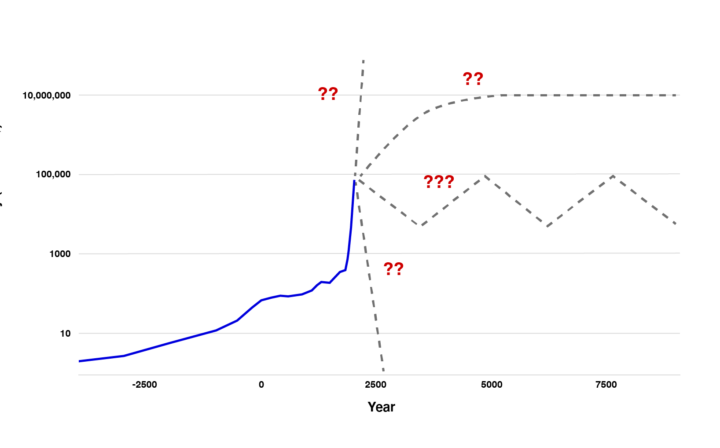
This could be the most important century
Article by Robert Wiblin · Published September 2021
All content tagged "Future generations & longtermism"
2026
October
September
August
June
April
- PodcastCareer reviewMarchFebruaryJanuary
2025
DecemberOctoberAugustJune- Blog postMayMarchJanuary
- Blog post
2024
October- ArticleSeptemberJuly
- PodcastMay
- PodcastPodcastBlog postMarch
- Podcast (80k After Hours)
January2023
DecemberOctober- PodcastSeptemberAugust
- Article
JulyJuneMay- Blog postFoundations: our most important and novel research on what makes for a high-impact career (First published)ArticlePodcastThe 80,000 Hours Podcast on Artificial Intelligence (First published)ArticleMarch
- ArticleBlog postWhat is social impact? A definition (Updated)Article
2022
NovemberOctober- Blog postSeptember
- Problem profileProblem profileProblem profileProblem profilePodcastProblem profileAugust
- Blog postJune
- PodcastThe case for reducing existential risks (Updated)ArticleMay
- PodcastMarch
- ArticleFebruary
- PodcastProblem profile
2021
DecemberNovemberOctober- PodcastSeptemberAugust
- PodcastJulyJuneMay
- PodcastMarch
- ArticlePodcastFebruaryJanuary
2020
December- PodcastEffective Altruism: An Introduction — ten curated episodes from The 80,000 Hours Podcast (First published)ArticleOctoberSeptemberAugust
- Blog postJulyAprilMarch
- PodcastPodcastJanuary
2019
December- PodcastSeptember
- PodcastAugustJune
- PodcastApril
2018
October- PodcastSeptemberJulyMay
- PodcastMarchJanuary
2017
DecemberOctober- The case for reducing existential risks (First published)ArticlePodcastSeptemberAugust
- Article
July- Is it fair to say that most social programmes don’t work? (First published)Article
2016
January2015
DecemberJune2014
October2013
October- Blog post
August2012
AugustJanuary