Catastrophic AI misuse



We’re looking for someone to build and lead 80,000 Hours’ recruiting function from scratch.
We’d like to make 15–25 strong hires each year through a recruiting team. Currently, we make around 10 hires — each of which represents a very large investment in capacity from team leads — which is a major bottleneck on our growth.
Our ideal candidate can solve the problems, hire the team, and build the systems needed to pull this off. So we expect this to be a challenging role which will require substantial relevant experience.
We’re looking for someone who has experience with:
We expect that you’ll initially report to Brenton Mayer (COO) and then transition to reporting to Sashika Coxhead (Head of People Operations) when she returns from maternity leave.
If you meet all three of the criteria mentioned above,
80,000 Hours’ aim is to help people find careers that tackle the world’s most pressing problems. To do this, one thing we do is maintain a public list of what we see as the issues where additional people can have the greatest positive impact.
We’ve just made significant updates to our list. Here are the biggest changes:

About half of people are worried they’ll lose their job to AI. And they’re right to be concerned: AI can now complete real-world coding tasks on GitHub, generate photorealistic video, drive a taxi more safely than humans, and do accurate medical diagnosis. And over the next five years, it’s set to continue to improve rapidly. Eventually, mass automation and falling wages are a real possibility.
But what’s less appreciated is that while AI drives down the value of skills it can do, it drives up the value of skills it can’t. Wages (on average) will increase before they fall, as automation generates a huge amount of wealth, and the remaining tasks become the bottlenecks to further growth. As I’ll explain, ATMs actually increased employment of bank clerks — until online banking automated the job much more.
Your best strategy is to learn the skills that AI will make more valuable, trying to ride the wave of automation. So what are those skills? Here’s a preview:
Skills most likely to increase in value as AI progresses
These will be especially valuable when combined with knowledge of fields needed for AI including machine learning, cyber & information security, data centre & power plant construction, robotics development and maintenance, and (lesso) fields that could expand a lot given economic growth.
In contrast, the future for these skills seems a lot more uncertain:

For decades, US allies have slept soundly under the protection of America’s overwhelming military might. Donald Trump — with his threats to ditch NATO, seize Greenland, and abandon Taiwan — seems hell-bent on shattering that comfort.
But according to Hugh White — one of the world’s leading strategic thinkers, emeritus professor at the Australian National University, and author of Hard New World: Our Post American Future — Trump isn’t destroying American hegemony. He’s simply revealing that it’s already gone.
“Trump has very little trouble accepting other great powers as co-equals,” Hugh explains. And that happens to align perfectly with a strategic reality the foreign policy establishment desperately wants to ignore: fundamental shifts in global power have made the costs of maintaining a US-led hegemony prohibitively high.
Even under Biden, when Russia invaded Ukraine, the US sent weapons but explicitly ruled out direct involvement. Ukraine matters far more to Russia than America, and this “asymmetry of resolve” makes Putin’s nuclear threats credible where America’s counterthreats simply aren’t.
Hugh’s gloomy prediction: “Europeans will end up conceding to Russia whatever they can’t convince the Russians they’re willing to fight a nuclear war to deny them.”
The Pacific tells the same story. Despite Obama’s “pivot to Asia” and Biden’s tough talk about “winning the competition for the 21st century,” actual US military capabilities there have barely budged while China’s have soared, along with its economy — which is now bigger than the US’s, as measured in purchasing power. Containing China and defending Taiwan would require America to spend 8% of GDP on defence (versus 3.5% today) — and convince Beijing it’s willing to accept Los Angeles being vaporised. Unlike during the Cold War, no president — Trump or otherwise — can make that case to voters.

We recently argued that AGI could be here by 2030.
And we’re not the only ones — CEOs of leading AI labs and many AI researchers are saying similar things.
But many people disagree, and there’s a good chance that AGI won’t be here by 2030. Some think it could still be decades away.
So what are the reasons to expect a longer path to AGI?
Reason 1: The path to AGI isn’t obvious
Today’s AI systems can write excellent code, produce research reports, and do Nobel Prize-worthy work in protein folding.
But frontier systems still can’t:
In other words, we don’t yet have AGI — AI systems with general intelligence that can reliably replace humans on a wide range of tasks.
In 2024, OpenAI’s Sam Altman declared, “we are now confident we know how to build AGI.” But how will we get there?
Some people think that we can build AGI by scaling up existing models. But others argue that scaling has only seriously improved AI performance in areas like software engineering, where the tasks are clearly defined and often quickly verifiable.

AI models today have a 50% chance of successfully completing a task that would take an expert human one hour. Seven months ago, that number was roughly 30 minutes — and seven months before that, 15 minutes.
These are substantial, multi-step tasks requiring sustained focus: building web applications, conducting machine learning research, or solving complex programming challenges.
Today’s guest, Beth Barnes, is CEO of METR (Model Evaluation & Threat Research) — the leading organisation measuring these capabilities.
Beth’s team has been timing how long it takes skilled humans to complete projects of varying length, then seeing how AI models perform on the same work.
The resulting paper from METR, “Measuring AI ability to complete long tasks,” made waves by revealing that the planning horizon of AI models was doubling roughly every seven months. It’s regarded by many as the most useful AI forecasting work in years.
The companies building these systems aren’t just aware of this trend — they want to harness it as much as possible, and are aggressively pursuing automation of their own research.
That’s both an exciting and troubling development, because it could radically speed up advances in AI capabilities, accomplishing what would have taken years or decades in just months. That itself could be highly destabilising, as we explored in a previous episode: Will MacAskill on AI causing a “century in a decade” — and how we’re completely unprepared.
And having AI models rapidly build their successors with limited human oversight naturally raises the risk that things will go off the rails if the models at the end of the process lack the goals and constraints we hoped for.
We’re excited to announce that 80,000 Hours has completed its spin-out from Effective Ventures (EV) and is now operating as an independent organisation. We announced this decision here in December 2023 and we’ve now concluded spinning out from our parent organisation. We’re deeply grateful to the Effective Ventures leadership and team for their support, especially during the complex transition process over the past year.
Our new structure
We’ve established two new UK entities, each with their own board:
Our new boards
Board of Directors (80,000 Hours Limited):
Board of Trustees (80,000 Hours Foundation):

What if there’s something it’s like to be a shrimp — or a chatbot?
For centuries, humans have debated the nature of consciousness, often placing ourselves at the very top. But what about the minds of others — both the animals we share this planet with and the artificial intelligences we’re creating?
We’ve pulled together clips from past conversations with researchers and philosophers who’ve spent years trying to make sense of animal consciousness, artificial sentience, and moral consideration under deep uncertainty.
You’ll hear from:

OpenAI’s recent announcement that its nonprofit would “retain control” of its for-profit business sounds reassuring. But this seemingly major concession, celebrated by so many, is in itself largely meaningless.
Litigator Tyler Whitmer is a coauthor of a newly published letter that describes this attempted sleight of hand and directs regulators on how to stop it.
As Tyler explains, the plan both before and after this announcement has been to convert OpenAI into a Delaware public benefit corporation (PBC) — and this alone will dramatically weaken the nonprofit’s ability to direct the business in pursuit of its charitable purpose: ensuring AGI is safe and “benefits all of humanity.”
Right now, the nonprofit directly controls the business. But were OpenAI to become a PBC, the nonprofit, rather than having its “hand on the lever,” would merely contribute to the decision of who does.
Why does this matter? Today, if OpenAI’s commercial arm were about to release an unhinged AI model that might make money but be bad for humanity, the nonprofit could directly intervene to stop it. In the proposed new structure, it likely couldn’t do much at all.
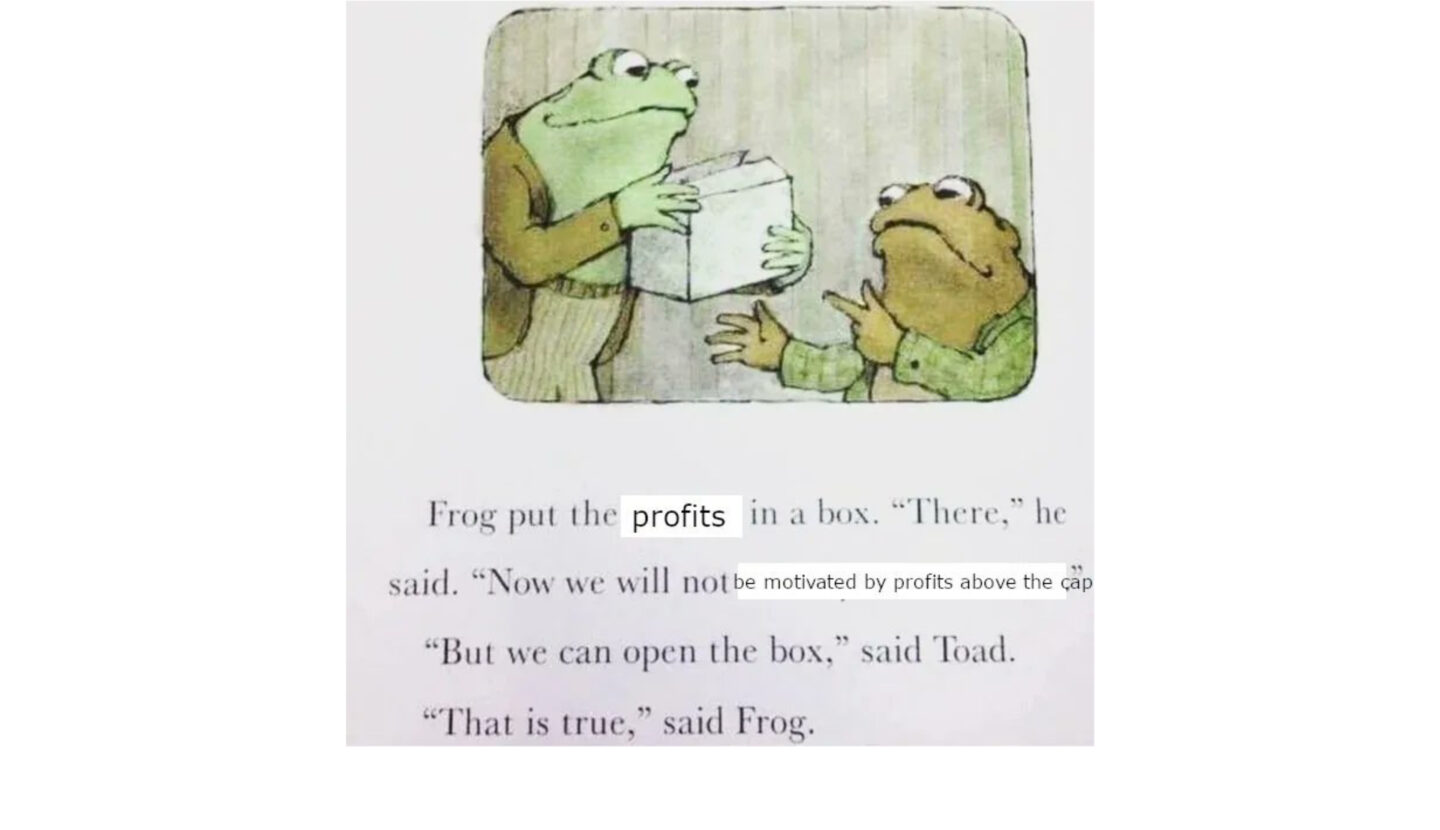
But it’s even worse than that: even if the nonprofit could select the PBC’s directors, those directors would have fundamentally different legal obligations from those of the nonprofit. A PBC director must balance public benefit with the interests of profit-driven shareholders — by default, they cannot legally prioritise public interest over profits, even if they and the controlling shareholder that appointed them want to do so.
When attorneys general intervene in corporate affairs, it usually means something has gone seriously wrong. In OpenAI’s case, it appears to have forced a dramatic reversal of the company’s plans to sideline its nonprofit foundation, announced in a blog post that made headlines worldwide.
The company’s sudden announcement that its nonprofit will “retain control” credits “constructive dialogue” with the attorneys general of California and Delaware — corporate-speak for what was likely a far more consequential confrontation behind closed doors. A confrontation perhaps driven by public pressure from Nobel Prize winners, past OpenAI staff, and community organisations.
But whether this change will help depends entirely on the details of implementation — details that remain worryingly vague in the company’s announcement.
Return guest Rose Chan Loui, nonprofit law expert at UCLA, sees potential in OpenAI’s new proposal, but emphasises that “control” must be carefully defined and enforced: “The words are great, but what’s going to back that up?” Without explicitly defining the nonprofit’s authority over safety decisions, the shift could be largely cosmetic.
Why have state officials taken such an interest so far? Host Rob Wiblin notes, “OpenAI was proposing that the AGs would no longer have any say over what this super momentous company might end up doing. … It was just crazy how they were suggesting that they would take all of the existing money and then pursue a completely different purpose.”
Now that they’re in the picture, the AGs have leverage to ensure the nonprofit maintains genuine control over issues of public safety as OpenAI develops increasingly powerful AI.

When you have a system where ministers almost never understand their portfolios, civil servants change jobs every few months, and MPs don’t grasp parliamentary procedure even after decades in office — is the problem the people, or the structure they work in?
Today’s guest, political journalist Ian Dunt, studies the systemic reasons governments succeed and fail.
And in his book How Westminster Works …and Why It Doesn’t, he argues that Britain’s government dysfunction and multi-decade failure to solve its key problems stems primarily from bad incentives and bad processes. Even brilliant, well-intentioned people are set up to fail by a long list of institutional absurdities.
For instance:

How do you navigate a career path when the future of work is uncertain? How important is mentorship versus immediate impact? Is it better to focus on your strengths or on the world’s most pressing problems? Should you specialise deeply or develop a unique combination of skills?
From embracing failure to finding unlikely allies, we bring you 16 diverse perspectives from past guests who’ve found unconventional paths to impact and helped others do the same.
You’ll hear from:

Why this role?
80,000 Hours provides free research and support to help people find careers tackling the world’s most pressing problems, especially mitigating risks from advanced artificial intelligence.
Since we started investing much more in growth in 2022, we’ve increased the hours that people spend engaging with our content by 6.5x, reached millions of new users across different platforms, and now have over 500,000 newsletter subscribers. We’re also the largest single source of people getting involved in the effective altruism community, according to the most recent EA Survey.
Even so, it seems like there’s considerable room to reach more people — and there are many exciting growth projects we’re unable to take on because of low capacity on our team. So, we’re looking for a new Engagement Specialist to help us ambitiously increase the amount of engagement with our advice and our impact.
We anticipate that the right person in this role could help us massively increase our readership, and lead to hundreds or thousands of additional people pursuing high-impact careers.
As some indication of what success in the role might look like, over the next couple of years you might have:

Throughout history, technological revolutions have fundamentally shifted the balance of power in society. The Industrial Revolution created conditions where democracies could dominate for the first time — as nations needed educated, informed, and empowered citizens to deploy advanced technologies and remain competitive.
Unfortunately there’s every reason to think artificial general intelligence (AGI) will reverse that trend.
In a new paper published today, Tom Davidson — senior research fellow at the Forethought Centre for AI Strategy — argues that advanced AI systems will enable unprecedented power grabs by tiny groups of people, primarily by removing the need for other human beings to participate.
When a country’s leaders no longer need citizens for economic production, or to serve in the military, there’s much less need to share power with them. “Over the broad span of history, democracy is more the exception than the rule,” Tom points out. “With AI, it will no longer be important to a country’s competitiveness to have an empowered and healthy citizenship.”
Citizens in established democracies are not typically that concerned about coups. We doubt anyone will try, and if they do, we expect human soldiers to refuse to join in. Unfortunately, the AI-controlled military systems of the future will lack those inhibitions. As Tom lays out, “Human armies today are very reluctant to fire on their civilians. If we get instruction-following AIs, then those military systems will just fire.”
Why would AI systems follow the instructions of a would-be tyrant? One answer is that, as militaries worldwide race to incorporate AI to remain competitive, they risk leaving the door open for exploitation by malicious actors in a few ways:

Help make spectacular videos that reach a huge audience.
We’re looking for someone to contract as a video editor, who can quickly learn our style and make our videos successful on shortform video platforms. We want these videos to start changing and informing the conversation about transformative AI and AGI.
Why this role?
In 2025, 80,000 Hours is planning to focus especially on helping explain why and how our audience can help society safely navigate a transition to a world with transformative AI. Right now not nearly enough people are talking about these ideas and their implications.
A great video program could change this. Time spent on the internet is increasingly spent watching video, and for many people in our target audience, video is the main way that they both find entertainment and learn about topics that matter to them.
To get our video program off the ground, we need great editors who understand our style and vision and can work quickly and to a high standard.
Responsibilities
About you
We’re looking for someone who ideally has:
If you don’t have experience here but think you’d be a great fit,

Which industry has the highest paying jobs?
Simple question. Hard to answer.
Until recently, good data wasn’t available: tax returns weren’t consistently categorised by job type until 2005.
Many rankings of the highest-paying jobs are based on job seeker surveys from GlassDoor, and this almost entirely misses the highest-earning people.
Other rankings, such as this one by US News, use median earnings rather than the mean, making them uninformative for industries with a wide spread of earnings.
The government’s Bureau of Labor Statistics (BLS) is much better, but it still doesn’t properly sample the highest-earning people. It also uses overly narrow categories –- “CEO” is one of the highest-earning jobs even thought CEO isn’t a career path you can enter.
But we’ve got hold of a forthcoming paper by three economists, Benjamin Lockwood (UPenn), Charles Nathanson (Northwestern University) and Glen Weyl (Yale) that combines the BLS figures with new tax data to accurately estimate the whole income distribution of the 11 highest-earning professions. This is the best ranking we’re currently aware of.
In this article, we explore this data, and how it could be used to estimate the expected lifetime income of different professions.
At 80,000 Hours, we help people we find fulfilling careers with positive impact. Earning more money only makes you a little happier, but it can be used to have a big positive impact.
Within 5 years, there’s a real chance that AI systems will be created that cause explosive technological and economic change. This would increase the risk of disasters like war between US and China, concentration of power in a small minority, or even total loss of human control over the future.
Many people — with a diverse range of skills and experience — are urgently needed to help mitigate these risks.
I think you should consider making this the focus of your career.
This article explains why.
1) World-changing AI systems could come much sooner than people expect
In an earlier article I explained why there’s a significant chance that AI could contribute to scientific research or automate many jobs by 2030. Current systems can already do a lot, there are clear ways to continue to improve them in the coming years. Forecasters and experts widely agree that the probability of widespread disruption is much higher than it was even just a couple of years ago.
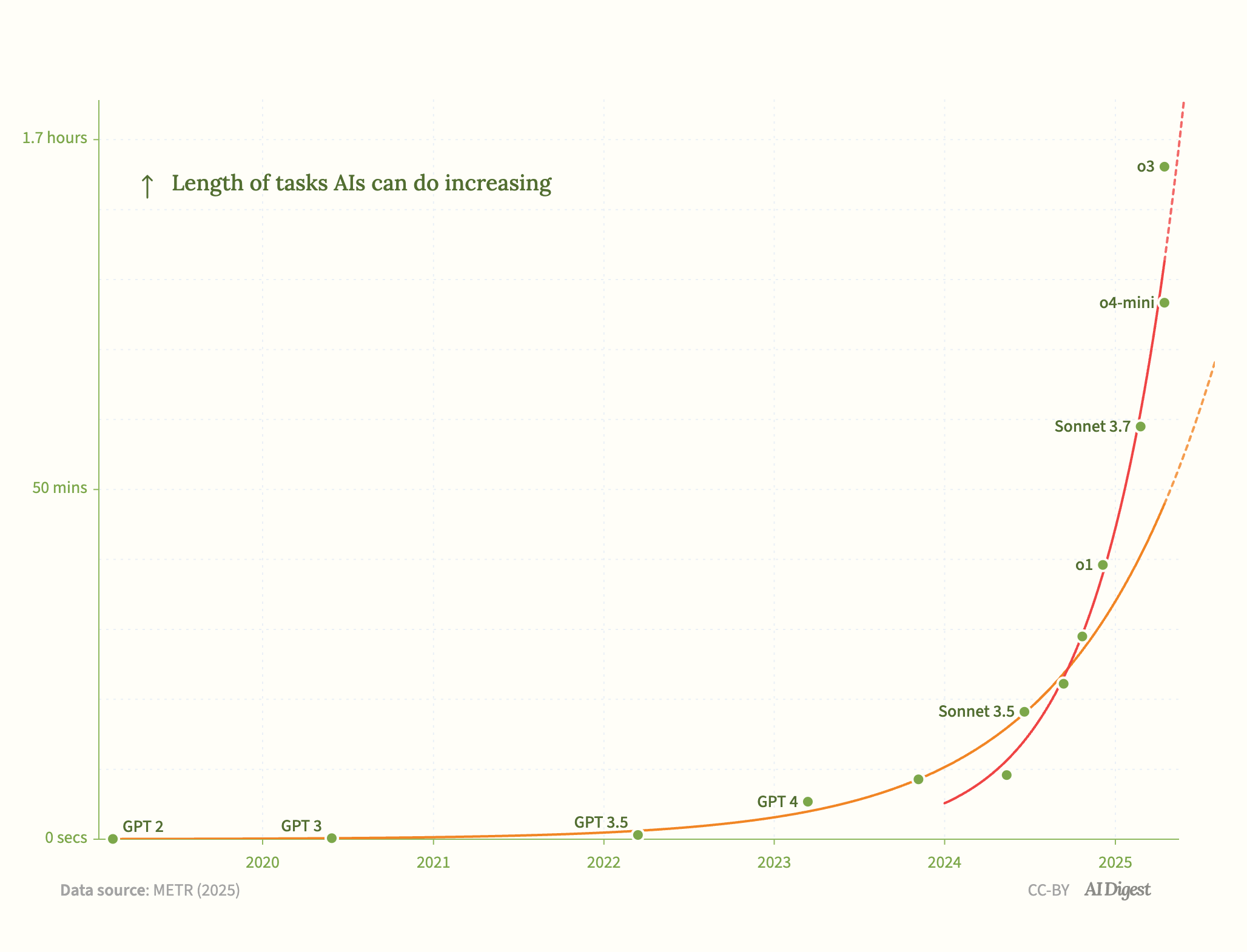 AI systems are rapidly becoming more autonomous, as measured by the METR time horizon benchmark. The most recent models, such as o3, seem to be on an even faster trend that started in 2024.
2) The impact on society could be explosive
People say AI will be transformative,

What happens when your desire to do good starts to undermine your own wellbeing?
Over the years, we’ve heard from therapists, charity directors, researchers, psychologists, and career advisors — all wrestling with how to do good without falling apart. Today’s episode brings together insights from 16 past guests on the emotional and psychological costs of pursuing a high-impact career to improve the world — and how to best navigate the all-too-common guilt, burnout, perfectionism, and imposter syndrome along the way.
You’ll hear from:

Most AI safety conversations centre on alignment: ensuring AI systems share our values and goals. But despite progress, we’re unlikely to know we’ve solved the problem before the arrival of human-level and superhuman systems in as little as three years.
So some are developing a backup plan to safely deploy models we fear are actively scheming to harm us — so-called “AI control.” While this may sound mad, given the reluctance of AI companies to delay deploying anything they train, not developing such techniques is probably even crazier.
Today’s guest — Buck Shlegeris, CEO of Redwood Research — has spent the last few years developing control mechanisms, and for human-level systems they’re more plausible than you might think. He argues that given companies’ unwillingness to incur large costs for security, accepting the possibility of misalignment and designing robust safeguards might be one of our best remaining options.
Buck asks us to picture a scenario where, in the relatively near future, AI companies are employing 100,000 AI systems running 16 times faster than humans to automate AI research itself. These systems would need dangerous permissions: the ability to run experiments, access model weights, and push code changes. As a result, a misaligned system could attempt to hack the data centre, exfiltrate weights, or sabotage research. In such a world, misalignment among these AIs could be very dangerous.
But in the absence of a method for reliably aligning frontier AIs, Buck argues for implementing practical safeguards to prevent catastrophic outcomes. His team has been developing and testing a range of straightforward, cheap techniques to detect and prevent risky behaviour by AIs — such as auditing AI actions with dumber but trusted models, replacing suspicious actions, and asking questions repeatedly to catch randomised attempts at deception.