

This is your most important decision
Why your career is your biggest opportunity to make a difference to the world

When people think of living ethically, they most often think of things like recycling, fair trade, and volunteering.
But that’s missing something huge: your choice of career.
We believe that what you do with your career is probably the most important ethical decision of your life.
This was true 10 years ago, but as we stand on the brink of human-level AI, we’ll argue it’s even more true today.
The first reason is the huge amount of time at stake. You have about 80,000 hours in your career: 40 hours per week, 50 weeks per year, for 40 years. That’s more time than you’ll spend eating, socialising, and watching Netflix put together.
And it means (unless you happen to be the heir to a large estate) that time is the biggest resource you have to help others.
So if you can increase the overall impact of your career by just a tiny amount, it will likely do more good than changes you could make to other parts of your life.
Or, to look at it another way, it’s worth thinking a lot about how to make even just small improvements to your career. For instance, if you could increase the impact of your career by 1%, it would be worth spending up to 800 hours working out how to do that.
And that brings us to the second reason why your choice of career is so important: some careers give you the opportunity to do vastly more good for the world than others — to a much greater extent than people realise.
In fact, we’ll argue that some career paths open to you likely have 10 or 100 or even 1,000 times more impact than others. And this makes it even more important to think hard about your career.
Why do careers differ so much in impact?
Table of Contents
How to compare careers in terms of impact: a framework
We think the impact you can have in different careers is driven by three main factors:
- How pressing the problems are that you focus on
- The scale of the contribution the path enables you to make
- Your personal fit for the path
In our experience, your options probably vary a great deal based on each of these three factors.
This claim requires some argument. And when we first encountered these arguments, we were unsure they’d hold up. But over time we’ve come to believe that, despite the uncertainties involved, large differences really exist. We present the arguments in various articles throughout the site (especially in our foundations series), but here is a brief summary of our bottom lines:
- It’s usually assumed that you can’t compare the importance of different global issues, like climate change or education, and you should just do what you’re passionate about. But with rough estimates, you can show that some problems are much bigger than others, and some are much more neglected than others. For example, climate change receives around 100 times more resources than efforts to prevent a pandemic worse than COVID-19. The bigger and more neglected an issue is, the greater the chance that an additional person can have an impact. This means that by focusing on these big but unconventional issues — like engineered pandemics, AI alignment, or space governance — you can set yourself up to have a much bigger impact.
When we think of doing good with our careers, people often first think of becoming a doctor, teacher, or charity worker. But by being open to more indirect routes to impact, it’s often possible to contribute on a greater scale — even if you’re not in a traditional social impact job. For instance, changing policy can allow you to influence hundreds of times more resources than most standard do-gooding careers.
The most productive people in a career tend to achieve far more than average. So by applying the best ways to predict your fit, exploring different paths, and investing in your skills early in your career, you can likely find something you’re much better at and increase your impact several times over.
These differences are not widely appreciated. When you poll people about how much more effective they think the best development charities are at saving lives compared to the average, they guess they’re about 50% better. A noticeable difference, but not huge. Poll experts in global health, however, and they’ll say the best are around 100 times more cost effective, a difference of 10,000%. In short, there are huge differences in the impact of different ways of helping people, but no one knows about them.
The compounding returns to finding the right career
Given how they’re defined, the three factors multiply together rather than merely add.
If you can eventually find a problem that’s twice as big or neglected, make twice as big a contribution to it, and find a path where your personal fit for your job means your chances of success are twice as high, then (holding all else equal) you can expect to have eight times as much impact.
One implication of this is that if a path scores near zero on one of the factors, then its overall impact is low. This means it’s very easy to ‘give up’ most of your impact by not paying attention to all the factors. But this also means that if you can make improvements on one dimension, it’ll multiply with improvements you make on the others.
In practice, it’s often not possible to find an option that’s better in every dimension. For instance, by changing the problem area you’re working on, you might have less confidence in your fit. And there are some reasons to be sceptical of claims of outsized differences that we’ve covered elsewhere in the series, such as regression to the mean and epistemic humility. All considered, however, we think it’s often achievable to find a path that is 10 times more impactful — and sometimes over 100 times more impactful — than what you’re currently doing. This might not even involve changing job, but simply better directing your efforts within your current role.
It’s easy to gloss over these differences. Intuitively, people often group careers into those that ‘help’ (e.g. doctor, charity worker, teacher), those that are neutral (e.g. accountant), and those that are unethical (e.g. oil baron).
This is driven by a common psychological bias known as scope neglect. Helping 100 people feels about as satisfying as helping 1,000, even though the latter is 10 times more impactful.
But if, even among careers that help, some are 10 or 100 times more impactful than others, it’s vital to try to overcome our biases and take these differences seriously. It could mean saving 100 times more lives, reducing carbon emissions 100 times as much, or making 100 times more progress reducing the biggest risks facing humanity.
These differences may not be the only ethically relevant factors, and everyone has priorities in life besides their impact on the world, but they do really matter.
Here’s another way to see their significance: if it’s possible to find an option that’s 100 times higher impact than the option you currently think is best, then 10 years in that higher-impact path would achieve what could have otherwise taken you 1,000 years. You could then spend the next 30 years doing whatever makes you happiest, and still have done far more to help than you otherwise would have. Most importantly, if you can help 100 people instead of 10, that matters a lot to the 90 extra people.
As a lower bound, our article on ways anyone can make a difference, no matter their job shows it really is possible for typical college graduates in rich countries to save the lives of tens of other people over their careers by donating to carefully chosen charities. And if you also have the good fortune to be able to make changes to your career, we think it’s possible to do substantially more good again. Few other decisions in life have such big implications.
We may now be on the brink of human-level AI. In the next three to ten years, we face risks from AI that could kill a large fraction of people, such as AI-enabled bioweapons, or others that could permanently disempower humanity, such as concentration of power into a small minority of companies, or loss of control of autonomous AI agents. These risks only have a few thousand people working on them at best, making them over 100 times more neglected than global health.
People joke we may now only have 8,000 hours left in our careers. But if true, these are the years in which your choices matter most. They’re your chance to help humanity navigate its most dangerous moment.
The personal stakes have increased too. Gen Z are more pessimistic than ever, and over half of people are worried their job will be automated. They’re right to be concerned. The traditional answers — law, medicine, consulting — no longer obviously make sense like they once did. But AI tools have also made it possible for teams of three to accomplish what would have taken thirty before, and the value of the skills needed to do that are increasing dramatically. As the pace of change accelerates, small differences in your decisions get magnified.
Why not to focus on cutting your carbon footprint (or other lifestyle changes)
At this point, you might be wondering: what about the common advice to focus on changing our behaviour and personal consumption, such as by cycling to work instead of driving, buying ethical products, and reducing our carbon footprint?
One problem is that many of these actions achieve very little. Using a canvas bag instead of a plastic one every day for three years would reduce your CO2 emissions by about 0.01 tonnes. In contrast, a single transatlantic flight emits about 160 times as much.1 And the non-climate environmental impacts of manufacturing the canvas bag, such as on water pollution, may well be worse.2
The bigger problem is that even if you took this to the extreme and decided to live in the woods and never emit any CO2 ever again, you’d only be removing the emissions of one person: less than 15 tonnes per year in the US and about 7 in Europe.3
By contrast, donating 10% of a $70,000 salary to purchase carbon credits — which cost under $100 per tonne in the EU and create a legal obligation for companies to emit less — would reduce emissions by 70 tonnes per year, about 7 times as much as entirely eliminating your personal emissions.4
And it’s probably possible to do a lot better. Founders Pledge, a nonprofit that provides philanthropic advice, has researched which charities most effectively reduce CO2 emissions. They’re sceptical about many of the options, but believe that exceptional organisations, such as the Clean Air Task Force, which advocates for greater investment in neglected clean energy technology, have reduced emissions for under $10 per tonne in the past. At that rate, donating 10% of your income would reduce emissions by over 700 tonnes of CO2 per year — 70 times more than your personal emissions.5
This example is for a 10% donation, but if you use your career to work directly on those solutions, that’s worth a lot more to the cause than $7,000 per year. So, by changing your career, it’s most likely possible to reduce CO2 emissions by hundreds or even thousands of times as much as you would by changing your lifestyle — making that decision hundreds of times more important to get right.
The third problem is that the issues you can affect with your consumption may not be the most crucial to focus on in the first place. We’ve shown elsewhere that a donation of $7,000 per year can also save about two lives per year from malaria. And we’ve also argued there are even bigger and more neglected global problems than climate change. But many of these issues — like preventing an engineered pandemic — won’t be affected by what you happen to buy in a supermarket (or not).
If you want to make a difference, the most important decision to get right is your choice of career, followed by where to donate and what ideas to spread, followed by volunteering, and finally followed by what you choose to consume.
But most discussions of making a difference do the reverse: they start with the idea that “every little bit helps,” when in reality, every little bit only helps a little. If you have the option, focus on the big decisions first.
If such big differences exist, why are they not more widely appreciated?
It might sound unbelievable that some careers open to you might do 100 or 1,000 times as much good for the world as others, especially while being similarly satisfying. We certainly aren’t 100% positive this is right, but we’ve become more confident since we first heard the arguments.
If these differences really exist, though, why are they not more widely known?
We think it’s because our common-sense understanding of what it means to live ethically stems from hundreds — if not thousands — of years ago, and it hasn’t caught up with the power that many of us now have.
The massive economic and technological bounty of the Industrial Revolution means that today, many ordinary citizens of rich countries have what would have been kinglike wealth and power in previous centuries.
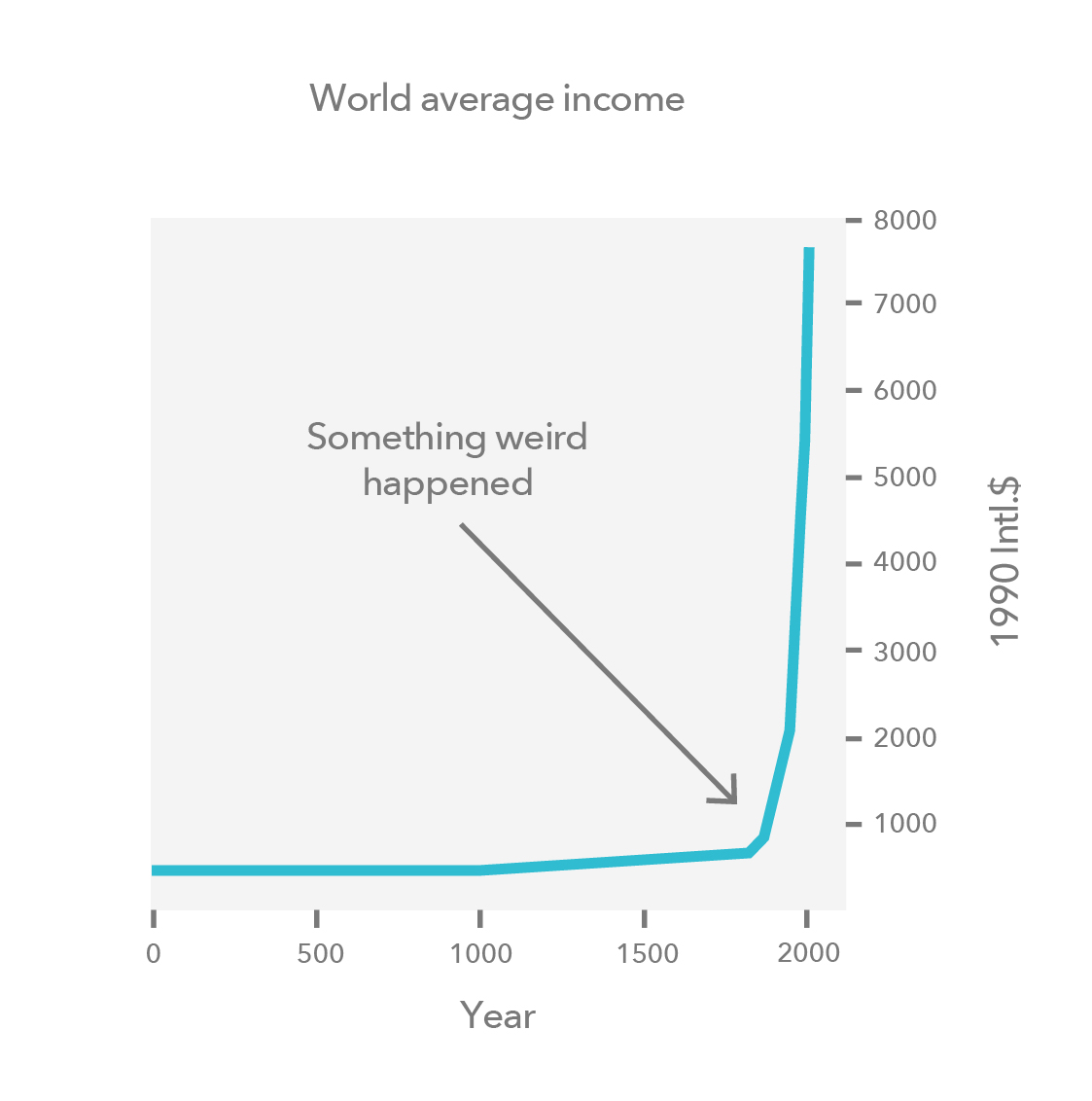
Our generation can:
- Wreck the climate for thousands of years, or build a sustainable economy that supports a greater standard of living for all.
Continue to expand factory farming, or eradicate it.
Allow technologies like nuclear weapons to end civilisation, or usher in a future better than we can easily imagine.
The above mostly did not hold as recently as the 1940s. Looking forward, there’s a good case to be made that these crucial technological junctures will make the next century among the most important in history.
Our aim is to help people like you understand your new power. There are real jobs you might be able to take that can help change the course of history on these vital issues.
This is not an easy path, but it is a worthwhile one.
Finding the best path for you requires exploring, investing in yourself, taking risks, and making hard tradeoffs.
We’ve often felt racked with uncertainty about what to do, and overwhelmed at the scale of the issues. But we’ve also found meaning and satisfaction in our efforts, especially as more and more people have united around them.
We still have a lot to learn, but we hope that by sharing what we’ve learned so far we can help you avoid the mistakes we’ve made and speed you along your path to an impactful career.
You have 80,000 hours in your career. Make them count.
Read next
This article is part of our foundations series. See the full series, or keep reading:



Notes and references
- According to the 2020 Founders Pledge Climate & Lifestyle Report, reusing a plastic bag 1,000 times (approximately three years) saves about 0.01 tonnes of CO2.↩
- An investigation by the Danish government concluded that a conventional cotton cloth bag would need to be re-used fifty-two times to have the same carbon impact as a regular LDPE plastic bag, and 7,000 times to be equivalent in terms of ten-plus other environment impacts, including water eutrophication and resource depletion. Organic cotton bags needed to be re-used 20,000 times.
Here is also a meta-analysis comparing different types of bags that found similar results for their climate impacts.
If the concern is ocean plastic pollution, that almost all comes from certain locations in Asia where plastic is allowed to escape into waterways. Europe accounts for only 0.5% of all ocean plastic, because plastic is put into landfill in those countries. In addition, plastic bags make up a small fraction of all plastic use, so should account for a small fraction of ocean plastic waste (for example, 20–30% of ocean plastic waste is from fishing).
For more, see: ourworldindata.org/ocean-plastics↩
- These calculations include emissions from transport, electricity generation, and heating, but not land-use change such as deforestation. Emissions from international aviation and shipping are not included. “Co₂ Emissions per Capita.” Our World in Data, archive.ph/f6wHz. Archived link retrieved 10 October 2025.
These amounts are also in sharp decline.↩
- Assuming average personal emissions are about 10 tons per year.↩
- A common response is that you should change your personal consumption because it sets as an example for others, potentially encouraging behaviour change on a wider scale. That, however, applies to whatever you do. If instead you donate to the world’s most effective climate charities, that could encourage others to do the same, raising even more money than you would donate individually. My guess is that the latter effect would be larger, because it’s a more striking and unusual signal. Everyone has already been told to reduce their carbon footprint many times in their life, making it relatively hard to cause more behaviour change of this kind.↩