

How to get good at something useful: Part 8 Which skills will be most valuable in the future?

Table of Contents
Ten years ago we told a lot of people they should learn to code. This worked out well for those who did: software engineering jobs grew rapidly for years afterwards.1 But today, the question of whether to learn to code is much more ambiguous.
As I write this, the best AI models can already complete short, real-world coding tasks better than most human experts. But by the time you read this, that sentence will almost certainly be out of date. And these changes don’t only concern coders. Around half of people are worried they’ll lose their job to AI,2 and they’re right to be concerned.
AI can now generate photorealistic videos, drive a taxi more safely than humans, and perform accurate medical diagnoses.3 Although many economists still dismiss the possibility, experts in the technology itself believe it will be possible to eventually build AI and robotic systems that will be able to do every economically important task more efficiently than humans.
Many assume this will drive down wages. But the reality is more complicated. Even if wages do eventually fall, that’ll likely be preceded by a period in which automation generates a huge amount of wealth, driving wages up on average. During that period, as AI drives down the value of skills it has mastered, it’ll drive up the value of skills it hasn’t.
As a job-seeker, your best strategy is to learn skills that AI will make more valuable, staying one step ahead of automation. It’s hard to predict exactly what those skills will be, but I think an even bigger mistake would be to ignore what’s happening.
You shouldn’t be training as a lawyer, accountant, financial analyst, actuary, writer, translator, or graphic designer right now without giving serious thought to the effects of AI.
Just as in 2015 it was possible to say that coding and data science were sectors with huge growth potential,4 it’s possible to make similar (if not certain) bets now about the skills that will put you in the best position over the next 10 years. That’s what we’ll explore here.
But to understand how automation will change the economy in the future, we first need to understand how it has transformed it in the past.
Reading time: 20 minutes — or see our video version of this chapter:
The bottom line:
Which skills will be most valuable in the future?
The skills that will be most valuable in the future are those that are useful in the most impactful jobs; fast to learn relative to their value; transferable; and that AI is likely to make more, rather than less, valuable.
The skills that will increase in value due to AI are those that are hard to automate (because they are messy, involve doing work over a long time-horizon, or require human judgement), needed for AI deployment, or can be used to produce things people always want more of.
Some especially transferable skills that are valuable in any job:
- Deploying AI to solve real-world problems
- Taking care of yourself and your mental health (sleep, exercise, mental health)
- Personal effectiveness and agency
- Prioritisation, forecasting, and decision-making
- Social skills
- Learning how to learn
Most valuable transferable work skills:
Most valuable specialist skills:
- Machine learning research and engineering
- AI governance and strategy
- Cybersecurity and information security
- Expertise in emerging powers (especially China)
- Expertise in AI hardware
- Economics
- International relations and security studies
- Robotics development and maintenance
- Engineering (especially for pandemic prevention)
- Synthetic biology and bioengineering
What people get wrong about automation
In the mid-1990s, ATMs started showing up in banks. At the time, people expected that these automated tellers would soon put human bank clerks out of the job.5 And indeed, they were almost right: the number of clerks per branch dropped from 21 to 13.
However, what they didn’t predict was that this also made it far cheaper to run each individual branch. In response, banks opened far more locations, which meant that overall employment of clerks actually increased for two decades, only they now spent their time talking to customers rather than counting money.
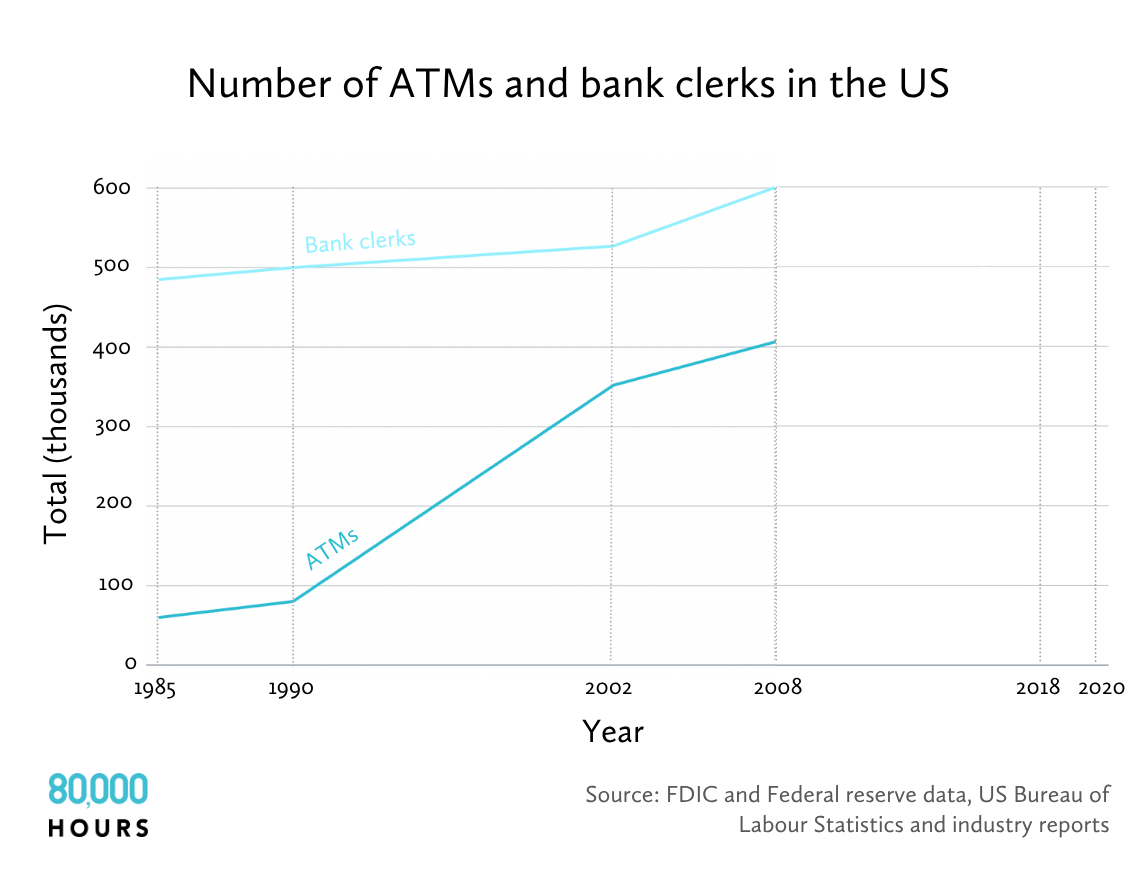
While it’s commonly assumed that automation decreases wages and employment, this example illustrates two ways that can be wrong. First, while automation decreased the value of the skill being automated (counting money), it increased the value of other skills (talking to customers).
Second, it shows that partial automation can even increase employment for people with the same job title, because it makes them more productive, which in turn makes employers want to hire more of them. In this case, fewer people could run a branch, providing better service to the same number of customers.
But there’s a final twist to the story: today, bank clerk employment is in decline.
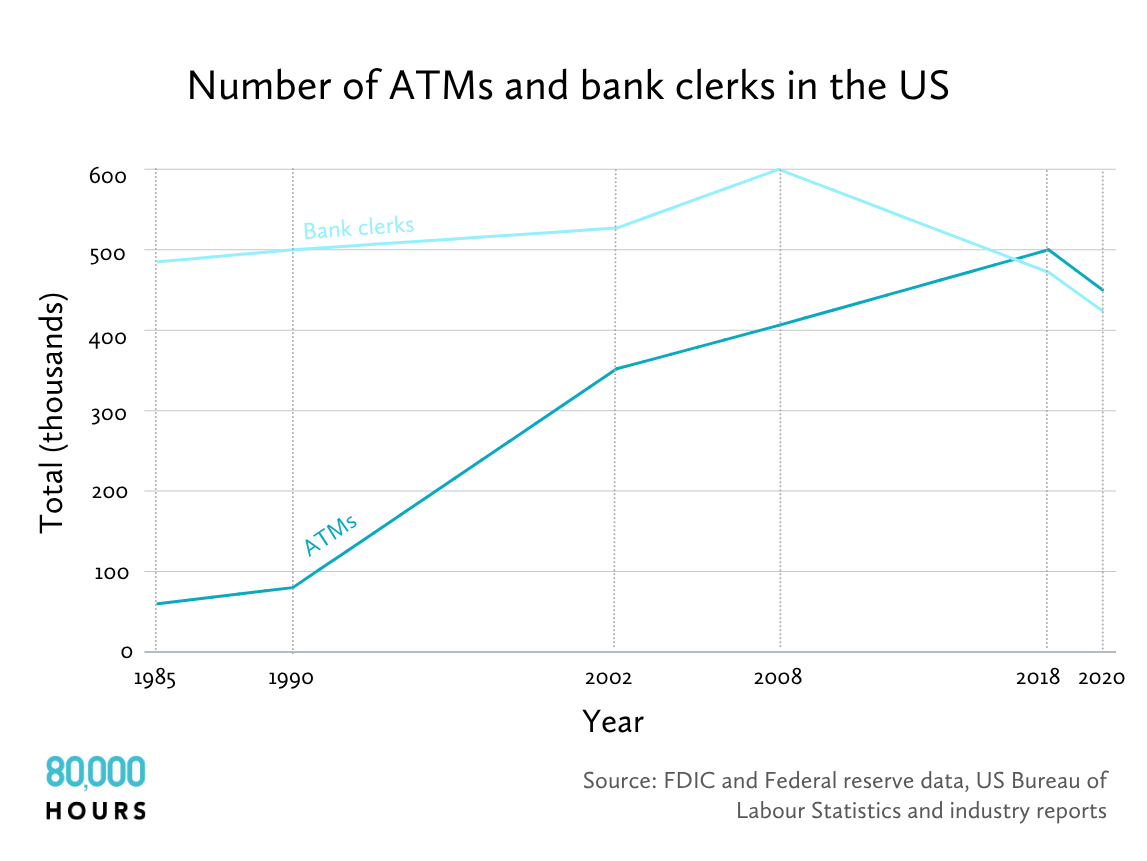
While partial automation increased employment, the more dramatic automation made possible by online banking did indeed reduce it. This is a common pattern.
During the Industrial Revolution in Britain, textile production was automated significantly following the arrival of the spinning jenny, the water frame, and the spinning mule through the eighteenth century. Productivity increased greatly, while the industry remained one of the country’s biggest employers with over one million workers.
But the employment boom didn’t last forever. As automation went even further, for instance with the development of the power loom, and as foreign competition intensified, employment went into decline a generation later.6 A pattern of increasing then decreasing textile employment was also observed in the US in the nineteenth century.7
In the twenty-first century, some predicted that AI would soon replace radiologists. But so far, their employment numbers are up.8 This is probably because routine image analysis, the part AI is good at, is a small part of what radiologists actually do. Much of their time is spent talking to patients, conferring with other specialists, and dealing with edge cases.9 AI has made radiologists more productive rather than replaced them.
Sometimes automation means a smaller number of more highly paid workers using the new technology can replace a larger number of less skilled ones. There are signs this is happening in software engineering. Hiring of the most junior engineers shows signs of decreasing, but as of writing, senior employment is up, and average wages have increased.
Sometimes it has the opposite effect by making jobs easier to enter. The introduction of ride-sharing apps made it a lot easier to become a taxi driver. That reduced the wages of drivers by about 20% but tripled the number of people doing the job.10 Going forward, we might see things like nurses with AI advice able to do work that would have required a doctor before.
This doesn’t mean that radiologists, software engineers, and taxi drivers will never see declining employment in their fields. Employment of cashiers, secretaries, telemarketers, and special effects artists has been in decline for years as new technologies have automated their work. The point is that it’s hard to predict when automation will switch from increasing employment to decreasing it.
One intriguing possibility is that the pattern of rising then falling employment we saw with bank clerks could happen to the human race as a whole. As AI and robotics improve, they might initially make people more productive, meaning the world gets wealthier and wages as a whole increase, only to collapse later.
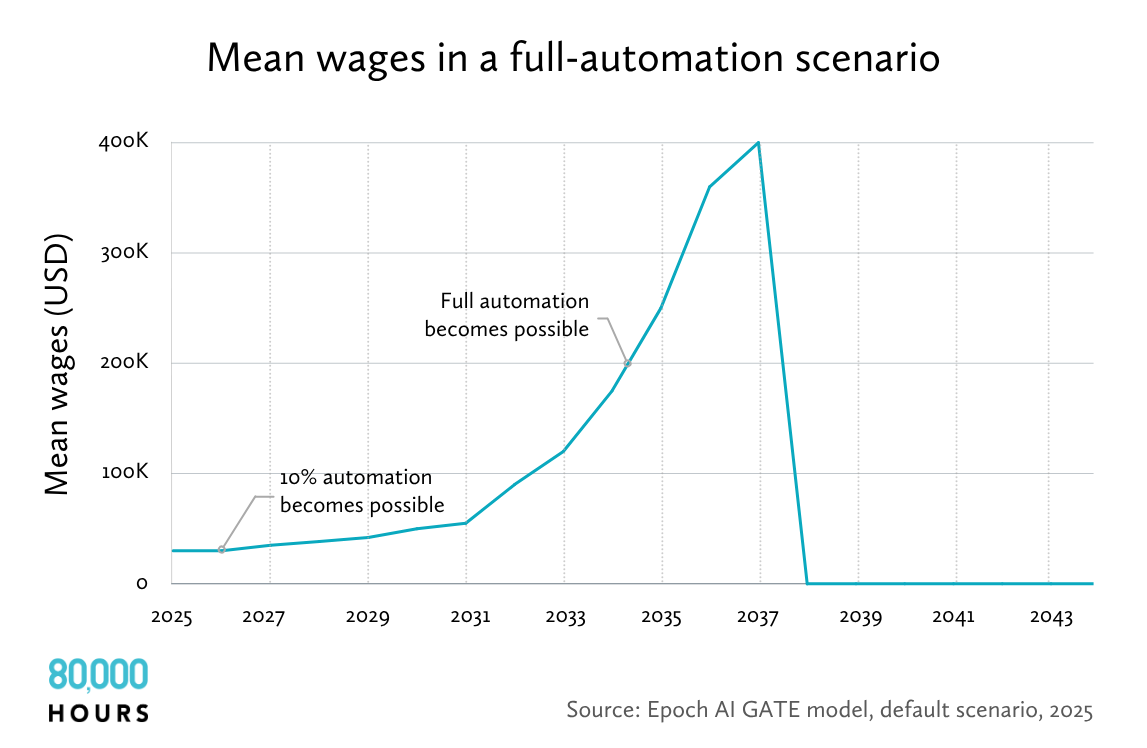
Economic models that allow for the possibility of full automation predict a rising-then-falling wage pattern. For example, the research institute Epoch AI modelled what would happen if an AI capable of doing 10% of all economically important tasks is created in 2026, and an AI capable of doing 100% of those tasks is created in the early 2030s. In their model, wages rise by 10 times until around 2037, creating a brief golden age for labour before they suddenly crash to zero after the final tasks are automated.
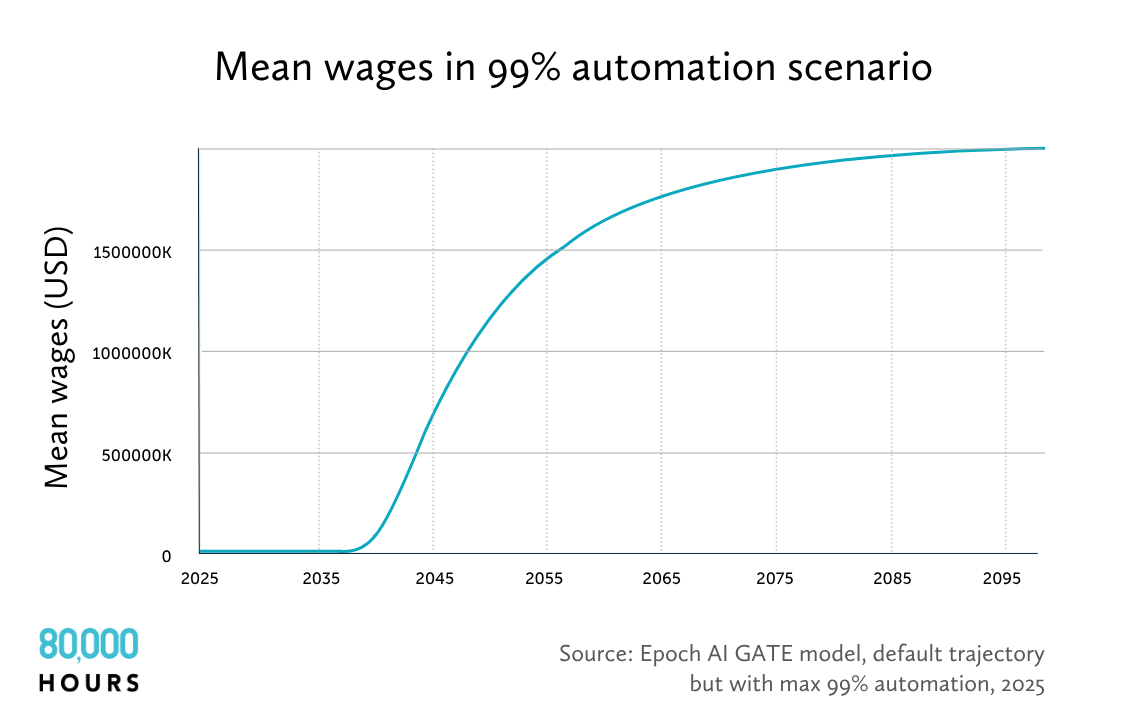
In contrast, if humans remain necessary for just 1% of tasks, the same model shows that wages increase indefinitely. The world gets richer and richer, and everyone works on the remaining 1% of tasks AI can’t do. The difference between 100% and 99% automation is enormous.
This second scenario can be compared to agricultural automation. Historically, almost everyone on earth worked in agriculture, and yet today in high-income countries only a couple of percent of people do. So we could say that the majority of jobs in these economies have already been automated.
And yet incomes in these countries are around 100 times higher now than they were back then. That means that on average people moved into much higher-paying and often newly created jobs. In some countries, such as South Korea, much of this transition was accomplished in just a single generation.
Regardless of whether wages continue to rise or eventually fall, the coming decades are likely to be very disruptive for the people whose jobs are automated. My purpose here isn’t to figure out the ideal societal response, but to help you navigate the years and decades ahead.
If wages on average are going to increase initially, then even if the value of some skills are going down, the value of others must be going up. Your best strategy is to focus on learning those skills increasing in value, maximising your contribution (and wages) in the time between now and full automation (if that ever happens).
Four types of skills likely to increase in value in an age of AI
We’ve reviewed all the economics literature and recent data we could find about AI automation, and combined that with some theory about how AI works, to create the following four categories of skills more likely to increase in value. Which skills to focus on is a moving target, but you can use these categories to evaluate your options at the time. You’ll want to look for skills that are valuable today, and that satisfy at least two of the four categories.
1. Skills that are hard to automate
The best way to build an intuition for what AI can and can’t do is to try to use the most cutting-edge tools to do real work. But we can also understand AI’s limitations by looking at how these systems are trained.
LLMs like ChatGPT are created by training them to predict patterns in (primarily) internet data. This makes them excellent at tasks that involve pattern matching, recall, and recombination of that data. That turns out to be a lot of tasks.
In 2017, experts assumed social skills and creativity would most resist automation.11 Today, therapy is a popular use of AI, and it’s also surprisingly good at certain types of idea generation, creating visuals in novel combinations of artistic styles, or writing poetry most can’t distinguish from the human authored stuff.12
The internet contains a lot of data that’s relevant to many routine knowledge work tasks, things like fact-finding, translation, outlining basic context, and giving advice. And if a job is done on a computer, it’s also easy to track how it’s being done and gather even more data.
This is why most research finds the tasks most likely to be affected by this wave of AI are the more routine aspects of white-collar jobs, especially those in the 70th–90th percentile of income, which is those earning $100,000–200,000 in the US.13
On the other hand, AI remains bad at tasks totally missing from their training data. The internet contains huge amounts of text, but there’s no equivalent store of data describing physical movement. Creating this data will require building physical robots with cutting-edge sensors and having them move around the real world.14 So, unlike previous waves of automation, white-collar workers are likely to be affected before many blue-collar ones.
The physical tasks that will resist automation the longest will be the ones that require the most complex movement, that are done in unpredictable environments, and that require the highest reliability, because those factors increase how much data is needed to describe the task.15 Driving seems close to cracked, with Waymo operating fully self-driving cars in multiple cities and growing over 10% per month,16 but something like surgery or plumbing seems significantly further away.
Does this mean you should retrain as a plumber? Probably not. While wages in blue collar jobs might grow faster than many white collar ones, they’re starting from a lower base. Plumbing also doesn’t look attractive on the other three criteria to come. In addition, some white collar knowledge work skills will also prove hard to automate, which could make their value go up a lot. Which skills are those?
Since 2024, leading AI models have become much more than simple LLMs. The LLM is used as a base model, but it’s also taught to reason and complete tasks using ‘reinforcement learning.’ This is a bit like learning through trial and error. The model tries to solve a problem (like a maths puzzle), is graded on the accuracy of its output, and is then adjusted in a way expected to make it more accurate next time.
Reinforcement learning has led to dramatic progress in maths, coding, and answering known scientific questions — areas in which pure LLMs are weak — because these domains have objective answers that can be verified immediately.
But consider a task like building a company: it involves making judgement calls with no obviously correct answers, and success is determined over many years. It’s much harder to get reinforcement learning to work for a task like this. Other examples might be things like starting a new community, directing a frontier research project, having a conceptual insight, or setting organisational strategy. All of these require skills that aren’t clearly described within internet data, but are also:
- Messy — they lack clearly defined instructions and measurable outcomes.
- Long-horizon — they take time to implement and measure success.
This is why AI can solve maths problems most PhDs would struggle with but, as of 2025, is still worse than most 10-year-olds at playing Pokémon,17 a game which is open-ended and unfolds over days.
Most real jobs consist of projects that take weeks, are open-ended, and require coordination within large teams. Something most humans would find easy, like getting a set of shelves installed in an office, still seems significantly beyond what current models are able to do. This is why so few jobs have been automated to date.
This is likely to change, as AI is becoming better at longer and more open-ended tasks. But it’s where, absent a major paradigm change, humans will likely continue to add value the longest. Given this, it’s plausible many knowledge work organisations will become more top heavy, with an expanded class of managers overseeing AI-enabled teams who do the more routine work.
In fields like finance, this would be a continuation of long-term trends in which a smaller number of (often higher-paid) quants have replaced a larger number of discretionary traders.18 Likewise, it’s plausible that client-facing, direction-setting lawyers and consultants will see the value of their skills go up, while the need for junior analysts shrinks.
Next, in some cases, even if AI can perform a task proficiently, it might not be allowed to. The following are some categories of task suggested by economists who study automation in which people might demand a ‘human-in-the-loop’:
- Legal liability: Someone needs to be legally responsible for important decisions, such as with chartered engineers or court lawyers.
High reliability required: AI systems make weird mistakes, so people will want human oversight, such as historians checking AI-generated research, control of expensive industrial machinery, or military leadership.
Professional protections: Doctors and lawyers control certifications and form powerful lobbies that could block AI applications.
Preference for human touch: Many people will prefer humans for certain services, perhaps as a luxury, such as with nannies, artists with compelling stories, and religious leaders.
Physical presence needed: Many roles require someone physically present, and in some cases people might not be willing to fully hand these responsibilities to robots for a long time, such as police or teachers.
Institutional inertia: Many organisations will be slow to adopt AI, keeping humans in important jobs for longer than otherwise makes sense, perhaps including in government or in monopolistic companies.
These factors could work to protect certain oversight positions in white-collar professions, as well as protecting certain social jobs, at least for a while.
In addition, AI automation will be slowed by a lack of physical infrastructure. Even if robotics suddenly started working perfectly, robot production today is only in the millions, so it would take many years to build the billion or so robots required to do all physical jobs.
Even in the digital world, lack of physical infrastructure might well slow down adoption of AI. If ‘AGI’ were created tomorrow, it would probably take a ton of computing power to run, making it prohibitively expensive to use to automate lower-paid jobs. That would mean its deployment would initially be limited to the highest-value applications, like assisting with R&D.
2. Skills needed for AI development
In 2014, Facebook bought WhatsApp for $19 billion back when it had 450 million users but only 55 employees. The declining cost of software has made it easier and easier for a small group of people to rapidly build a product that can serve millions of people. Now this trend seems to be entering a new phase.
Generative AI startups are growing fast even compared to the previous generation of software as a service (SaaS) companies, themselves famous for their speedy growth:
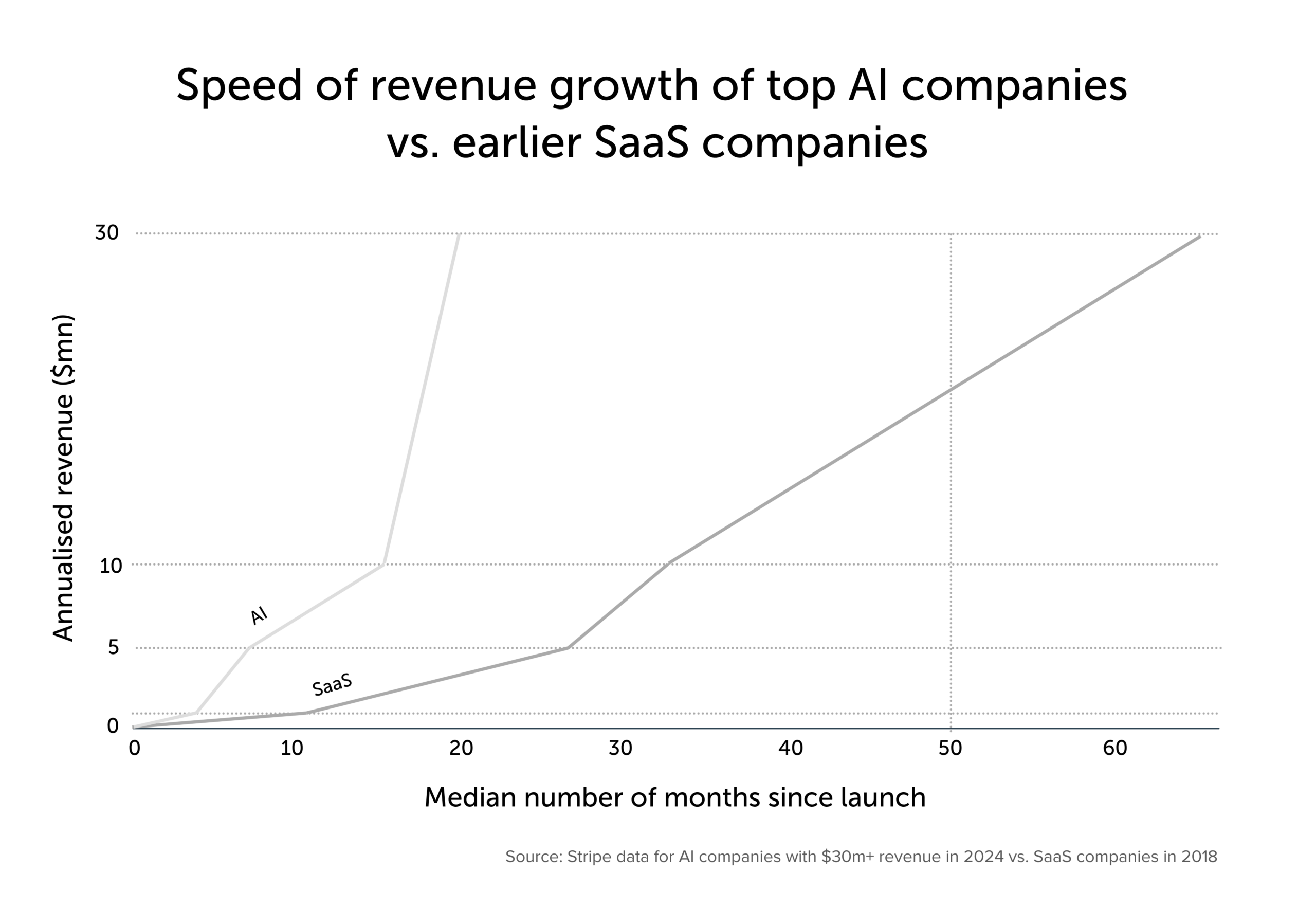
As AIs move from being reactive chatbots into proactive agents, the skills required to direct these ‘digital workers’ will become incredibly valuable.
You will be able to use these workers to rapidly build and iterate on new products, but you could just as easily have them help you set up a nonprofit on a shoestring budget, search for new cancer drugs, or provide expert medical advice 24/7 anywhere in the world. Key skills could include:
- Spotting problems and deciding what to focus on
- Understanding different AI models and designing around their weaknesses
- Writing clear project specifications for AI agents to follow
- Understanding what users really want
- Designing systems to manage AI workers, including error-checking
- Coordinating with people and bearing responsibility for results
These skills are similar to managing humans today, and there’s already evidence that competent human managers are better at managing AI teams.
What’s crucial is that these kinds of skills are complementary to AI. As AI gets better, they become more needed, rather than less.
A tailor of bespoke Neapolitan suits, descended from a long line of tailors, is not something AI can easily replicate, so it satisfies the first category — it’s hard to automate. But tailoring is not complementary to AI, so while it might retain its relative value, it doesn’t increase.
To give another example, as AI becomes better at generating solutions to scientific problems, the key question becomes what problems to direct those AIs towards. This skill in ‘research taste’ is also messy and long-horizon, so seems harder for AI to learn. For both reasons, it likely increases in value as AI gets better.
Other complementary skills involve knowledge of the fields needed for AI scale-up, such as AI software and hardware development; robotics development, manufacture, and maintenance; the construction of datacentres and factories required for these; and cybersecurity.
3. Skills that produce things people could use far more of
I only need to file my taxes once a year, so if AI can do it more cheaply, I will spend less on my accountant. I’m not going to start filing taxes more often with the money saved. In contrast, as we saw, the arrival of ride-sharing platforms made taxis much cheaper and easier to use, and as a result, people took way more rides.
There are many other areas where, as what’s on offer gets better and cheaper, people use them more and more. As people get richer they spend more of their income on healthcare, suggesting that even if technology made healthcare more efficient, people would simply use far more of it.19
Likewise, if luxury experiences like exotic travel suddenly became affordable, people would choose to travel a lot more. This is in contrast to jobs that exist to satisfy legal requirements, like licensing or certification. If they can be done much more efficiently using AI, people will simply hire fewer human workers.
Other jobs, like nurses in the UK’s National Health Service, have employment effectively set by the government, so even if their efficiency increases, wages and employment might not. Likewise, the number of academic jobs is not mainly set by market forces, which means their employment could remain steady, even as AI makes researchers more productive.
AI automation will also likely create a huge amount of wealth, potentially concentrated in the top 1% who own most capital, and therefore who own the AI systems that are doing the automation. Increased income inequality will spike demand for luxury goods. Something like providing personalised tea-tasting events in San Francisco would be hard for AI to do and would likely also see increasing demand.
4. Specialised skills that are hard for others to learn
Consider a job like being a server at a fancy restaurant. People often eat out more as they get wealthier, and this is the sort of physical, social-skills-heavy job where people might retain a strong preference for a human touch, so I expect there to be plenty of jobs like this going forward.
However, it’s also a job that other people can enter relatively quickly. The skills that will see the largest increases in value will be those where it takes time for the labour market to respond.
This favours learning specialised skills that match your unique strengths. For example, construction work is a complex physical job that will be harder to automate. However, a construction worker who learns a trade like electrician, and specialises in data centres, is more likely to become a critical bottleneck, and see the value of their skills increase a lot faster. In fact, electrician wages in Virginia, where many datacentres are being built, are already 37% above the national average.20 So which specific skills will be most valuable in the future?
Which skills will be most valuable in the future?
Let’s combine this discussion with our findings from the last couple of sections to make a list of valuable work skills. This list isn’t comprehensive, but should give you some ideas about where to focus.
Broadly speaking, the most valuable skills will be those that are most needed in the impactful categories of jobs we discussed in part six, are more likely to increase in value given automation (satisfying at least two of the four categories we’ve just covered) and are faster to learn relative to their value, since that means each hour spent learning yields a higher return. The latter could be of increasing importance as the job market starts to change faster. Spending eight years in medical school, for instance, is a much riskier proposition today.
Another quality that makes skills more valuable is how transferable they are to different jobs and problems. Management is a relatively transferable skill, because basically every organisation needs managers, so even if one industry disappears, or you decide you want to switch into a totally different area, your skills are more likely to remain useful. Become an expert in early Roman portraiture, however, and your options are more limited.
Some skills are so transferable they’re useful in basically every career. Here are some that seem likely to increase in value in the future and which we consider especially useful for impactful career paths.
Although they’re not all the classic ‘work skills’ you’d list on your LinkedIn profile, they’re often more worth learning, because they’ll make you more effective at everything else you want to do. You can start practicing them in whatever job you’re doing now.
- Deploying AI to solve real world problems: If I had just one piece of advice right now, it would be to learn to use AI to accomplish real work. This advice has already become a bit of a cliche, but is still often not applied. Some universities even try to ban their students from using AI. As AI becomes more powerful, the skills involved in effectively directing AI systems increase in value, in particular those that address the messy gaps where people want a human-in-the-loop. Having concrete AI expertise also makes you more credible when working on its social impact. (Read more→)
- Taking care of yourself: Ambitious people often don’t take care of themselves. This can make them burn out and ultimately be less successful. Taking care of yourself starts with the basics: getting enough sleep, exercising regularly, eating well, and maintaining your close friendships. Building these habits can have a big impact on your day-to-day energy and happiness. In addition, about 30% of people in their twenties have some kind of mental health issue.21 If you’re one of them, learning to cope with it better is usually one of the best investments you can ever make — both for your own sake and your ability to help others. This often involves some form of therapy, such as cognitive behavioural therapy (CBT) and its variants, which are practical, solution focused, and have the clearest evidence base. You should speak to a psychiatrist about other treatment options, too. Trying to tackle the world’s biggest problems will be challenging at times, and making yourself more resilient is well worthwhile.(Read more→)
- Personal effectiveness and agency: It’s often possible to significantly increase your productivity by developing good habits, like setting daily goals and learning to run meetings. These skills are relatively quick to improve and help you in every job. On a more advanced level, if you can become the type of person who can work on difficult, ill-defined problems over many years, that’ll be of huge value. And this is something AI is likely to continue to struggle with. (Read more →)
- Prioritisation, forecasting, and decision-making: In 2017, we did an analysis of which skills were most commonly required in the most attractive jobs, and found that judgement and decision-making came out on top. Over time, the proportion of jobs that require decision-making skills has been expanding, roughly doubling from 1995 to 2018, and these jobs have seen faster wage growth than average. If you want to do good, these skills are probably even more important, because some projects have much more impact than others, and these skills are needed to identify what’s best. Looking forward, as technology makes it easier to get stuff done, the question of what’s worth doing in the first place will become ever more important. (Read more→)
- Social skills: Every job involves working with others at least to some degree, and the importance of social skills has also been increasing over time. Looking forward, even though AI is good at certain types of social interaction, people will still want relationships with other people. Smaller teams of humans managing powerful AI agents will need to coordinate extremely well because their leverage will be so much greater. Social skills are also a core component of leadership and management, and vital in many of the most impactful paths, such as policy and communications roles. (Read more→)
- Learning how to learn: Being able to learn things quickly is useful almost no matter what you want to do, but as technology changes faster, being able to rapidly retrain becomes ever more valuable. AI has also meant you can get basically free 24/7 private tutoring on almost any skill, which many people say is enabling them to learn a lot faster than before. (Read more→)
It’s often worth spending some months taking the lowest-hanging-fruit ways to improve each of the skills listed above (explaining how would take a whole chapter, so we’ve put the best resources in our guide to being more successful).
But these skills are not typically what people make the main focus of their career. Here are some skills that are still highly transferable, seem relatively future-proof, and can become such a focus:
- Leadership and management skills: These include people management, project management, entrepreneurship, and organisational strategy. Leadership and management skills have always been among the most valuable because they help coordinate and direct teams of people, compounding your impact.22 Their importance could increase going forward as AI automates more routine knowledge work, allowing small groups of leaders to get more done than before, unlocking moonshot projects that were previously too expensive. (Read more→)
- Operations management: Every organisation needs people to actually run things. This isn’t about big-picture strategy, but rather all the day-to-day realities all organisations must handle, like recruitment, setting up financial systems, and office management. Some aspects of this skill, like more routine admin tasks, are being automated by AI, but humans are still crucial for more complex tasks that require good judgement. It’s plausible operations teams will get smaller, but more organisations will be founded, and they’ll grow faster than before. Among organisations we think are impactful, these skills are highly in demand today.23 (Read more→)
- Policy and political skills: We’ve already seen the huge influence government has on many of the world’s most pressing problems, and how individual government workers can have a surprising amount of influence on it. Looking forward, even if much routine analysis and bureaucracy gets automated, citizens will want decision makers to be real people for a while longer. That means the nebulous, long-horizon skills of understanding how the system works and getting things done in government will likely remain valuable. (Read more→)
- Communications: Every organisation needs skilled communicators, both internally and externally, to explain their mission and offering, and they’re especially in demand at the organisations we think are most impactful right now.24 You can also use these skills to help spread important ideas. As it becomes easier to create large volumes of reasonable-seeming content with AI, it’s possible the value of creating content will decrease, but the skill of figuring out what to produce in the first place will increase in importance, as will the value of having a sense of taste. Likewise, trust and an authentic relationship with your audience become more important. More practically, this could look like mastering social media, building a Substack following, acquiring PR expertise, or becoming good at running in-person events. (Read more→)
These four skills can be applied to almost any global problem, but many of the highest-impact roles also require specific, in-depth expertise. Next we’ve made a list of more specialist skills to consider learning. We chose them because they seem the most useful given our views about pressing problems and the likely trajectory of AI. While almost everyone should be able to agree on the skills listed above, the list below could look quite different depending on your views about what matters.
Some of the following skills also take longer and are harder to learn, but true expertise seems likely to be one of the last things that will get automated,25 and experts of many kinds will be required to provide oversight of AI systems.
- Machine learning research and engineering: This is the technical side of getting AI systems to work. As AI becomes more useful, the value of making it 1% more efficient goes up. This means that even as much of ML engineering is itself getting automated, the remaining parts that only humans can do are becoming more valuable (as reflected by rapidly increasing salaries).
Within this skill, you could focus on the more technical aspects of AI safety research, which we believe is one of the most valuable fields of research in the world today. Many promising research ideas in that field are bottlenecked by a lack of engineers able to implement them. Another option would be to use this skill to apply AI to important global problems, such as building AI tools to improve government decision making. Having this skill also gives you much more credibility if you decide to work in AI policy or communications.
Finally, it commands huge salaries, which you can use to earn to give. One risk is that working on frontier AI development accelerates AI progress without improving society’s capacity to adapt, so if you learn this skill, we recommend focusing on applying it to AI safety, or the application of existing AI technology to important social problems.
- AI governance and strategy: This means studying the potential impacts of AI, and how government, philanthropists, and other key actors can best respond. This is a diverse area which overlaps with many other fields including economics, law, policy, ethics, forecasting, and macrostrategy. Given the risks and rapid rate of change, there’s currently a huge need for more expertise of this kind, but not many people have more than a couple of years’ experience, so it’s possible to get to the forefront relatively quickly. (Read more→)
- Cyber and information security: As the world becomes more digital and robotics becomes more integrated into our lives, it becomes more important to guarantee these systems are secure (after all, no-one wants to be kidnapped by their robot butler). At 80,000 Hours, we’re especially concerned about the theft of new biotechnologies and advanced AI systems themselves. It’s hard to see how the coming years go well if these technologies can be immediately stolen by bad actors. This skill is also extremely in demand commercially. (Read more→)
- Expertise in an emerging power: China is likely to play a crucial role in shaping the coming decades, but decision makers in the West tend to understand China poorly and often fail to coordinate with it to solve global problems. This means expertise in China-West relations, and especially coordination around AI and other catastrophic risks, seems highly valuable.
More broadly, the world is transitioning from an era of US dominance to a multipolar system with several great powers, including countries like India, Russia, and Saudi Arabia, expanding their spheres of influence. These dynamics are going to affect the development of many issues going forward. (Read more→)
- Expertise in AI hardware: AI chips may turn out to be the oil of the next century. Whichever country has the best and the most chips will be able to deploy the most effective AI systems, and could therefore wield the most economic power. If this turns out to be the case, understanding how these chips work and how they are made could become one of the most valuable skills to possess. In particular, one avenue for the governance of AI systems focuses on the design and availability of chips. Among people working on reducing the risks associated with AI, there is vastly more expertise in software than hardware. (Read more→)
Here are several other valuable areas of specialist expertise, though they’re less targeted at the most crucial gaps, and in some cases less transferable:
- Economics, especially the understanding of growth and automation, though also its general toolkit
- International relations, security studies, and public policy
- Robotics development and maintenance (as well as the construction of datacentres and factories) since they often become huge bottlenecks, making them valuable skills, especially for earning to give
- Engineering, especially for pandemic prevention
- Synthetic biology and bioengineering
- Applied mathematics, since those skills are useful in many other fields
- Certain branches of philosophy, such as moral philosophy and philosophy of mind
- Certain areas of history, such as economic history, macrohistory, and the history of social change and important ideas
We’ll come back to how to pick what to study in the next part of the guide, which asks which jobs best advance your career.
Finally, the value of skills used in jobs that require a physical presence or involve complex physical manipulation — such as those used in law enforcement, construction, teaching, and surgery — and the skills used to provide luxury services or where a human touch is highly valued — like mediator, conference organiser, artist, or bespoke craftsperson — will probably keep pace with the rest of the economy, though won’t obviously outpace it.
Which combinations of skills are best?
Now you’ve gained a sense of which skills will be most valuable in general, it’s worth thinking a little about the combinations that could prove especially useful. In a widely cited paper, the economist David Deming shows that outside of computer technology, jobs requiring mathematical skills have represented a decreasing share of employment, and have had below-average wage growth for decades, while jobs involving social skills have grown more than average.26
However, he also shows that the biggest growth has been for jobs that require both technical and social skills. This could be because they allow you to act as a bridge between more widely deployed technical systems and real-world applications.27 In particular, we think there’s a huge need for people who understand emerging technologies like AI and synthetic biology, but also have skills in policy and communication.
You should also think about whether to focus on one main skill, or build a portfolio of several. In some areas, success is more a matter of being exceptional at one thing — for example, a salesperson is mainly judged based on how many sales they bring in — and so in those areas you should focus most of your efforts on that core skill. Having one impressive achievement usually also opens more doors than having several moderate ones.
In other areas it’s useful to have an unusual combination of skills, becoming the best person in that niche. Many organisation-building roles require generalists with some knowledge of management, operations, and marketing, communications, as well as sufficient understanding of what the organisation actually does.
But in every case, remember what the history of automation tells us about its likely future. While most people assume automation drives down wages, that’s only true when it’s nearly 100%. Until then, automation drives down the value of some skills, but drives up the value of others. The aim isn’t to find a single job that will never be automated, but rather to ride the wave, moving into the skills that become most valuable at each time.
So which jobs will let you learn these skills the fastest?
Put into practice
- How do the skills you’re learning in your current job or course stack up on the four categories of skills likely to increase in value due to automation?
- Difficult to automate
- Needed for AI deployment
- Produce things society could use far more of
- Hard for others to learn
- Might any of the work skills highlighted in this article be a good fit for you? Look over the list again.
- What are 1–2 things you could do to start learning these skills in the next month? Typically the fastest way to learn a skill is to start using it, while also reading about how to do it and seeking mentorship.
See our most up-to-date advice on how to learn the skills discussed.

Have a greater positive impact with your career
Join our newsletter to receive a free copy of our new career guide, weekly high-impact job opportunities, and updates on our research.
We’ll never share your email, and you can unsubscribe in one click.

Notes and references
- In 2015, around 1.353 million people were employed in software developer roles. By 2024, that figure had reached 2.077 million, a growth rate of about 53.5%.
“2015 annual averages – employed persons by detailed occupation and age.” Bureau of Labor Statistics, 10 February 2016, bls.gov/cps/aa2015/cpsaat11b.htm. Accessed 9 October 2025.
“2025 annual averages – employed persons by detailed occupation and age.” Bureau of Labor Statistics, 25 January 2025, bls.gov/cps/cpsaat11b.htm. Accessed 9 October 2025.↩
- Different surveys find different results, but all agree a significant fraction of people are concerned, often around 50%. A survey of 31,000 by Microsoft in May 2023 found 49% were worried AI will replace their jobs.
A survey of 3,000 employees found 52% of those in Gen Z felt worried about being replaced with someone who’s more comfortable with AI. McGraw, Mark.
A 2025 survey by Pew found 52% of workers were worried about the future impact of AI use in the workplace (though this might be for other reasons).
A Gallup Bentley University poll from September 2023 found 75% of workers think AI will decrease the total number of jobs over the 10 years.
Lin, Luona, and Kim Parker. “U.S. workers are more worried than hopeful about future AI use in the workplace.” Pew Research Center, 25 February 2025, pewresearch.org/social-trends/2025/02/25/u-s-workers-are-more-worried-than-hopeful-about-future-ai-use-in-the-workplace/.
Marken, Stephanie, and Tara Nicola. “Three in four Americans believe AI will reduce jobs.” Gallup, 13 September 2023, news.gallup.com/opinion/gallup/510635/three-four-americans-believe-reduce-jobs.aspx.
McGraw, Mark. “Survey finds Gen Z most worried about AI’s workplace impact.” Pennsylvania SHRM, 23 February 2024, pshra.org/survey-finds-gen-z-most-worried-about-ais-workplace-impact/.
“Will AI fix work?” Microsoft, 9 May 2023, microsoft.com/en-us/worklab/work-trend-index/will-ai-fix-work.↩
- Waymo self-driving taxis are deployed for real-world operation in several cities, including San Francisco. As of June 2025, they report over 80% fewer injuries compared to human benchmarks.
A 2025 systematic review in Nature compared generative AI to physicians and found similar accuracy:
Analysis of 83 studies revealed an overall diagnostic accuracy of 52.1%. No significant performance difference was found between AI models and physicians overall (p = 0.10) or non-expert physicians (p = 0.93). However, AI models performed significantly worse than expert physicians (p = 0.007).
Takita, Hirotaka, et al. “A systematic review and meta-analysis of diagnostic performance comparison between generative AI and physicians.” npj Digital Medicine, vol. 8, no. 175, 22 March 2025, doi.org/10.1038/s41746-025-01543-z.↩
- We also published an article making the case for data science in 2015, just before jobs in the field took off. Since the late 2010s, growth in the data science roles has outperformed overall job market growth by 533%.↩
- Here are four articles from the time about ATMs reducing teller jobs:
Glater, Jonathan D., and Frank Swoboda. “Taking a bite out of bank jobs.” The Washington Post, 10 July 1995, washingtonpost.com/archive/business/1995/07/10/taking-a-bite-out-of-bank-jobs/cfe451cd-c921-43dc-85d8-6c8fabf8a71b/.
“Livelyhood: Work in America.” PBS, pbs.org/livelyhood/resources/jobtrends.html.
Morisi, Teresa L. “Commercial banking transformed by computer technology.” Monthly Labor Review, vol. 119, no. 8, August 1996, pp. 30+, bls.gov/opub/mlr/1996/08/art4full.pdf.
“Your money: Study finds ATM charges up, costs down: Finance: Consumer group says banks earned $2 billion in profits from the machines. Bankers call the fees justified.” Los Angeles Times, 2 June 1994, latimes.com/archives/la-xpm-1994-06-02-fi-65172-story.html.↩
- Widespread adoption of the powerloom took place in the early 1800s. By 1815, estimates put the number of cotton weavers in Great Britain at around 200,000.
Sugden, Keith, and Amy Louise Erickson. “Estimating the number of cotton handloom weavers in England, c. 1780–1813: Women and children hiding in plain sight.” Textile History, 30 January 2025, pp. 1–22, doi.org/10.1080/00404969.2024.2437180.↩
- Similarly, later in the nineteenth century, US cotton textile production was automated with power looms and other machinery. Labour productivity grew by around 3% per year from 1820–1900. Yet instead of destroying jobs, employment in textiles exploded, from tens of thousands to hundreds of thousands of workers.
Similarly, after the US adopted the Bessemer steelmaking process in 1865, productivity in steel grew 3% annually, but employment soared to over 500,000 workers by the mid-twentieth century. In both cases, automation made workers so productive that prices fell dramatically and demand increased.
The industries expanded faster than automation could replace workers. But again, the employment boom didn’t last forever. As automation continued and markets became saturated with cheap textiles and steel, demand growth slowed. Employment eventually went into decline; by 2011, textiles employed only 16,000 and steel just 100,000.
Bessen, James. “Automation and jobs: When technology boosts employment.” Scholarly Commons at Boston University School of Law, October 2019, scholarship.law.bu.edu/faculty_scholarship/815/.↩
- According to the BLS May 2021 report, their employment was 29,530, but by the latest May 2023 report, it was 31,960.
In 2025, American diagnostic radiology residency programmes offered a record 1,208 positions, a 4% increase from 2024, and the field’s vacancy rates are at all-time highs. Each year since 2013, nearly all radiology residency spots have been filled by applicants.
“Occupational employment and wages, May 2021 – radiologists.” U.S. Bureau of Labor Statistics, 31 March 2022, bhttps://www.bls.gov/oes/2021/may/oes291224.htm.
“Occupational employment and wages, May 2023 – radiologists.” U.S. Bureau of Labor Statistics, 3 April 2024, https://www.bls.gov/oes/2023/may/oes291224.htm.
Mousa, Deena. “AI isn’t replacing radiologists.” Understanding AI, 1 October 2025, understandingai.org/p/ai-isnt-replacing-radiologists.↩
- After following 14 radiologists in Vancouver for a month, Dhanoa and colleagues reported:
Radiologists spent 36.4% of their time on image interpretation. The proportion of noninterpretative tasks was 43.8%, which includes activities such as protocolling requisitions, supervising and monitoring studies, performing image-guided procedures, consulting with physicians, and directly caring for patients
Dhanoa, Deljit, et al. “The evolving role of the radiologist: The Vancouver workload utilization evaluation study.” Journal of the American College of Radiology, vol. 10, no. 10, 2013, pp. 764–769, doi.org/10.1016/j.jacr.2013.04.001.↩
- See an accessible discussion in “Task first, pay later: AI’s twin routes for wages and work.”↩
- In one of the most widely cited papers on the topic, Frey and Osborne identified ‘social intelligence’ and ‘creativity’ as two of the skills least likely to be automated by AI.
Frey, Carl Benedikt, and Michael A. Osborne. “The future of employment: How susceptible are jobs to computerisation?” Technological Forecasting and Social Change, vol. 114, January 2017, pp. 254–280, doi.org/10.1016/j.techfore.2016.08.019.↩
- David Deming found that therapy accounts for 1.9% of GPT messages, and creative ideation 3.9%. AI systems are not yet able to have novel conceptual insights, but they are often near-superhuman at more everyday forms of creativity, such as coming up with titles for a blog post.
Deming, David. “ChatGPT really does offer mundane utility.” Forked Lightning, September 2025, forklightning.substack.com/p/chatgpt-really-does-offer-mundane.
Porter, Brian, and Edouard Machery. “AI-generated poetry is indistinguishable from human-written poetry and is rated more favorably.” Scientific Reports, vol. 14, no. 1, November 2024, doi.org/10.1038/s41598-024-76900-1.↩
- In a remarkably prescient paper, Mike Webb, at the time an economist at Stanford, realised that automation of a task is usually preceded by patent filings describing that task. So he looked at the text of patents and compared them to the text of the descriptions of the tasks involved in different jobs.
He found the tasks most exposed to the next wave of automation are routine analytical tasks, like those performed by clinical laboratory technicians, chemical engineers, and optometrists. Typically, these kinds of tasks are common in jobs that are in the 70–90th percentile of incomes (approx $100–200k in the US).
Other methods find similar results. For instance, OpenAI carried out a study in which human experts and AI models categorised different tasks by how well they could be performed by LLMs. It found that the most exposed tasks were things like programming and writing, while the least exposed were science, critical thinking, and manual work. Based on that, the most exposed industries were white collar jobs like data analysis, insurance, media, and publishing. (The paper also starts with a helpful review of other literature on this topic.)
The picture lines up with the jobs that are already experiencing the worst declines: customer service, telemarketers, secretaries, and administrative assistants.
Another approach is to look at where AI is already proving most useful. A survey by economist David Deming found that’s in routine writing, admin, translation, and coding.
Bick, Alexander, et al. “The rapid adoption of generative AI.” SSRN Electronic Journal, 18 September 2024, doi.org/10.2139/ssrn.4964384.
Eloundou, Tyna, et al. “GPTs are GPTs: An early look at the labor market impact potential of large language models.” arXiv, 22 August 2023, arxiv.org/abs/2303.10130.
Webb, Michael. “The impact of artificial intelligence on the labor market.” SSRN, 15 November 2020, papers.ssrn.com/sol3/papers.cfm?abstract_id=3482150.↩
- GPT-4 was trained on trillions of pieces of data, so you might need millions of robots working for years to build an equivalently useful data-set.↩
- For instance, if a task needs to be done in a wide variety of environments, then more data is needed to describe all those different environments.
See our podcast with Ken Goldberg for more discussion.↩
- Analysis of California Public Utilities Commission data shows that Waymo had a monthly compounded growth rate of around 14.6% between May 2023 and April 2025.
Campbell, Harry. “Waymo stats 2025: Funding, growth, coverage, fleet size & more.” The Driverless Digest, 1 October 2025, thedriverlessdigest.com/p/waymo-stats-2025-funding-growth-coverage.↩
- In early 2025, Anthropic used the Game Boy classic Pokémon Red as one means of testing Claude’s extended thinking capabilities. Claude 3.7 Sonnet (the most advanced model at the time) took roughly 140 hours to successfully battle three of the game’s bosses, while the average human player can complete the entire game in around 26 hours.↩
- Quantitative trading has dramatically grown as a share of all trades. In one vivid example, Goldman Sachs claimed that their cash equity trading desk had 600 traders in 2000, but by 2017 that had shrunk to only two — supported by 200 engineers.
Byrnes, Nanette. “As Goldman embraces automation, even the masters of the universe are threatened: Software that works on Wall Street is changing how business is done and who profits from it.” MIT Technology Review, 7 February 2017, technologyreview.com/2017/02/07/154141/as-goldman-embraces-automation-even-the-masters-of-the-universe-are-threatened/.↩
So long as medical care is a normal input in the individual’s production of health, an increase in demand for health will cause demand for medical care to rise. Assuming health is a normal good, an increase in real income will result in an increase in the demand for health. Producing health can be either time-intensive or goods-intensive. Individuals with higher earned incomes, and thus an increased command over goods and services, yet with no more time available to spend their incomes, will attempt to conserve on the use of time-intensive inputs. Production of health, therefore, may involve the use of more market purchased inputs.
Moore, W. J., et al. “Measuring the relationship between income and NHEs (national health expenditures).” Health Care Financing Review, vol. 14, no. 1, 1992, pp. 133–139, pubmed.ncbi.nlm.nih.gov/10124434/↩
- Union electricians working on data centre construction in Northern Virginia earn significantly above the national average, according to the IBEW (the labour union representing workers in the electrical industry). Inside wiremen — those working on electrical systems for commercial and industrial facilities — make $59.50 per hour in Northern Virginia. This is around 37% above the national IBEW average of $43.40 per hour. With overtime, some data centre electricians in the region earn over $200,000 annually. According to the IBEW, this growth in wages is due to the demand caused by the building of new datacentres.
“IBEW union electrician pay scales 2025.” Union Pay Scales, unionpayscales.com/trades/ibew-electricians/. Accessed 8 October 2025.
Ockerman, Emma. “Thanks to the AI data center boom, it’s a good time to be an electrician.” Yahoo Finance, 7 September 2025, finance.yahoo.com/news/thanks-to-the-ai-data-center-boom-its-a-good-time-to-be-an-electrician-133026522.html.↩
- Different surveys give different results, but 30% seems like a reasonable ballpark. For instance, the US National Institute of Mental Health (NIMH) says that 36.2% of 18–25-year-olds and 29.4% of 26–49-year-olds have “any mental illness.”
“Mental illness.” National Institute of Mental Health, September 2024, nimh.nih.gov/health/statistics/mental-illness.↩
- In our 2017 analysis, many of the skills most needed in the most attractive jobs were management skills, such as decision-making, monitoring performance, and coordinating people.↩
- We discuss some of the evidence in our review of operations management careers. We’ve also done more recent internal surveys of organisations that find these skills are among the most in demand.↩
- For example, in an unpublished survey of over 20 organisations focused on AI safety in September 2025, the most in-demand skills were “operations leads and staff, strong communications leads, and research managers.”↩
- Being able to have novel insights and good research taste in a field are probably among the hardest things to automate, because they’re messy and long-horizon tasks (though AI could become very good at brute force creativity via generating and testing huge numbers of options). In-depth expertise is also complementary to AI deployment, since it makes you better at directing and error-checking AI systems.↩
Jobs with high math and high social skill intensity grew by about 7.2 percentage points as a share of the U.S. labor force between 1980 and 2012. Low math, high social skill jobs grew by about 4.6 percentage points, for a total increase of 11.8 percentage points in the employment share of social skill-intensive occupations since 1980. In contrast, the
employment share of jobs with high math but low social skill intensity shrank by about 3.3
percentage points over the same period.Deming, David J. “The growing importance of social skills in the labor market.” The Quarterly Journal of Economics, vol. 132, no. 4, November 2017, pp. 1593–1640, doi.org/10.1093/qje/qjx022.↩
- Deming updated the analysis to 2017, and found the results still held.↩