

How to make a difference: Part 6 Which careers help the most people?

Table of Contents
- 1 How to help the most people with your career
- 2 Approach 1: Earning to give
- 3 Approach 2: Communicating ideas
- 4 Approach 3: Research
- 5 Approach 4: Government and policy
- 6 Approach 5: Building organisations
- 7 With great power comes great responsibility
- 8 Which is the right approach for you?
- 9 Do you need to sacrifice to do good?
- 10 Put into practice
- 11 Have a greater positive impact with your career
Superman might be the greatest example of underutilised talent in all of fiction. It was a blunder to spend his life fighting crime one case at a time; if he’d thought a little more creatively, he could have done far more good.
How about delivering vaccines to everyone in the world at superspeed? That would have eradicated most infectious diseases, saving hundreds of millions of lives.
Many people who want to “make a difference” with their career fall into the same trap as Superman. Idealistic college graduates often want to help the people right in front of them. But like Superman fighting crime, these paths are often limited in the amount they can contribute.
Once you’ve identified the problems you want to tackle, try to identify the paths where you can make the biggest contribution to tackling them. This often means looking for more indirect or abstract ways to help, because they often let you contribute on a greater scale. In this chapter, we’ll introduce five ways to make a bigger contribution with your career.
To get even more ideas, take a look at our longer list of the highest-impact career paths our research has found so far.
Reading time: 30 minutes.
The bottom line:
How to help the most people with your career
The most impactful careers don’t always come out of traditional ‘do-gooder’ jobs. Instead, consider which of the following five approaches would allow you to make the greatest contribution:
- Earning to give: take a well-paid (but non-harmful) job and donate to highly effective charities, switching your donations to whichever pressing problem is most in need.
- Communicating ideas: spread neglected and important ideas by creating content, working in the media, or doing marketing for impactful organisations, whether full-time or alongside your current job, can mobilise other people, enabling you to have far more impact than you could individually.
- Research: investigate the most crucial questions related to pressing world problems, either in academia or at a nonprofit, think tank, or company. Research has been one of the most impactful paths historically, in part because new discoveries can benefit everyone at basically zero cost, and there’s a huge need for new solutions to pressing problems today.
- Government and policy: become a government worker, enter party politics, or try to influence policy from the outside, such as in think tanks. Ensuring budgets are spent even a few percentage points more effectively could be worth millions of extra dollars for pressing problems.
- Building organisations: join a highly effective organisation and use your skills to scale it up. Many organisations are constrained by lack of talent rather than funding, and a robust organisation will continue to have an impact after you’ve left.
Approach 1: Earning to give
When we think of careers that do good, dealing Picasso prints is not the first thing that comes to mind. But it’s how Fred Mulder has been able to give roughly £10 million over the years, providing crucial early funding to many charities (including ourselves!).
As a student, Fred considered becoming a social worker, but he soon realised he’d be terrible at it. He also thought of becoming a university teacher, but wondered if it would suit his entrepreneurial instincts. During his student days, on a visit to Paris he came across a group of Picasso lithographs he was sure he could resell in the UK for a profit, and he used his next year’s academic fellowship to buy them.
He quickly sold them, returned to Paris for more, and gradually depleted their supply, so he had to move on to other things (like finally writing his doctoral dissertation). What started as a hobby quickly morphed into a business, and instead of returning to Canada to teach at a university, he stayed in London and became one of the world’s leading dealers of Picasso works on paper.
During the next 50 years, he not only continued to donate, he also founded The Funding Network, an organisation that does live crowdfunding for social change projects, and has raised over £20 million, mostly with gifts of £100 or less. By funding other people better suited to work in the charitable sector, he’s convinced he has been able to make more impact than if he had worked for a charity himself.
We call this approach earning to give. We often meet people who feel like their skills are a match for a higher-earning job, like tech, business, law, or accounting, but who are worried they won’t make a difference if they do it. These jobs are associated with personal enrichment much more than their positive impact.
However, there are many impactful organisations in the world that have no problem finding enthusiastic staff but don’t have the funds to hire them. This suggests an obvious idea: people who are a good fit for higher-earning careers can donate to these organisations, making a large contribution indirectly by enabling others to work in these jobs.
In the past, well-directed philanthropy has had a huge impact, whether that’s Katharine McCormick funding early research into the pill, Bill Gates saving millions of children’s lives through vaccinations, or the Gill Foundation’s funding for advocacy that eventually led to same-sex marriage equality in the US.1
More precisely we define “earning to give” as when someone works in a job with a neutral or small positive direct impact, but that pays more than they would have earned otherwise, and donates a large fraction of these extra earnings to organisations they think are highly effective.
Earning to give is not just for people who want to work in the highest-paying industries. Earlier, we saw that anyone with a salary typical of a graduate in a high-income country can have a real impact by giving 10% of their income to an effective charity. Earning to give is just an extension of this principle, and applies to anyone who earns more in order to donate more.
Consider the story of Jeff and Julia, a couple from Boston with three children. Julia was a social worker who inspired Jeff to try to use his career for good as well. At the time he was working as a research technician, a job which didn’t pay well. He decided to train to become a software engineer and eventually got a job at Google. Collectively they were able to earn more than twice as much and started to donate about half their income to charity each year.2

As a result, Jeff and Julia may have had more impact than they could by working directly in a nonprofit. Consider the following approximate comparison of salaries in 2012:
| Google software engineer | Nonprofit CEO | |
|---|---|---|
| Salary | $250,000 | $65,000 |
| Donations | $125,000 | $0 |
| Money to live on | $125,000 | $65,000 |
| Direct impact of work | Neutral | Very positive |
Jeff could live on about twice as much as he would have earned in the nonprofit sector, and still donate enough to fund the salaries of two nonprofit CEOs.3 So while Jeff’s guess was that the direct impact of his job was approximately neutral, his overall impact was maybe a lot higher. He also thinks he became happier in his work because he finds engineering engaging hour-to-hour.
Moreover, it gave them more flexibility. Whereas it’s harder to change where you work, Jeff and Julia could switch their donations to whichever organisations were most in need of funds at the time based on their research. This flexibility is particularly valuable if you’re uncertain about which problems will be most pressing in the future. Over the years, Jeff and Julia have donated to global health, pandemic prevention, and philanthropic community building, among other areas.
Making this much difference is possible because, as we saw in our chapter on making a difference, we live in a world with huge income inequality. At the same time, hardly anyone donates more than a few percent of their income,4 so the donations you make are very unlikely to have been made otherwise. This makes it possible to help tackle the world’s most neglected problems from a very wide range of jobs.
Since we introduced the concept of earning to give in 2011, hundreds of people have taken it up and stuck with it. Some give around 30% of their income, and a few even give more than 50%.
Matt Wage was a philosophy student at Princeton, who won the prize for best senior thesis. But rather than continue with philosophy, he took a job in quantitative trading. He turned out to be good at it, and enjoyed the work as well as being surrounded by sharp, nerdy colleagues. He was able to donate $1 million while still in his twenties, and was featured in The New York Times.

Jon Yan, a software engineer in New York and child of first-generation immigration parents, knew how fortunate he’d been, and wanted to give something back. While 30% seemed out of reach, he was able to give 10–20%.
Collectively, people earning to give will donate hundreds of millions of dollars to high-impact charities over their careers. As a result, it has proven one of our most memorable and controversial ideas, attracting media coverage in the BBC, The Washington Post, Daily Mail, and many other outlets. For this reason, many people think it’s our top recommended career path. But it’s not.
We see earning to give mostly as a baseline. It’s a path that many people could pursue and do a lot of good – on the scale of saving 100 lives or more. But we think that most of our readers can have an even greater impact again by adopting one of the other approaches we’re going to cover in this chapter.
Earning to give is usually best for people who are well-suited to a high-earning career, but aren’t a good fit for other impactful careers. It’s also more attractive when you want to support issues that are especially funding constrained (perhaps lacking other donors altogether) or if you want to support a family or build skills in a corporate job while still having an impact.
The most common objection to earning to give is that many of the highest-earning professions — from big tech to speculative finance to corporate law — are controversial. Doesn’t working for them do harm, and propagate a harmful system?
Common objections to earning to give
We don’t think people should take jobs that cause significant harm, even if they could donate a lot. Not doing harm is a key part of living an ethical life, whether you think that’s because it’s inherently right, or because it tends to make things better in the long term.
There’s no better illustration of this than Sam Bankman-Fried, who is now unfortunately the most notorious example of earning to give, and to our great regret was featured on our website.
At one point, Bankman-Fried had amassed tens of billions of dollars, which he intended to donate to issues like pandemic prevention. However, his wealth was built on fraud — his cryptocurrency exchange, FTX, had misappropriated billions of dollars in customer deposits to bail out its associated hedge fund.5 When this was discovered, both entities collapsed, and Bankman-Fried was sentenced to 25 years in prison.
No one knows exactly why he did what he did. A large factor was probably ordinary pride and recklessness. However, if he thought it was justified to commit fraud in order to donate more, we can clearly see how wrong that reasoning was. Besides the inherent badness of lying and breaking the law, getting caught was always likely, and ultimately destroyed his entire fortune. He caused enormous harm to his customers, and also to the reputation of the good causes he supported.
In practice, most people who earn to give do so in jobs we deem morally neutral or slightly good, such as working on Google Maps as an engineer, being a surgeon, or consulting for a utility company. That’s not to say harmful jobs in these industries don’t exist, just that not every job is. (If you’re a Marxist and think every job with above-average pay is harmful, then earning to give probably isn’t for you.)6
Still, these decisions are rarely ethically straightforward. Oskar Schindler ran a munitions factory for the Nazis, but by doing so was able to use his earnings to save the lives of hundreds of Jews from the Holocaust. He also deliberately slowed production so that fewer munitions were made. You, however, are probably not Oskar Schindler. If a job seems morally wrong, even if the benefits appear to outweigh the harms, our advice is not to take it.7
The next most common objection is that people earning to give will end up being influenced by their peers to spend the money on luxuries rather than donating. This is a real risk. Many students are happy living on very little money while at college, but after becoming hotshots in the city, they quickly find they want a lot more.
But although people we’ve advised have ended up spending more than they expected as students, that hasn’t stopped them from continuing to make large donations. One thing that’s helped has been taking the Giving What We Can pledge, and finding community with others on this path.8
The third most common objection is that you wouldn’t find this path motivating. To which we say: don’t do it! There are lots of other options, as we’ll now cover.
Read more about how best to earn to give, its advantages, and major arguments against it
Approach 2: Communicating ideas
Consider the following options:
- Earn to give yourself.
- Persuade two other people to earn to give.
The second path does more good — in fact, probably about twice as much. This isn’t to say you should try to convince everyone to earn to give, but rather to illustrate the power of communicating ideas.
Many of the highest-impact people in history have been communicators and advocates of one kind or another. Take Rosa Parks, who refused to give up her seat to a white man on a bus, sparking a protest which led to a Supreme Court ruling that segregated buses were unconstitutional.
Parks was a seamstress in her day job, but in her spare time she was heavily involved with the civil rights movement. After she was arrested, she and the National Association for the Advancement of Colored People worked strategically, staying up all night creating thousands of flyers to launch a total boycott of buses in a city, while simultaneously pushing forward with legal action.

There are also many examples you don’t hear about. Take Viktor Zhdanov, arguably one of the highest-impact people of the twentieth century. Smallpox was the most dangerous disease of that time, killing 300–500 million people,9 but has been entirely eliminated.
Credit for its elimination often goes to Donald Henderson, who was in charge of the World Health Organization’s smallpox elimination programme. However, the programme already existed before Henderson was brought on board, and he only took the role reluctantly.
The programme would probably have eventually succeeded even if he hadn’t accepted the position. It was Zhdanov who single-handedly lobbied the WHO to start the elimination campaign in the first place. Without his involvement, it would not have happened until much later, and possibly not at all.
Communicating ideas can have an outsized impact for two major reasons. First, ideas can spread quickly, so communicating them is a way for a small group of people to contribute on a large scale. A small team can launch a social movement, lobby a government, start a campaign that influences public opinion, or just persuade their friends to take up a cause. In each case, they can have a lasting impact on the problem that goes beyond what they could achieve directly.
Second, spreading important ideas in a careful, strategic way is neglected. Few social advocates make much money from their work. And even if some people can make money by, for example, charging for public speaking, the commercial incentives encourage them to spread the ideas that will turn out the largest audiences, rather than those that are most important. Instead, advocacy is mainly pursued by people willing to dedicate their careers to helping others.

Moreover, the ideas that are most impactful to spread are those that aren’t yet widely accepted. Standing up to the status quo is uncomfortable, and it can take decades for opinion to shift. Many social movements were widely unpopular in their prime. Martin Luther King’s net favourability in 1966 was −25%. This means you might not even get much praise for your work, let alone money.
Communicating ideas is also an approach where the most successful efforts do far more than typical ones. The most successful advocates influence millions of people, while others might struggle to persuade a single one. This means if you’re exceptionally good at communicating ideas, it’s often the best thing you can do, and you’re likely to achieve far more by doing it yourself than you could by funding someone else.
One nice thing about communicating ideas is that it needn’t monopolise your time. Communications careers can be pursued as a full-time job (e.g. as a communications specialist for a nonprofit), but also as part of a wider role (like an academic who does science communication), or alongside almost any other position (like Rosa Parks).
For instance, Kuhan Jeyapragasan discovered 80,000 Hours when they were a student at Stanford. They became convinced of the importance of tackling existential risks. However, they also saw there were no organisations on campus discussing those ideas. They founded the Stanford Existential Risk Initiative, which runs courses and conferences to build a community of students working on these risks, eventually getting hundreds of people involved.

We’d love to see more people become journalists or take other jobs in the media, but we’d also love to see people starting Substacks or podcasts about neglected topics. One of the people having the biggest influence in AI right now is a 23-year-old podcaster, Dwarkesh Patel, who has the ear of many of the most important people in tech.10
Many of the crucial topics we covered in part five on the world’s most pressing problems remain little known and poorly understood. While it’s not helpful to performatively post on social media about things your tribe already agrees with, calmly providing information about genuinely neglected ideas can do a lot of good. Rather than spreading ideas on a mass scale, it’s also possible to have a big impact through person-to-person community building or simply talking to your friends.
The American women’s rights activist Susan B. Anthony hated writing, so while her cofounder at the Women’s Loyal National League, Elizabeth Cady Stanton, was a powerful communicator — writing long books and editing their weekly newsletter — Anthony primarily focused on organising and building a community. Her work running events, talking to activists, and building the suffragist community in the United States eventually led to the 19th Amendment to the US Constitution, guaranteeing all adult women the right to vote. It’s often called the “Anthony Amendment” in her honour.
If you’re interested in pursuing a communications career, see our full article:

Approach 3: Research
People often pan academics as ivory-tower intellectuals whose writing has no impact. And we agree there are many problems with academia that mean researchers achieve less than they could. However, we still think research is often high impact, both within academia and outside.
Along with communicators and certain philanthropists, many of the highest-impact people in history have been researchers. Alan Turing was a mathematician who developed code-breaking machines that allowed the Allies to be far more effective against Nazi U-boats in World War II.
Some historians estimate this enabled D-Day to happen a year earlier than it would have otherwise.11 Since World War II resulted in about 10 million deaths per year, Turing may have played a major role in saving about 10 million lives.
Plus he sort of invented the computer.12

Much of Turing’s work concerned the abstract mathematics of computing, which wasn’t initially practical but became important over time, showing that theoretical as well as applied research can be impactful.
Of course, not everyone will be Alan Turing, and not every discovery gets adopted. Nevertheless, we think that in some cases, research can be one of the best ways to have an impact. Why?
First, if someone discovers a new idea, other people can use it with basically zero cost to themselves. This means that coming up with a new idea is a way for a single person to change an entire field.
Moreover, new ideas accumulate over time, which is why research is a big part of how society makes progress. At the same time, only 0.1% of the population work as researchers,13 and historically the proportion was much smaller. If a small number of people account for a large fraction of progress, then on average each person’s efforts are significant.
Second, as with communicating ideas, there’s relatively little commercial incentive to undertake important research. Like most researchers, Turing made no money from the invention of the computer, whereas today it’s a multitrillion-dollar industry. This is because the benefits of research arrive far in the future, so they usually can’t be protected by patents.
All of this indicates that research is impactful in theory. But does it actually help with the most pressing problems facing the world today? When you look at the problems we’re most concerned about — like preventing future pandemics or reducing risks from AI — many are heavily constrained by a need for new ideas. Research could help us develop vaccines faster, come up with new policies to reduce the chance of accidental nuclear launch, or design better ways to monitor deceptive behaviour in AI systems.14
Like communicating ideas, research is especially promising when you’re a very good fit, because the best researchers achieve much more than the median. Most papers only have one citation, whereas the top 0.01% of papers have over 1,000.15 When we did a case study on biomedical research, remarks like this were typical:
One good person can cover the ground of five, and I’m not exaggerating.
If you might be a top 25% researcher in a topic that’s relevant to a pressing problem, then it’s likely to be one of your most impactful options. And if you might be exceptional in any academic field (such as in the top few percent), even if you can’t see now how it’ll be useful, that’s an option you should seriously consider.

While lots of research happens in academia, there are also many research positions elsewhere. For example, the company BioNTech is now famous for developing the first COVID vaccine,16 while think tanks often do important research to support policy.
See our full guide to learning to do high-impact research, both within and outside of academia:
Don’t forget supporting positions
Becoming an academic administrator doesn’t sound like a high-impact career, but that’s exactly why it is. Research requires administrators, managers, grant-makers, and communicators to make progress. Many of these roles require capable people who understand the research, but because they’re not glamorous or highly paid, it can be hard to attract the right people. But that means if you might be one of those people, it can be very impactful.
A hero of ours is Seán Ó hÉigeartaigh. He studied for a PhD in comparative genomics, but ultimately decided to pursue academic project management. He became a manager at the Future of Humanity Institute and a pioneer of the concept of existential risks like risks from AI and engineered pandemics, doing a huge amount of work behind the scenes to keep things running as funding rapidly grew. When there was an opportunity to start a new research group in Cambridge, he used what he’d learned to lead efforts there too — at one point managing both groups. The field would have moved much more slowly without his management. Seán wasn’t the one doing the research, but was just as important to making it happen.17
If you’re interested in positions like these, the best path is usually to pursue a PhD, pick a field, then apply to research groups. If you want to enable great research, you need a combination of familiarity with the field and operations skills.
Approach 4: Government and policy
Frances Kelsey was an academic and a pharmacologist. But in 1960 she made a major career change when she was hired by the US Food and Drug Administration (FDA). Just one month into her new career in government, she was given her first assignment to review a drug: thalidomide. Despite considerable pressure from the drug’s manufacturer, Kelsey insisted that it be tested more rigorously.
And so, while more than 10,000 children across the world were born with birth defects as a result of thalidomide — living with life-long deformed limbs and defective organs — only seventeen such children were born in the US. Kelsey was hailed by the American public as a hero and was awarded the President’s Award for Distinguished Federal Civilian Service in 1962.
When we think of careers that do good, we also don’t think of becoming an unknown government bureaucrat. While Kelsey was recognised for her efforts, hundreds of senior government officials behind the scenes oversee budgets of tens or even hundreds of millions of dollars going towards important programmes.18
If you could enable those budgets to be spent just a couple of percent more effectively, that would be worth millions of extra dollars spent on those programmes. Here are some figures comparing the number of people in the federal government with its total budget. The ratios in other high-income countries are similar.
| Subset of people | Approximate number | Budget per person per year within this subset |
|---|---|---|
| All federal employees (except US Postal Service workers) | 2.3M | $700,000 |
| Federal employees working in Washington, DC | 370,000 | $4.6M |
| Senior Executive Service and political appointees | 12,000 | $142M |
| Political appointees | 4,000 | $425M |
Only looking at budgets also understates the government’s importance. Government is crucial in addressing many of the issues we most recommend people work on, because it’s the only institution that can create and enforce regulation, or that can control foreign policy. Only governments can do something like ban battery cages for egg-laying hens, ensure that everyone does contact tracing to slow the spread of a new virus, or make a treaty about AI deployment with China.
This scale means government careers can provide a lot of leverage. Suzy Deuster became a public defender because she wanted to ensure that disadvantaged people have good legal defence. But after starting, she realised that while she might improve criminal justice for hundreds of people as a defender, by changing policy she might improve the justice system for thousands or even millions.
Even if the impact per person is smaller, the numbers involved give her the chance of having a far greater impact. She was able to use her legal background to enter government and eventually took a job working in the Executive Office of the President on criminal justice reform under Joe Biden.
When many of our readers picture policy careers, they imagine kissing babies or being out on the campaign trail. And while working with a political party is one option, there’s a huge number of behind-the-scenes roles doing research, analysis, and operation of important programmes. While some find the bureaucratic culture of government difficult to navigate, you can also work in think tanks, campaigning nonprofits, or as an advisor seeking to influence government from the outside.
There’s also a huge range of work to be done, from improving the details of the implementation of existing programmes to trying to dramatically shift how an important issue is perceived in the first place. Hundreds of people we’ve advised have taken a wide variety of policy roles. We’ll cover how to enter them in part nine on selecting jobs for the long-term, or you can see our full guide to learning how to have an impact in policy:
How to enter government and policy careers
Approach 5: Building organisations
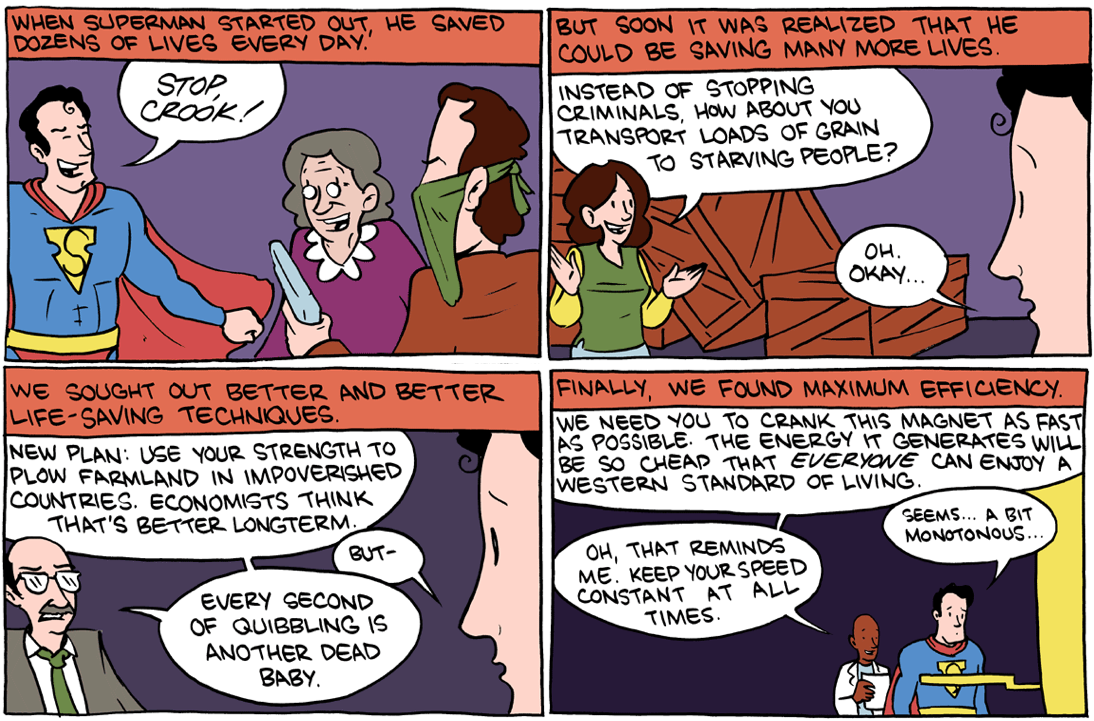
When most people think of careers that “do good,” the first thing they think of is working at a charity. The problem is that lots of jobs at charities just aren’t that impactful. Some charities focus on programmes that don’t work, like Scared Straight. Others focus on ways of helping that don’t have much leverage, like Superman fighting criminals one-by-one.
Another problem is that many organisations are more constrained by funding than people who want to work there. It’s not unusual for a high-flying lawyer to volunteer at a soup kitchen or animal shelter. But with a billable rate of $100 or even $1,000 an hour, with one hour of work they could donate enough to pay for someone else at minimum wage to do 10 or 100 hours of the same work.19
However, there are plenty of situations when working for a nonprofit is the most effective thing to do. Nonprofits can tackle issues that other organisations can’t: do research that doesn’t earn academic prestige, carry out political advocacy on behalf of disempowered groups, or provide services that would never be profitable in the market.
And there are lots of nonprofits doing great work that really need more people to help scale them up. If your skills are a good match, it’s often possible to make a greater contribution through building an organisation than through donating to it.
When we surveyed organisations we think are impactful about how many donations they’d be willing to give up in order to retain key members of staff, they often gave figures in the hundreds of thousands per year, if not more. This means if you could be a key employee at an impactful organisation, that’s probably better than earning to give. If there’s a specific organisation you’re considering working at, you could try asking them whether they’d prefer your work or your donations.
Earlier we met Jeff, who took a job at Google so he could earn to give. But after ten years on that path he decided to make a change. He’d been sceptical about working on existential risks for years, because he was worried that it was too difficult to measure your progress reducing them. But he’d become more convinced that there are grounded ways to prevent a pandemic, if not other risks like AI.
When he came across the Nucleic Acid Observatory (now known as SecureBio), a nonprofit project building systems for early detection of novel pandemics, including wastewater monitoring, he was intrigued — especially because it was based near where he lived, in Boston.
He spoke to friends and advisors, and eventually decided to take a job there. Initially he used his software engineering skills to write code and analyse data. But over time the management skills he’d learned in a large company proved more useful, and he was promoted to lead the whole project. He thinks his impact is much higher than it would have been donating to this organisation, because the organisation seems far more limited by talent than funding.
Building organisations enables large groups of people to coordinate. If you can make an organisation of 100 people several percent more efficient, that’s equivalent to them hiring several extra staff. Better yet, if you build a strong enough organisation, it can continue to have impact after you’ve left.
There are also many nonprofits we’d like to see founded, and you could help make sure they exist at all. For example, while lead has been eliminated in high-income countries, it still exists in paint and other products in much of the developing world. Because of lead poisoning, the average child in a low- or middle-income country loses one to six IQ points and has a 50% greater risk of cardiovascular disease. Before the Lead Exposure Elimination Project (LEEP) there was no organisation specialising in lead removal.
Clare Donaldson joined LEEP as its third staff member, helping to manage programmes that presented evidence of high lead levels to government and industry in 16 countries. Because of Clare’s work, the government of Malawi started to enforce its existing regulations against putting lead in paint, and by 2024, the paint market in Malawi had transitioned to being almost entirely lead-free.
Others we’ve worked with joined to help expand the organisation even further. Srujith was working in Bengaluru for a think tank tackling malnutrition among the global poor. He learned about LEEP from our podcast, and joined to help roll out their Indian programmes. Founder’s Pledge estimates that every $1.66 donated to LEEP keeps one child from being exposed to high levels of lead.20 And this was all achieved by a team of under 30.
A common mistake in this category is to try to fix a struggling organisation. If everything is on fire, helping to put out those fires can feel really meaningful. But if the most successful organisations have hundreds of times more impact than the typical ones, improving one of the best by a couple of percent can have more impact than making a bigger contribution to one that’s struggling. And you’ll be less likely to burn out too.
I’ve been talking about nonprofits, but you could also help to build impactful think tanks, research groups, advocacy campaigns, and even for-profit companies. Sendwave enables African migrant workers to transfer money to their families through a mobile app for fees of 3%, rather than 10% fees with Western Union.
That means that for every $1 of revenue they earn, they make some of the world’s poorest people several dollars richer. Within three years, they’d already had an impact equivalent to donating millions of dollars to GiveDirectly, and they’ve grown even more since then. The total size of the market is hundreds of billions of dollars — several times larger than all foreign aid spending.

To find impactful organisations, think about which problems you think are most pressing, try to identify the best organisations addressing those problems, and then try to figure out which of them have the most need for your skills. You can see lists of recommended organisations in our problem profiles and on our job board.
See more information about building high-impact organisations:
How to work on organisation building
Founder of new projects tackling top problems
With great power comes great responsibility
This chapter presented five approaches to increasing your influence. But to switch superheroes for a moment, Spiderman’s uncle was right. The more power you have, the more ability you have to change things, for better or worse. While it’s easier to have a big positive impact on the world than most people think, it’s also easier to make things worse.
One reason is that people often don’t compare their impact to the counterfactual. Imagine you’re at the scene of an accident and you see an injured person. In your enthusiasm to help, you push the paramedics out of the way and perform CPR on them yourself. You’re successful and bring them back to consciousness, but because you’re less well-trained, you cause permanent damage to their spine. If you had let the paramedics perform CPR instead, the injured person would have made a full recovery. In this case, the impact you had directly was to save a life, but your counterfactual impact was to cause spine damage.
Now imagine you’re later in your career and running a government department. You believe there’s an important new programme that isn’t getting enough support. By directing resources there, you’ve diverted them from somewhere else. If you’re wrong about the programme being impactful, you’ve made things worse.
In some areas of life, your downsides are relatively capped. If you try to write a great novel, and no one wants to publish it, the worst thing you’ve done is waste some time. But when it comes to doing good, it’s possible to make things a lot worse than you found them. A blunder can set back the reputation of an entire field as well as your own.
If you’re reading this, you may also be more ambitious than average. Ambition often means pursuing a goal single-mindedly. That can help you uncover far more effective ways to make a difference. But the world is too complex to capture everything that matters in a single, simple goal. Pursue one objective too aggressively and you end up ‘reward hacking’ like the misaligned AIs we met in part five — doing something that furthers a specified goal but doesn’t necessarily make the world better overall.21
As people become more influential, their capacity to make things worse increases, and the more cautious they should become. Instead, they often become more sure of themselves and get surrounded by sycophants. Meanwhile, the more power they have, the greater the temptation to act unethically in order to hold onto it.
This might sound a bit discouraging. And to be clear, I think it’s far better to try to make a difference than to sit sceptically on the sidelines. However, it’s worth thinking a little at the start of your career about how to avoid some of these pitfalls, especially if you’re going to aim high.
One way to avoid becoming a reward hacker is to look for courses of action that seem good (or at least neutral) according to many different perspectives, and avoid those that a significant number of experts think would make things a lot worse. Be particularly wary of courses of action that are irreversible. Be ambitious, but not aggressive. Stay open to the possibility that you’re wrong, and hold yourself to higher-than-typical standards of honesty.
Early in your career, seek out mentorship and focus on learning more before making big bets (we’ll discuss how in the next chapter).
Later in your career, set up guardrails to keep yourself on track. Stay friends with people who will call you out. If you’re running an organisation, set up a board who actually have teeth and encourage disagreement. When you face difficult ethical questions, err on the side of caution. You can do a lot to tackle some of the world’s most pressing problems, but we shouldn’t pretend the road is always going to be a straight one.
Read more about how to avoid accidentally making things worse
Which is the right approach for you?
How can you put the advice in this chapter into action? The point of the chapter is to give you more options for how to contribute. So first, try to generate a couple of more specific ideas within each of the five categories.
For example, within communicating ideas, could you become an individual communicator, like on YouTube or Substack? Could you learn marketing and help an organisation spread ideas, or could you community build on the side of another job? Don’t just consider what you can enter today, but also where you might be able to end up in a couple of years.
If you’re already in a career path, how might you use these five strategies to further solutions to the problems you think are most pressing? Could you get involved in political advocacy, consult, or donate? Can you use your skills to help with research or spreading ideas? Is there an impactful organisation who would hire you?
Once you have some more specific ideas, the most important question to ask yourself is which will be the best fit for you, considering your personality and talents (this will be the theme of part 10 on ‘personal fit’).
You might also find that some of these options can let you contribute at a much greater scale than others. In the case of earning to give, you can roughly quantify this in terms of how much you expect to be able to donate. With organisation-building or research, you can try to figure out how many donations relevant organisations would trade for your labour. For communicating ideas, try to think about how many people you might be able to reach and enable to take more impactful actions. These quantifications are difficult, but you might find some paths seem over 10 times better than others.
Which approach to focus on can also depend on the problems you want to support. For instance, breast cancer doesn’t need more advocacy to promote awareness, because almost everyone is aware that breast cancer is a problem. Instead, it probably most needs more skilled researchers to develop better treatments. You can start by asking experts in the issues you’re interested in about what the problem most needs, or you can enter the area and develop your own takes over time.
Remember that the approaches are also not mutually exclusive. For instance, a teacher could help their students (direct impact), but could also develop new educational techniques (research), or tell their students about pressing problems (communicating ideas). We know a teacher who did private tutoring in order to donate more (earning to give). Your impact is often more about how you use your position than the position itself — a job is just a platform for impact.
Finally, don’t compare yourself to other people. Unless you’re the world’s most impactful person, there will always be someone else who’s achieving more. Rather what matters is your personal list of options, and choosing the best option from among them.
Do you need to sacrifice to do good?
In this section of the guide we’ve seen that by considering more abstract and indirect ways to help, you can open up many more routes to doing good with your career than the standard ‘social impact’ careers.
Rosa Parks was a seamstress and helped to trigger the civil rights movement. Alan Turing was a researcher who helped to end World War II with maths. Victor Zhdanov was an unknown Russian bureaucrat who helped to end smallpox. Expanding your options can make it possible to find a career that’s both more personally satisfying and more impactful than what you thought was on the table before.
Earlier, we saw that an enjoyable and fulfilling job:
- Helps others.
- Is something you’re good at.
- Has the right supportive conditions (e.g. engaging work, supportive colleagues, fit with the rest of your life).
In the last three parts of the guide, we’ve seen that the careers which most help others:
- Focus on the most pressing problems — those that are big, neglected, and solvable.
- Let you make the biggest contribution to those problems.
- Provide you with a chance to excel. (We’ll explain how to work out where you have the best personal fit later on).
The more pressing the problem, the bigger your contribution, and the better your fit, the greater your expected impact. If you can find a problem that’s 100 times more pressing, and then a career path that lets you contribute ten times as much to solving it, you’ve increased your impact 1,000 times.
Find something impactful that fits you well, and you’re well on your way to a fulfilling career. You may also have other important personal criteria, like working in a certain location or earning a minimum level of salary. These criteria are not only important to your satisfaction, but also your impact — ignore them and you’re more likely to burn out, decreasing how much you can do in the long term.
More broadly, enjoyment and impact are mutually reinforcing. Enjoy your work and you’ll be a better fit and so achieve more. Have an impact and you’ll gain a sense of purpose that will make you more motivated and satisfied.22
This isn’t to say there are no tradeoffs at all, just that they’re smaller than commonly supposed. In fact, people often think an action isn’t truly altruistic unless it involves self-sacrifice. But what matters is how much you help people, not how much it hurts.
If you can find something with a better impact that’s also better for you personally, that’s better for everyone.
How, then, do you find a job like this? That’s what the next section is all about.
Put into practice
Before we move on, make a long list of ideas for impactful careers you could work towards. Err towards listing more rather than less: as we’ll see, it can be easier to switch into new paths than you might think, and you don’t need to stick to your existing expertise. We’ll come back to how to narrow these ideas down later. To begin, here’s some ways to generate ideas.
- Try to generate 2–3 more specific paths you might take within each broad approach. If you want more detail, see our pages on each approach.
- Earning to give: Some common options include tech startups, investment management, software and ML engineering, jobs at big tech, and consulting. You can also earn a lot in healthcare, corporate management and real estate, while still gaining transferable skills. Less glamorous industries often involve less competition, so can be worth considering too.
- Communicating ideas: This includes organisational communication roles, such as marketing and PR specialist; individual communication roles, such as podcaster, YouTuber, Substacker, journalist, and author; jobs in the media, such as documentary production and journalism; part-time roles combined with another job that pays the bills, such as academic and public speaker; and finally community building roles either full- or part-time.
- Research: This includes academic roles; nonprofit research including think tanks and charities; and corporate research labs. We have advice on which fields to study in part eight on the skills we think will be most useful in the future.
- Government and policy: If becoming a government employee, ask yourself which departments and role types might be best for you. But it could also involve working in political parties, think tanks, and other influencer roles, such as campaigning nonprofits.
- Building organisations: This includes roles in management, entrepreneurship; operations; executive assistance; finance / legal / HR. Which organisations do you think are doing the best work in the problems you think are most pressing? How could you help those organisations? How might you be able to put yourself in a position to help found an impactful organisation in the future?
- If you’re already in a career, how might you use each approach to have a greater impact on pressing problems in your existing role? Could you use your position to spread neglected ideas, help influence policy, consult for an impactful organisation, make donations, or come up with new ideas?
What do the problems you want to focus on most need? To get more ideas, read our profiles. If you have more time, speak to experts in the field or start learning about the area to develop your own takes. Are there evidence-based solutions, hits-based opportunities, or new interventions you could test? When you’ve identified some priorities, how could you best help with them?
To get even more ideas, see our list of impactful careers

Have a greater positive impact with your career
Join our newsletter to receive a free copy of our new career guide, weekly high-impact job opportunities, and updates on our research.
We’ll never share your email, and you can unsubscribe in one click.
Notes and references
- Between 2000 and 2019, the Bill & Melinda Gates Foundation pledged over $3 billion to Gavi — about 20% of its total funding and more than any individual nation. Li et al. estimated that Gavi averted between 30 and 50 million deaths by expanding childhood vaccination programmes in low- and middle-income countries during this period.
For the role of philanthropy in developing the birth control pill and legalising same-sex marriage in the US, see Budiman and their cited sources.
Budiman, Britney. “Seven philanthropic wins: the stories that inspired Open Phil’s offices.” Open Philanthropy, 2 Jul. 2024. open-philanthropy.org/research/seven-philanthropic-wins-the-stories-that-inspired-open-phils-offices/.
Gavi. Annual progress report (2019). Gavi, 2020, pp. 1–68. gavi.org/sites/default/files/programmes-impact/our-impact/apr/Gavi-Progress-Report-2019_1.pdf.
Li, Xiang, et al. “Estimating the health impact of vaccination against ten pathogens in 98 low-income and middle-income countries from 2000 to 2030: a modelling study.” The Lancet, vol. 397, no. 10272, 2021, pp. 398–408. doi.org/10.1016/S0140-6736(20)32657-X.↩
- In 2012, they donated to 80,000 Hours.↩
- Watkins Uiberall found that:
The median salary for [nonprofit] executive directors/CEOs is between $50,000 and $75,000. CEO salaries correlate with organisational budget size. For small organisations, the median salary is between $30,000 and $50,000. Among medium-sized organisations, 36% of CEOs have salaries between $50,000 and $75,000, while 50.5% earn more than $75,000 and 13.5% earn less than $50,000. Among large organisations, 14.2% pay salaries of $100,000 or less; 38.1% pay between $101,000 and $150,000; and 47.7% pay more than $150,000.
Note that this is significantly lower than the median figures reported by the prominent Charity Navigator Annual Survey. This is because Charity Navigator focuses on ‘mid to large’ US charities, which pay substantially higher salaries.
Watkins Uiberall. 2012 nonprofit compensation survey. 2012. assets.speakcdn.com/assets/2800/2012_wu_nfp_survey.pdf.↩
. . . those with income between $100,000 and $200,000 contribute, on average, 2.6 percent of their income, which is lower compared to those with income either below $100,000 (3.6 percent) or above $200,000 (3.1 percent).
Rates of charitable giving in the US are among the highest in the world.
“Charitable giving in America: Some facts and figures.” National Center for Charitable Statistics, Urban Institute. nccs.urban.org/nccs/statistics/Charitable-Giving-in-America-Some-Facts-and-Figures.cfm.↩
- According to testimony at Sam Bankman-Fried’s trial:
After the crypto market entered a downturn that spring and many of [the hedge fund] Alameda’s loans were recalled, [Caroline Ellison] testified, Bankman-Fried directed her to repay the lenders with money that could only have been drawn from their sixty-five-billion-dollar line of credit with FTX — that is, with assets that customers believed safe in the exchange’s custody.
Lewis-Kraus, Gideon. “Will Sam Bankman-Fried’s guilty verdict change anything?” The New Yorker, 3 Nov. 2023. newyorker.com/news/our-local-correspondents/the-trials-of-sam-bankman-fried.↩
- Though consider that Engels worked as a factory manager in order to fund Marx’s research.↩
- The first recorded proponent of earning to give, the founder of Methodism, John Wesley, agrees. He advocated the principle, “Gain all you can, save all you can, give all you can,” but caveated this advice by saying we shouldn’t work so hard that we hurt ourselves and that we should “gain all we can without hurting our neighbour.”
We discuss the ethics of taking harmful careers in a lot more detail in our article devoted to the topic.
Wesley, John, and Henry Maldwyn Hughes. The Use of Money. Wesleyan Methodist Union for Social Service, 1912.↩
- See more on the pros and cons in our article about earning to give .↩
- Because we don’t have smallpox death records for most countries and years throughout the early twentieth century, the estimate of its total death toll must rely on some extrapolation.
Fenner et al. estimate that in the early 1950s there were around 50 million smallpox cases worldwide every year (175). Assuming that rate held for each year before 1950, and that one in 10 people who contracted smallpox died — the lower end of the worldwide fatality rate estimated in 1967, after vaccination campaigns had started reducing the death toll — that implies five million × 50 years = 250 million people died in the first half of the twentieth century alone. Assuming the number of deaths then decreased linearly until eradication in 1977, another (5 × 27) / 2 = 67 million people would have died over that period, yielding an estimated death toll of more than 300 million people over the century.
Fenner, Frank, et al. Smallpox and its eradication. World Health Organization, 1987.
Ord, Toby. “Aid works (on average).” StudyLib. studylib.net/doc/13259236/aid-works–on-average–toby-ord-president–giving-what-we.↩
- The Dwarkesh Podcast has earned endorsements from influential figures like Jeff Bezos, Mark Zuckerberg, and Microsoft CEO Satya Nadella.
He discusses how he did it on our podcast.↩
- Copeland quotes a number of historians, concluding:
If Turing and his group had not weakened the U-boats’ hold on the North Atlantic, the 1944 Allied invasion of Europe — the D-Day landings — could have been delayed, perhaps by about a year or even longer, since the North Atlantic was the route that ammunition, fuel, food and troops had to travel in order to reach Britain from America.
Copeland, B. J. “Alan Turing: the codebreaker who saved ‘millions of lives.'” BBC News, June 2012. bbc.com/news/technology-18419691.↩
- Many others contributed, but he built one of the first working computers, and made enormous contributions to founding computer science, so he has one of the best claims to it.
Copeland, B. J. “Alan Turing.” Encyclopaedia Britannica, updated 24 Aug. 2025. britannica.com/biography/Alan-Turing.
Hodges, Andrew. “Alan Turing.” Stanford Encyclopedia of Philosophy, edited by Edward N. Zalta, Fall 2013 ed., Metaphysics Research Lab, Stanford University. plato.stanford.edu/entries/turing/.↩
- According to UNESCO’s 2022 estimates, there were 1,420 full-time equivalent researchers per million people globally, corresponding to 0.142% of the population.
UNESCO Institute for Statistics. “UIS data browser: researchers (in full-time equivalent) per million inhabitants (SDG 9 monitoring).” UNESCO Institute for Statistics, 2025. databrowser.uis.unesco.org/.↩
- For more ideas, and to get a sense of what you might be able to work on in different fields, see our list of potentially high-impact research questions, organised by discipline.↩
- Most scientific articles get little to no attention. One study found that 47% of articles catalogued by the Institute for Scientific Information have never been cited, and more than 80% have been cited fewer than 10 times. Articles in the median social science journal, on average, get only 0.5 citations within two years of publication. The mean number of citations per article in mathematics, law, and history journals is less than one.
By contrast, the top 0.01% of papers in the Institute for Scientific Information have been cited over 1,000 times. Citations per paper are basically distributed by a power law, which means that only a few papers dominate. This trend seems to hold across fields, even when the average number of citations per article varies widely, and a similar distribution holds across individual researchers, not just articles.
Citation count isn’t a perfect measure of the difference in impact between different papers, and in particular could overstate it due to bandwagon effects (everyone cites the first paper on a topic, even if many discovered the same idea around the same time), but could also understate it (a paper could be crucially important but not attract as many citations for unrelated reasons).
Journal Citation Reports (JCR): Impact Factor 2023 (Web of Science). 20 Jun. 2023. Web Archive. lib-pub.iut.ac.ir/sites/lib/files/Site/Impact/MIF%202023.pdf.
Klamer, Arjo, and Hendrik P. van Dalen. “Attention and the art of scientific publishing.” Journal of Economic Methodology, vol. 9, no. 3, 2002, pp. 289–315.
Petersen, Alexander M., Fengzhong Wang, and H. Eugene Stanley. “Methods for measuring the citations and productivity of scientists across time and discipline.” Physical Review E, vol. 81, no. 3, 2010, article 036114. doi.org/10.1103/PhysRevE.81.036114.
Petersen, Alexander M., H. Eugene Stanley, and Sauro Succi. “Statistical regularities in the rank-citation profile of scientists.” Scientific Reports, vol. 1, 2011, article 181. doi.org/10.1038/srep00181.
Radicchi, Filippo, Santo Fortunato, and Claudio Castellano.”Universality of citation distributions: toward an objective measure of scientific impact.” Proceedings of the National Academy of Sciences, vol. 105, no. 45, 2008, pp. 17268–17272. doi.org/10.1073/pnas.0806977105.
Redner, Sidney. “How popular is your paper? An empirical study of the citation distribution.” The European Physical Journal B, vol. 4, no. 2, 1998, pp. 131–134. doi.org/10.1007/s100510050359.
van Dalen, Hendrik P., and Arjo Klamer. “Is science a case of wasteful competition?” Kyklos, vol. 58, no. 3, 2005, pp. 395–414. doi.org/10.1111/j.0023-5962.2005.00294.x.↩
- Technically, it was the first vaccine cleared for use by a regulator recognised by the World Health Organization as a stringent regulatory authority
Boseley, Sarah, and Josh Halliday. “UK approves Pfizer/BioNTech COVID vaccine for rollout next week.” The Guardian, 2 Dec. 2020. theguardian.com/society/2020/dec/02/pfizer-biontech-covid-vaccine-wins-licence-for-use-in-the-uk.↩
- We’ll discuss which fields to enter and whether to go to graduate school in parts seven and eight. For more resources on research careers, see our article on research skills.↩
- Based on interviews with UK civil servants. For more, see our review of UK civil service careers.↩
- A position working at a soup kitchen is something that would typically be paid around minimum wage, which is about $12 per hour in the US.
In January 2020, almost 90% of Americans earning the minimum wage were earning more than the federal minimum wage due to local minimum wages. The effective nationwide minimum wage (the wage that the average minimum-wage worker earns) was $11.80 in May 2019
Minimum wage in the United States, Wikipedia
- Lead has a major impact on intellectual development and lifetime income, so Founder’s Pledge estimates that every $6 donated results in the equivalent of doubling one child’s income and that each $137 donated saves one DALY.
Barnes, Tom. “Lead Exposure Elimination Project.” Founders Pledge, 1 Aug. 2023. founderspledge.com/research/lead-exposure-elimination-project-leep.↩
- The concept of ‘reward hacking‘ is closely related to Goodhart’s Law: “When a measure becomes a target, it ceases to be a good measure.”
Real examples of people ‘reward hacking’ are common. Tim Harford’s book The Data Detective includes many amusing examples, and his book Messy devotes a whole chapter to them.
There was the time the UK government collected data on how many days people had to wait for an appointment when they called their doctor, which is a useful thing to know. But then the government set a target to reduce the average waiting time. Doctors logically responded by refusing to take any advance bookings at all; patients had to phone up every morning and hope they happened to be among the first to get through. Waiting times became, by definition, always less than a day.
Tim Harford, The Data Detective
Mattson, Christopher, et al. “‘When a Measure Becomes a Target, It Ceases to Be a Good Measure.'” Journal of Graduate Medical Education, vol. 13, no. 1, 2021, pp. 2–5, https://doi.org/10.4300/JGME-D-20-01492.1.↩
- That’s not to say there’s no tradeoff at all. It’s unlikely that the very best career for you personally is also the one that most benefits the world. For example, the careers that are most fulfilling involve helping others in highly visible ways, while as we’ve seen, you can often do more good by helping in more abstract and indirect ways. Likewise, you can often increase your impact by working harder, but at the cost of your social life. Ultimately, you’ll have to make a value judgement about how to weigh helping others against your own interests. But fortunately, the tradeoff is often a lot less than it first seems.↩