

Making your plan and putting it into action: Part 14 How to actually get a job

Table of Contents
When it comes to advice on how to get a job, most of it is pretty bad.
- CollegeFeed suggests that you “be confident” as their first interview tip, which is a bit like suggesting that you should “be employable.”
Many advisors cover the “clean your nails and have a firm handshake” kind of thing.
One of the most popular interview advice videos on YouTube, with over 13 million views, makes the sage point that you definitely mustn’t sit down until you’re explicitly invited to do so by the interviewer.
Who could ever recover from taking a seat a few seconds too early?
Over the years, we’ve sifted through a lot of bad advice to find the nuggets that are actually good. We’ve also hired over 50 people ourselves, so we’ve seen what works from both sides.
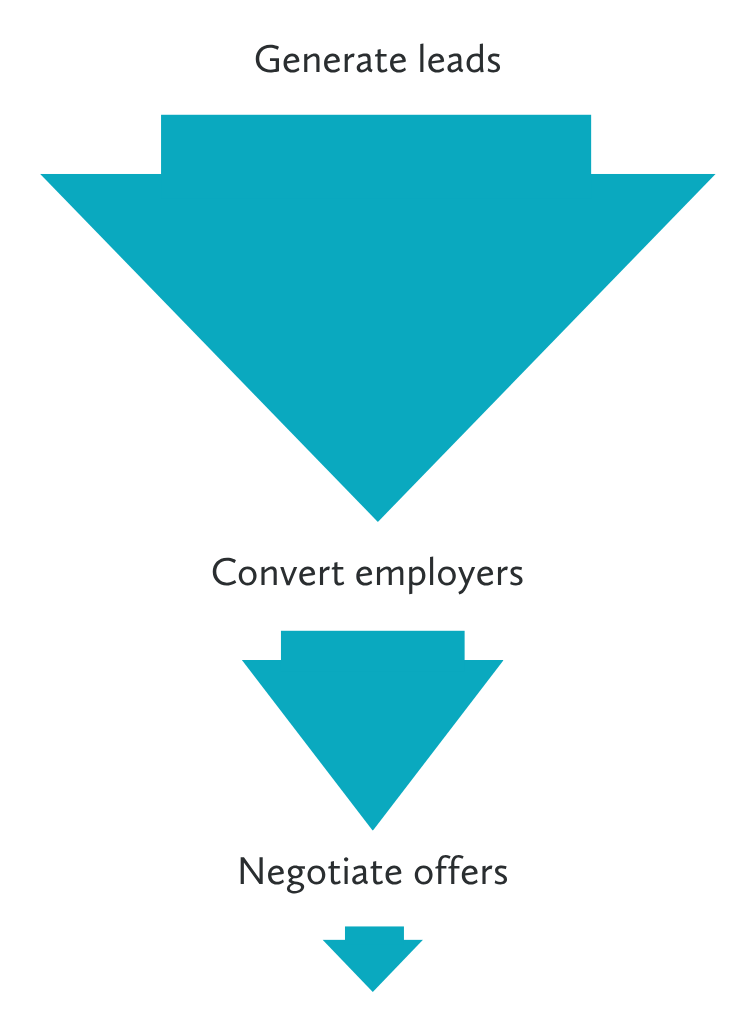
Let’s be blunt. You’re not entitled to a job, and hiring is rarely fair. Rather, getting a job is, at its root, a sales process. You need to persuade someone to give you responsibility and a salary, and even to put their reputation on the line. In exchange, they want results. That’s why it can be helpful to borrow from sales and think about your job search as having three key stages:
- Generating leads
- Convincing employers
- Negotiating offers
While the rest of this guide is about working out which job is best for you and the world, here we focus on the practicalities of taking action on your plans. The recurrent theme is to think from the employer’s point of view, and do whatever they will find most convincing.
Before we start, bear in mind there’s no point using salesmanship to land a job you won’t actually be good at. You won’t enjoy it, and if your performance is worse than the next-best applicant, you’ll have a negative impact.
We wrote this part of the guide to prevent the opposite situation: we’ve seen too many great candidates who want to make a difference failing to live up to their potential because they don’t know how to sell themselves.
Today, AI is rapidly changing how people apply to jobs, but the principles in this article still apply. You can use AI tools to help you better implement them (we’ll give examples).
Reading time: 20 minutes
The bottom line:
How to get a job
Getting a job is fundamentally a sales process with three stages. As you progress, try to think from the employer’s point of view and figure out how to prove you can solve their problems. The three stages are:
- Stage 1: Generate leads through referrals, not job boards.
- Stage 2: Prove you can do the work by actually doing it — with a pre-interview project, portfolio project, or by seeking a related position first. Use AI to help identify your selling points and practice interviews out loud.
- Stage 3: Once you get an offer, actually negotiate.
Be prepared to face a lot of rejection. Treat your search like a job — work 9–5 and use every motivational technique you can. Team up or check in with someone who’s recently gone through it.
Stage 1: Leads

A lead is any opportunity that might turn into a job. It might be a position you could apply for, a friend who might know an opening, or a side project you might be able to get paid for.
We once interviewed someone who became a top NPR journalist. But when he started out, he applied to 70 positions and got only one serious offer.1 This illustrates the first thing to know about leads: you probably need a lot of them. Early in your career, it can easily take 20–100 leads to find one good job, and getting rejected 20 times is normal. In fact, the average length of a spell of unemployment in the US is six months, so be prepared for your job hunt to take that long.
This is especially true if you’re applying to the most desirable jobs. This includes many jobs directly working on the pressing problems we’ve talked about throughout the guide.
Moreover, because we focus on neglected problems, sometimes there just aren’t that many jobs available in these areas. Even if you can find 10 leads for jobs focused on reducing engineered pandemics, it’s still unlikely that will lead to a position. You need to find more leads elsewhere.
To compound the problem, there’s a huge amount of luck involved in getting a job. Most employers are not only looking for general competence, they’re also looking for someone who will fit that particular team and organisation. And they have to make decisions with very little information, which means they’ll make a lot of mistakes.
While bad luck can derail even the best candidates, many people struggle in their job search due to a lack of confidence. We’ve met lots of people who thought they’d never get a certain job, but went on not only to land it, but to excel in it.
Others, meanwhile, are overconfident. We’ve met individuals whose main option was to become an academic, with a backup of working at a nonprofit. But exciting nonprofit roles are also very competitive, so this isn’t really a backup at all.
As we’ve seen, lacking confidence is the more common, and perhaps more dangerous, bias to have. But it’s hard to know whether you’re underconfident or overconfident. This makes it important to pursue both backup and stretch positions. Backup positions are those you’re more confident you’ll land. They reduce the risk of not ending up with anything at all, and can improve your negotiating position. Stretch positions are those you think you’re unlikely to get, but would be great if you do.
Writing all these applications is a lot of work, so it helps to bear in mind that it’s also one of the best ways to assess your fit with a career path — indeed, job applications are specifically designed to assess fit as quickly as possible. This means you stand to learn a lot from applying widely.
How to get leads
Many large organisations, like the government or Teach for America, have a fully standardised application process. They want to keep the process fair, so there isn’t much wiggle room. In those cases, just apply.
But what about all the other cases? The most obvious approach is to send your CV to lots of employers and apply to the postings on job boards. This is often the first thing career advisors mention.2
We would recommend doing this, but the problem is that sending out your CV and responding to lots of internet job ads has a low success rate.
Richard Bolles — author of the bestselling career advice book of all time What Color Is Your Parachute? — estimates that the chance of landing a job from cold-emailing your resume to a company is around one in 1,000, which sounds about right to us.3 This means that (unless your application is much stronger than average) you’ll need to send out 100 resumes just to have a 10% chance of landing a job. We’d estimate that responding to a listing on a job board typically has about a 1% chance of success.
The greater problem is that job postings tend to be dominated by large organisations advertising highly standardised roles. The best opportunities are often at small but rapidly growing companies, where roles can be tailored to you. These types of roles get snapped up before they need to be posted, which means you need a different way to find them. But what is that?
Let’s consider things from the employer’s point of view. They want to find someone they’re confident can do the work as quickly as possible. Which would you prefer: a recommendation from someone you trust, or 20 CVs from people who saw your job listing on Indeed.com?
The referral is more likely to work, because the person has already been vouched for. It’s also less effort. Screening 20 people you know nothing about is hard. Referrals also often come from a better pool of applicants. The most employable people already have lots of offers, so they more rarely respond to job listings.
For these reasons, many recruiters consider referrals to be the best method of finding candidates.4 But job-seekers often get things backwards — beginning instead with the methods that employers least like.
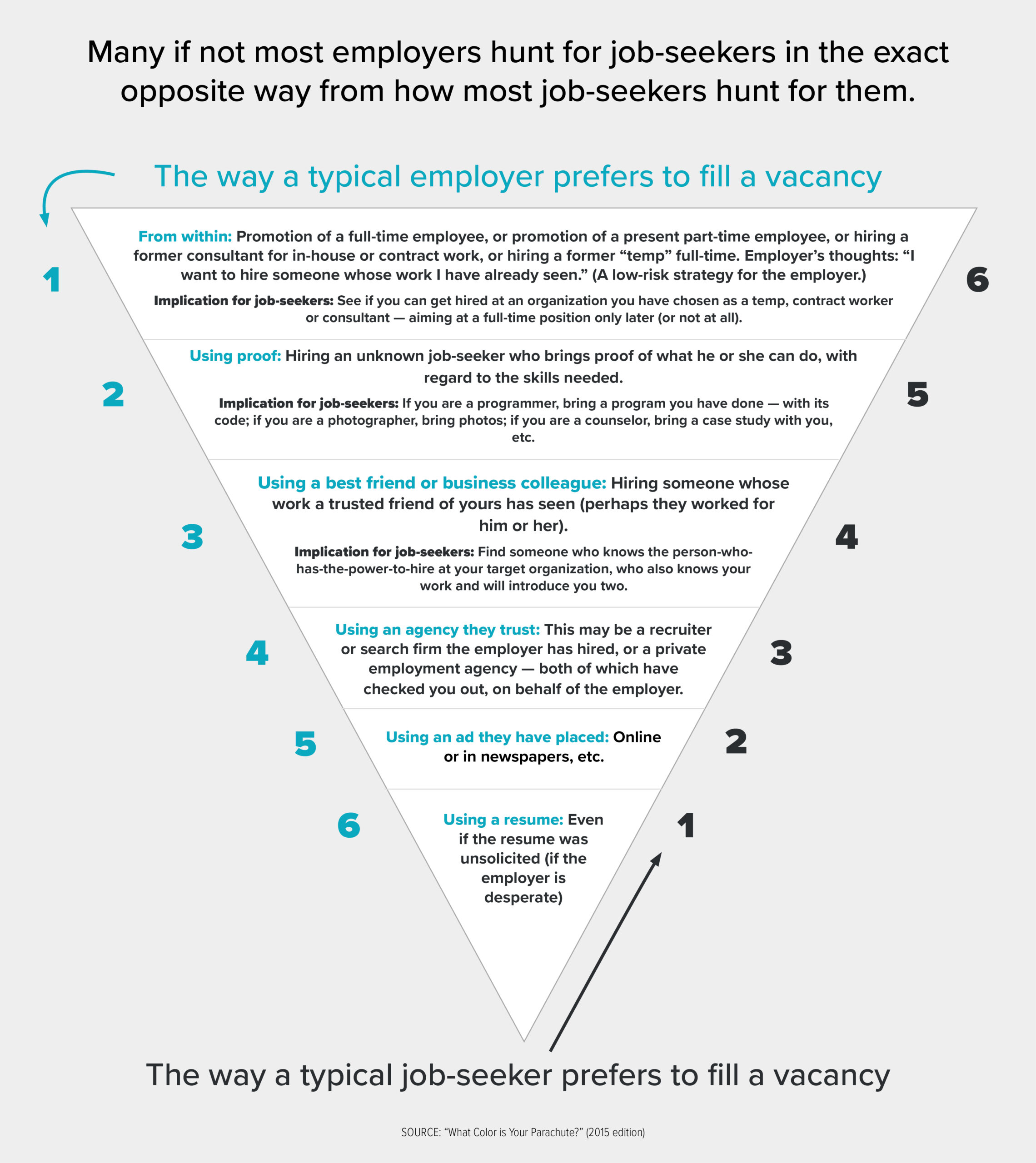
In fact, around 30–50% of jobs are found through connections,5 so if you don’t pursue referrals, you’ll miss many opportunities. And since the odds of a referral converting into a job are higher, you don’t need as many of them.
How do you get referrals? Here’s a step-by-step process. (If you’re not applying for a job right now, skip this section until you are.)
- Update your LinkedIn profile (or personal website and other public social media accounts). This isn’t because you’ll get great job offers through LinkedIn — that’s pretty rare — it’s because people who are considering meeting you will check out your profile. Many people fill up their CVs with everything they’ve done, but it’s usually better to focus your profile on your most impressive accomplishments and be as concrete as possible, e.g. “ranked third in the nation,” “increased annual donations 100%.” Cut the rest. It’s better to have two impressive achievements than two impressive achievements plus three weak ones.
Search yourself on Google and do anything you can to make the results look good (e.g. delete embarrassing posts
If you already know someone in the industry who can hire people, ask for a meeting to discuss opportunities. This is close to going directly to an interview, skipping all the screening steps. Plus, you’ll be able to ask them for really useful information about how to best apply and which positions might best fit you. Remember, there doesn’t need to be an open position — employers will often create positions for good people. (Before you take the meeting, use the advice on how to prepare for interviews later in the article.)
If you know them less well, ask for a meeting to find out more about jobs in the industry: an ‘informational interview.’ If it goes well, ask them to introduce you to people who may be able to hire you, which is a bit like getting a referral from this person. If you promised it was an informational interview, do not ask them for a job.
Prepare a one-sentence description of the types of opportunities you’d like to find and use it when asking for introductions. A good example is something like: “an entry-level marketing position at a technology startup in education.” Two bad examples are: “a job in software” or “a job that fits my skills.” Being concrete makes it easier for people to come up with ideas, so lean towards being too narrow rather than too broad.
Turn to the connections of your connections. If the steps above don’t work, then ask your friends for more referrals to people who might know about jobs. The ideal is to ask someone you’ve worked with previously where you performed well. You can also use LinkedIn to find connections of connections at the organisations you’d like to work at. If you have 100 connections and they each have 100 unique connections, you can reach 10,000 people with this method.6
If you still haven’t got anywhere, then it may be worth spending some time building your connections in the industry first. We’ll cover how to network in part 15. Start with people with whom you have some connection, such as your university alumni and friends of friends of friends. Your university can probably give you a list of alumni who are willing to help in each industry. Otherwise you can resort to cold emailing.7
To do this process well, you need to master the art of asking for introductions. In short, in a sentence or two explain your connection to the person, and explain what you’re after (being specific). If relevant, point out benefits to them, one or two facts that make you credible, and end with a very specific next step. AI can be helpful for drafting these, as well as honing the descriptions of your achievements in your LinkedIn profile and what you’re looking for. As of 2025, we generally find Claude to be the best for natural writing. We also have some email scripts you can use.
By all means, supplement the above with browsing job listings and speaking to recruiters, but referrals should be the core of your process.
If you do make mass applications, AI makes it much easier to customise your materials than in the past. Put as much information about your past work experience as possible into context, feed in the job description, then ask it to edit your application materials to better target that job (making sure to carefully check any additions for errors and AI clichés.)
Stage 2: Conversion
When you’re speaking to someone who has the power to hire you, how do you convince them? Again, think about it from their point of view. When we were trying to hire a web engineer at 80,000 Hours, we found that most applicants just filled out our application form. But one candidate sent us a redesigned version of a career quiz we had up at the time. Which application do you think was more convincing? The person who sent the quiz was immediately in the top couple of applicants despite having very little formal experience (in fact, they were still in high school).
Employers are looking for several qualities. They want employees who will fit in socially, stick around, and won’t cause trouble. But most importantly, they want to be sure that you can solve the problems they face. If you can prove you’ll get the results the employer values the most, everything else will take a back seat.
When the process is highly standardised, you have to jump through equally standardised hoops to offer this proof. Maximise your chances by finding out exactly what the process involves and practicing exactly that. For instance, if it’s a competency interview, where you’ll be asked for evidence of specific abilities deemed most relevant to the job, find out which competencies they look for, then have a friend ask you similar questions and practice responding out loud.8
The most useful thing you can do is to speak to someone else who recently went through the process. Sometimes there are books written about exactly how to apply, and some public service organisations even publish the rubrics they use to assess candidates.
Once you know what competencies they’re looking for, you can upload descriptions of your past work experience, old projects, and written feedback into an AI model and ask it to suggest times you might have demonstrated them. You can also find common interview questions for larger organisations on websites like Glassdoor.
Most employers, however, don’t have a fully standardised process, so what do you do in those cases? The basic idea is: do the work. That is, the most powerful way to prove you can do the work is to actually do some of it. It’s also one of the best ways to discover your fit and learn about what the job actually involves, so it’ll help you avoid wasting your own time too. Here are four forms “doing the work” can take.
1. Do a pre-interview project
The pre-interview project is what the web engineer did with our career quiz. First, for the roles you’re interested in, find out what you’ll actually be doing (this research alone will already put you ahead of most applicants). In particular, what problems will you need to solve? Is the job about optimising a database, helping customers with support requests, figuring out a strategy, spreading an idea, or something else? You’ll probably need to do some desk research, then speak to people in the industry to find this out.
Next, spend a weekend putting together an (at least partial) solution to one of these problems. This could be a couple of pages describing the problem and how you’d fix it, or if it’s a technical challenge, it could be a working demo. When you speak to people at the company, bring up your suggestions. In the most full-on version, you take out a physical copy of your report — a technique the business author Ramit Sethi calls “‘the briefcase technique.” If you haven’t yet had any referrals to someone in the organisation, you can try emailing your proposal to the company. If you don’t hear back after a week, follow up at least once.
We’ve overseen 10 years of competitive application processes, and doing something like this would immediately make you stand out (provided your suggestions made sense). It demonstrates enthusiasm compared to the typical candidate who hardly knows anything about the role they’re applying for.
2. Do a portfolio project
If you want to become a writer or a journalist, run a blog or social feed about a relevant topic. If you want to become a software engineer, put projects on your GitHub. If you want to become a designer, run a slick Instagram. Include these projects on your online profiles. These can generate job opportunities by themselves, but you can also mention them in your applications or during interviews.
After 10 years at 80,000 Hours, I wanted to focus more on writing and research, so I left the CEO role. That gave me space for new opportunities, but I then totally failed to follow my own advice. Part of me was hoping a bunch of opportunities would automatically come my way, since, after all, I thought I’d done a good job. But little surfaced.
I ended up taking a sabbatical (great for my meditation practice but not much help in my career). Some time later, I just started doing the work I was interested in. I created a Substack, began researching the investment implications of AI, and posted about what was happening with AI on X. Within months I had several job offers. Despite having “CEO” on my CV, what collaborators found most convincing was real work relevant to them.
Suppose you’ve been in the corporate sector and want to switch into policy. You can read about the area of policy you’re interested in and start meeting people, but that might not be enough to transition. A portfolio project shows you’re serious and actually have something to offer — and in far less time than doing a fellowship or a master’s.
3. Go for a nearby position
If you can’t get the job you want right away, consider applying for a different position in the organisation. This might be a freelance position or a position one step down from the one you really want.
Working in a nearby position gives you the opportunity to prove your motivation and cultural fit. When your boss has a position to fill, it’s much easier to promote someone they are already working with than to start a lengthy application process.
Just be sure that the position can lead to the one you want. We often see people apply to operations positions at research organisations in the hope of later becoming a researcher. But these paths require very different skills and are treated in most cases as entirely separate tracks. While it does sometimes work out, it’s rare, and is usually just frustrating for both sides.
4. Offer a trial period
If the employer is on the fence about working with you, a final technique that can work in smaller or more flexible organisations is to offer to do a one- to four-week trial period. Make it clear that if the employer isn’t happy at the end, you’ll leave gracefully. If you have the financial flexibility, you could even offer to do the trial at reduced pay, but a trial alone can significantly reduce the employer’s risk. (That said, don’t bring this up unless they’re genuinely on the fence, or it can seem like you’re underselling yourself.)
How to prepare for interviews
If you can show an employer you can solve their problems, you’re most of the way there. That said, it certainly doesn’t hurt to present your story as well as you can. Two people can have exactly the same career capital, but one can make it sound far more compelling. Here’s some of the best advice we’ve found on preparing for interviews:
- When you meet an employer, ask questions that help you understand their challenges, and then discuss how you might be able to help solve them. This is exactly what great salespeople do. A survey of research on sales concluded, “There is a clear statistical association between the use of questions and the success of the interaction.” Moreover, when salespeople were trained to ask more questions, it made them more effective.9
Prepare your three key selling points ahead of the meeting. These are the messages you’ll try to get in during the discussion. For instance: 1) I have done this work successfully before, 2) I want to work on this project because X, and 3) I have suggestions for what I could work on. Writing out your messages ahead of time makes it more likely you’ll mention what’s most important, and three points is about the limit of what your audience will remember.
Prepare 1–2 facts or stories to back up each of your key messages. For instance, if you’re applying to be a web engineer, rather than, “I’m a hard worker,” try, “We were about to get press coverage at short notice, and needed to build a website in 24 hours, so we pulled an all-nighter to build it.” (This is roughly how our website was first launched.) Rather than saying, “I really want to work in this industry,” tell the story of what led you to apply. Stories and concrete details are far more memorable than abstract claims, and again, AI can help you firm up descriptions of your past work.10
Focus on what’s most impressive. What sounds better: “I advised Obama on energy policy” or “I advised Obama on energy policy, and have done a normal job the last three years”? Focusing on your one or two most impressive achievements sounds better, makes it more likely you’ll cover it, and it makes it more likely that your audience will remember it.
Work out how to sum up what you have to offer in a sentence. Steve Jobs didn’t sell millions of iPods by saying they’re 30% better than other MP3 players, but rather with the slogan: “1,000 songs in your pocket.” Having a short, vivid summary makes it easy for other people to promote you on your behalf. Something like “She’s the person who fixed that PR disaster at McKinsey” is good.
Prepare answers to the most likely questions. There are certain questions that almost always come up in interviews, including (1) tell me about yourself — which is an opportunity to tell the story of why you want a role and mention one or two achievements, (2) why do you want this position? and (3) what are your questions for us? — to which you should have a good question. Usually, the interviewer will add some behavioural questions about the traits they care most about. These often start with “Tell me about a time you…” followed by a real-world challenge, like: “showed leadership,” “had to work as a team,” “had to deal with a difficult situation or person,” “failed,” or “succeeded.” If it’s a technical or case study interview, you can get an AI model to generate example cases based on the role and type of work the company does. You can find a list of common interview questions here.
Practise the meeting, from start to finish. If possible, meet with a friend or mentor and have them ask you interview questions, then practice responding. In addition, you can use voice mode in ChatGPT or another service to help you practice. Load up as much context as possible about the job, interviewers, company, and likely questions. Then ask it to do a mock interview and provide feedback on your answers. In the next session, ask it to focus on whatever gaps were identified. If the interview is further away, ask for super critical feedback, but when you’re a few days out, ask it to be more encouraging. Either way, don’t skip practicing out loud. Something can sound great in your head but completely flop when you actually say it. Also ask what’s most likely to go wrong, and plan for what you’ll do if that happens.
Improve your process
Applying to jobs is a difficult skill that takes time to learn. After every interview or other important interaction with an employer, jot down what went well, what could have gone better, and what you’ll do differently next time.
It’s normal to do five interviews and still not make it through to the next stage. If you’ve done more than five, however, consider doing a more thorough reassessment of your approach, since you might be making a mistake in how you present yourself. Ask someone in the area, ideally with hiring experience, to check over your materials and do a mock interview with them (or explain what happened in the interviews).
Similarly, if you’ve made more than 20 applications and haven’t been invited to any interviews, ask someone in the area to review your application materials.
If you can’t find a mistake, then you might be applying to jobs that aren’t a good fit and should consider a different type of role.
If you’ve done 10 interviews and have made it through to the later stages a couple of times, but haven’t yet had any offers, keep going. Often 3–10 people make it through to the final stage, so you’ll probably have to do at least five final-stage interviews before you get an offer. On the other hand, if you’re getting offers with relative ease, then apply to more stretch positions.
Stage 3: Negotiation
Negotiation begins after you have an offer, once the employer has said they’d like to hire you. Most people are so happy to get a job, or feel so awkward about the very idea of negotiating, that they never try. But 10 minutes of negotiation could mean thousands of dollars extra per year, making those minutes some of the most profitable of your life.
Negotiation, however, isn’t only about asking for money. You could also negotiate to work on a certain team, have more flexible hours, or focus on specific skills. All of these could make a big difference to your day-to-day happiness and career capital, and are often much easier than asking for a higher salary. Another idea is to ask your employer to match your donations to charity.
Negotiation is not always appropriate. Don’t do it if you’ve landed a highly standardised offer, like many government positions, since they won’t be able to change the contract. It’s also risky if you don’t have any good alternative options. And definitely don’t negotiate until the employer has made an offer. It’s a bad look to start negotiating during an interview.
Nonetheless, we think negotiation should be tried in most cases once you have an offer. Hiring someone takes months and consumes a lot of management time. By the time an employer has made an offer, they’ve usually invested many thousands of dollars in the process. The top candidate is likely to be significantly better than the next best option. This makes it much less likely that they’d let the top candidate get away for the sake of, say, a 5% increase in costs.11 It’s even more unlikely that they’ll retract their initial offer because you tried to negotiate. Stay polite, and the worst case is probably that they’ll stick to their original offer.
The basic idea of negotiation is simple: explain the value you’ll give the employer, then look for objective metrics and win-wins — can you give up something the employer cares about in exchange for something you care about? For instance:
- Other people with my level of experience in this industry are usually paid $50,000 and can work at home two days per week. But I’d prefer to work with you. Can you match the other companies?
- I’m really motivated to learn sales skills, so I’d like to work alongside person X. This will make me much more effective in the role in six months.
If your position is weaker, you could negotiate about a future promotion or salary increase:
- I’d like to work towards position Y. What would I need to do in the next six months to make that happen?
Then ask them to commit to it if you hit their conditions. Or, push ahead trying to perform as well as possible and plan to negotiate during the next performance review.
Have a plan to stay motivated
Your first job search may be one of the hardest things you’ve ever done. You may have never been rejected 30 times in a row before. It can involve months of work. And you may have to do most of it alone. It can make online dating look easy.
This means you’ll need to throw every motivational technique out there at it. The most useful is to pair up with someone else who’s job hunting. Check in on progress and share tips and leads. Alternatively, find someone who was recently successful at a similar hunt and is willing to meet up periodically and give you advice, or put all your thoughts into an AI model and ask it to act as a coach, helping you figure out what to focus on next week.
Treat it like a job. You’re most likely going to be doing the job for thousands of hours, so it makes sense to spend at least 5% of that time to secure the position, and that’s already 1–2 months of full-time work. The more time you can put into it, the better your results will be, and it can also help a lot with motivation. Find somewhere to serve as your ‘office.’ Turn up at 9:00 AM and work until 5:00 PM.
As with a real job, set yourself specific targets and deadlines, like speaking to five people each week until you have an offer. Publicly commit to the goal and promise to make a forfeit if you miss it, like having to tear up a $100 note. Specifically define when and where you’re going to take the actions needed.12
Finally, try to make it easier to face rejections. Make a loyalty card you stamp each time you get one, and reward yourself once the card is filled up.
Getting a job can be an unpleasant process, but if you go through the steps in this article, you’ll give yourself the best chance of success — fulfilling your potential to find a career that’s both satisfying and that does good in the world.
But even better, you can eventually set yourself up to never need to job-hunt again. The best marketing is word of mouth. If you’re great at your job, then people will actively want to refer you to employers because it’s doing them a favour as well as you, and employers will start to actively seek you out. Likewise, as you make more and more connections, job opportunities will start to arise without you trying. We’ll cover how to do that next.
Put into practice
Who are three people you could speak to in the industry you want to enter? When and how are you going to contact them?
Where else can you get leads? How can you get to at least 30? Include both stretch and backup options.
What might a pre-interview or portfolio project look like in your industry? When can you schedule time to work on this?
Is there anyone else you could pair up with to do your job hunt? Can you treat it like a 9–5, set clear targets and make a commitment?
Optionally, learn more about salary negotiation. Our single top recommendation would be “Salary negotiation: make more money, be more valued” by Patrick McKenzie, but there’s more reading in the footnotes.13
Given all this, what are your top three next actions? And when are you going to do them?
Read next: Part 15: How to network towards a more fulfilling career

Or see an overview of the whole guide.
Have a greater positive impact with your career
Join our newsletter to receive a free copy of our new career guide, weekly high-impact job opportunities, and updates on our research.
We’ll never share your email, and you can unsubscribe in one click.
Notes and references
I applied to over 70 organisations. I got two offers, only one of which paid more than $10,000, so I went with that!
David Folkenfilk
From our article, ‘Tips on careers in journalism from NPR correspondent David Folkenfilk.’↩
- For instance, the UK’s national career advice service lists job boards, alerts from job boards, and internet job listings as their first three tips.
“Where to Find Job Vacancies.” National Careers Service. nationalcareers.service.gov.uk/careers-advice/advertised-job-vacancies.↩
- The 2015 edition of What Color Is Your Parachute? mentions several studies which found success rates per resume of under one in 1,000. His best guess at the overall success rate of sending out your resume is under 10%, which would be consistent with a per-resume figure of one in 1,000 if the average job seeker sent out 100 resumes, which sounds reasonable.↩
- Sam Altman is the former president of Y Combinator, the world’s most successful startup accelerator. In his advice to startups on hiring, which reflects best practice, he says:
Focus on the right ways to source candidates. Basically, this boils down to ‘use your personal networks more.’ By at least a 10x margin, the best candidate sources I’ve ever seen are friends and friends of friends. Even if you don’t think you can get these people, go after the best ones relentlessly. If it works out 5% of the time, it’s still well worth it. When you hire someone, as soon as you’re sure she’s a star you should sit her down and wring out of her the names of everyone that you should try to hire. You may have to work pretty hard at this.
Beyond tech, Nelson Schwartz also describes in The New York Times how referrals are becoming more widely adopted as a key method of hiring across the business world.
Altman, Sam. “How to Hire.” Sam Altman, 23 Sept. 2013. web.archive.org/web/20251230170321/https://blog.samaltman.com/how-to-hire.
Schwartz, Nelson D. “In Hiring, a Friend in Need is a Prospect, Indeed.” The New York Times, 27 Jan. 2013. web.archive.org/web/20251030072036/https://www.nytimes.com/2013/01/28/business/employers-increasingly-rely-on-internal-referrals-in-hiring.html.↩
- While estimates vary depending on the context, 30–50% of workers report having found their current job through a referral. People who live on the same block as higher-paid workers are more likely to get a job than people who live in the same neighbourhood but on a block with lower-paid workers. When they get a job, they also earn more money. Across studies, displaced workers are significantly more likely to find a new job if a higher share of their former coworkers are employed.
Schmutte, Ian. “How Do Social Networks Affect Labor Markets?” IZA World of Labor, 1 Oct. 2016. doi.org/10.15185/izawol.304.↩
- There are lots of people in the 80,000 Hours LinkedIn group who are happy to give advice on applications and may be able to make introductions.↩
- Here’s a guide to getting a job when you have no connections.
And here’s a guide on how to find anyone’s email address.
Belcak, Austin. “How to Get a Job Anywhere without Applying Online.” Cultivated Culture, 20 Jun. 2024. web.archive.org/web/20251114162135/https://cultivatedculture.com/how-to-get-a-job-anywhere-no-connections/.
Duò, Matteo. “13 Ways to Find Someone’s Email Address (Level Up Your Outreach Game).” Kinsta Blog, 28 Aug. 2025. kinsta.com/blog/find-email-address/.↩
- To learn more about how to answer competency interview questions, see:
Mellett, Edward. “Competency-Based Interview Questions (2025 Guide).” WikiJob. 23 Jun. 2025, wikijob.co.uk/interview-advice/interview-questions/competency-based-questions↩
- Conventional advice is about low-value sales, which turn out to benefit from pretty different tactics to high-value sales. To learn more about high-value sales, author Neil Rackham drew from the existing literature and surveyed 35,000 salespeople, making his one of the most thorough reviews we know.
Rackham not only found the techniques that the best salespeople use, he also trained people in these techniques and showed they made them more effective compared to a control group who received normal sales training.
In modern high-value sales there’s a greater emphasis on relationship building, but understanding the customer’s problem clearly is still a core part of the process.↩
- For a popular summary of the research on how to do memorable communication, see Made to Stick by Chip and Dan Heath. It puts a major emphasis on using stories, analogies, and concrete facts to make ideas more memorable.↩
- Though bear in mind if you ask for 5% extra, but in a way that will trigger other employees at the company to ask for more, the total cost to the employer could end up much higher.↩
- This is called an implementation intention, which we’ll see in the appendix makes you much more likely to actually do it.↩
- In tech, the most well-known guide is “Salary negotiation: make more money, be more valued” by Patrick McKenzie. The author has tracked hundreds of people saying they used it to earn more, adding up to millions of dollars of extra salary since it was released.
Rahit Sethi has also written a shorter and more basic guide called “How to negotiate your salary (scripts to use for any job).”
If you want to learn about negotiation in general, you could try one of the classic books like:
Fisher, Roger, William L. Ury, and Bruce Patton. Getting to Yes: Negotiating Agreement Without Giving In. Penguin Books, 2011.
Ury, William. Getting Past No: Negotiating in Difficult Situations. Bantam, 2007.↩