I recently gave a TEDx talk at Cambridge University, where I argue that, most of the time, graduates who want to have a big social impact shouldn’t go straight to work at a charity.
Blog post by Robert Wiblin · Published July 8th, 2015
Effective altruists are out working every day to fix society’s systemic problems. It’s time to definitely rebut the claim that we don’t care about systemic change.
Yesterday we put to rest the idea that 80,000 Hours, and effective altruists more generally, are only enthusiastic about ‘earning to give’. While some people should earn to give, we expect the right share is under 20%, and think that ‘earning to give’ is now more popular among the people who follow our advice than it ideally would be.
Today I want to put to rest another common misunderstanding about effective altruism and 80,000 Hours: that we are against systemic change.1
Despite being the most widespreadcritique of effective altruism, the idea is bizarre on its face. We are pragmatists at heart, and always looking for any ways to more effectively make the world a better place.
Why couldn’t pursuing broad-scale legal, cultural or political changes be the most effective approach to making the world a better place? The answer is simply that they could!
So there is nothing in principle about the idea of maximising the social impact of your work that rules out, or even discourages, seeking systemic change.
What about in practice, though? Here are some systemic changes people who identify as effective altruists are working on today:
Most of the recent Open Philanthropy research and grants, on immigration reform, criminal justice reform, macroeconomics, and international development, are all clearly focussed on huge structural changes of various kinds.
The OpenBorders.info website also researches and promotes the option of dramatic increases in migration from poor to rich countries.
A new startup called EA Policy, recommended for support by my colleagues at EA Ventures, is trialling making submissions to open policy forums held by the US government over this summer.
Our colleagues at the Global Priorities Project research the most important policy priorities for governments, and how they can establish better cost-benefit and decision-making processes.
One of GiveWell’s main goals from the beginning, perhaps it’s primary goal, has been to change the cultural norms within nonprofits, and the standards by which they are judged by donors. They wanted to make it necessary for charities to be transparent with donors, and run projects that actually helped recipients. They have already significantly changed the conversation around charitable giving.
Giving What We Can representatives have met with people in the UK government about options for improving aid effectiveness. One of the first things I wrote when employed by Giving What We Can was about appropriate use of discounts rates by governments thinking about health services. Until recently one Giving What We Can member, who we know well, was working at the UK’s aid agency DfID.
Some 80,000 Hours alumni, most of whom unfortunately would rather remain anonymous, are going into politics, think-tanks, setting up a labour mobility organisations or businesses that facilitate remittance flows.
Several organisations focussed on existential risk (FHI, CSER and FLI jump to mind) take a big interest in government policies, especially those around the regulation of new technologies, or institutions that can improve inter-state cooperation and preclude conflict.
80,000 Hours alumni and effective altruist charities work on or donate to lobbying efforts on animal welfare, such as Humane Society US-FARM, or are activists working for dramatic society-wide changes in how humans view the moral importance of non-human animals.
It looks to me like it’s more accurate to say that effective altruists <3 systemic change.
Norman Borlaug didn’t make millions, his research just saved millions of lives.
One of the most common misconceptions that we’ve encountered about 80,000 Hours is that we’re exclusively or predominantly focused on earning to give. This blog post is to say definitively that this is not the case. Moreover, the proportion of people for whom we think earning to give is the best option has gone down over time.
To get a sense of this, I surveyed the 80,000 Hours team on the following question: “At this point in time, and on the margin, what portion of altruistically motivated graduates from a good university, who are open to pursuing any career path, should aim to earn to give in the long term?” (Please note that this is just a straw poll used as a way of addressing the misconception stated; it doesn’t represent a definitive answer to this question).
Will: 15% Ben: 20% Rob: 10% Roman: 15%
Instead, we think that most people should be doing things like politics, policy, high-value research, for-profit and nonprofit entrepreneurship, and direct work for highly socially valuable organizations.
The misconception persists for a few reasons: when 80,000 Hours first launched, we led with the idea of earning to give very heavily as a marketing strategy; it was true that we used to believe that at least a large proportion of people should aim to earn to give long-term;
Blog post by Robert Wiblin · Published July 3rd, 2015
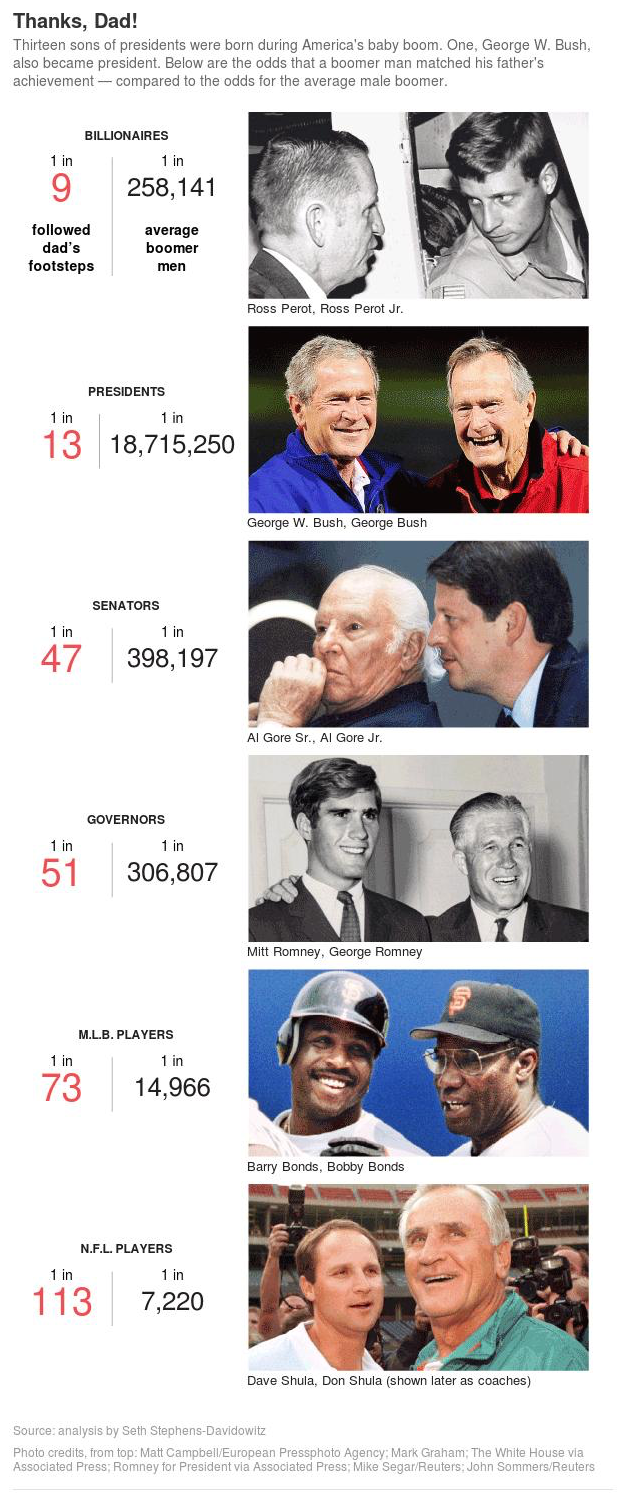
Would Angelina Jolie have been as successful if her father wasn’t Jon Voight?
In our talks we often note that in the past people typically went into the same career as their parents, but today young people are free to choose from a much wider range of options that might suit them better. That’s true, and it’s a great thing. However, there are still sometimes reasons to follow in your parents’ footsteps.
New research shows that working in the same field as a successful parent can give your odds of success a huge boost. Surely some of what’s going on here is that the child of a star parent is more likely to try to enter the same field in the first place, but part must also be that they are more likely to succeed when they do so.
Some, perhaps even most, of that effect will be due to to unfair and zero-sum nepotistic advantage, and so shouldn’t be actively exploited. But part of it must also be down to nothing immoral: you will start learning about the work incidentally from a young age, you’ll happen to make useful contacts as you grow up, and your parent may even be able to offer you personal coaching.
Unfortunately, the boost seems to be largest in fields where performance is hardest to measure (it’s smaller in sport and science) or where a brand surname matters, as in politics.
Here are the results for some of the most competitive positions in society:
I recommend reading the full article which has many more details.
There is some evidence, in fact, that markets for highly skilled workers, such as engineers and other specialized professionals, exhibit systematic periods of boom and bust…1
Earnings tend to fluctuate significantly more in highly skilled professions than in others, rising to high levels for a number of years before plunging and, ultimately, rising again. Why is this the case? Here’s the explanation put forward by Harvard economist George Borjas in his leading textbook on Labor Economics.2
Blog post by Benjamin Todd · Published July 2nd, 2015
If you want to make a difference, should you work in marketing? The short answer: probably not. Although marketing may have positive effects through informing consumers, there’s also arguments that marketing is harmful, so it’s overall effect is unclear.
However, marketing is a valuable, transferable skill. So spending several years in marketing keeps your options open and could open up positions in high-impact organisations.
It’s also well paid, so worth considering for earning to give.
Overall, it’s worth considering as an early career option, especially if you’re stronger on verbal rather than quantitative skills, and don’t want to work in consulting (which is also highly paid and keeps your options open).
Blog post by Robert Wiblin · Published July 2nd, 2015
The short answer to this question is ‘very low’. In total there are 535 seats in Congress and 320 million people living in the USA. At any point then, just 1 in 600,000 people living in the USA are members of Congress.
In a competition this insanely selective, only a small share of the population will have what it takes to seriously pursue a career in national politics. Some people who seem like they could be in with a chance – great undergraduate results, high verbal intelligence, charisma and persuasiveness – come to us looking for advice on their career.
If you were one of these people and actually tried to become a member of Congress, your odds would be much higher than 1 in 600,000 – but how much higher exactly?
It’s not straightforward to find a way to make progress. Nevertheless, we think we have found an approach that can get us in the right ballpark for some kinds of people. The method we will use is called reference class forecasting. In reference class forecasting you find a group that you are a member of and see what share of people in that group succeed.
Who makes it to Congress?
If you want to know how closely you resemble existing members of Congress the paper to start with is ‘Membership of the 114th Congress: A Profile‘, from the Congressional Research Service.
However, we generally do not recommend teaching as the best career path to maximize your social impact: if you’re working in a rich country, the impact you have as a teacher is by improving the lives of people who are almost all going to end up in the richest 15% of the world’s population. Moreover, teaching is an area that is already extremely popular among the socially-motivated, so it’s unlikely that you’ll make as big a difference on the margin within education as you could elsewhere. Further, even the most talented classroom teacher can only impact around 30 students at a time, less than is possible using other approaches.
As with all careers, if you think you could be truly exceptional within this career, but not at others, you should strongly consider it.
Career review by Roman Duda · Last updated July 2015 · First published June 2015
Spending a few years doing marketing in the private sector can teach you highly generalizable skills that can later be used in a wide range of industries and causes. You should consider marketing if you have good social and verbal skills, want a decent work life balance and want to keep your options open across causes.
Blog post by Benjamin Todd · Published June 28th, 2015
I recently came across the following question posted by Paul Buchheit (the founder of Gmail):
Assume that I’m going to get rid of $20,000 and my only concern is the “common good”. Which of these is the best use of the money: give it to the Gates foundation, buy a hybrid car, invest it in a promising startup, invest it in the S&P500, give it to the US government, give it to a school, other?
Many of our users donate money as way to do good with their careers, and I liked this way of posing the question – it’s both broad and concrete. So I spent an hour writing out a rough answer.
I’ll take each option in turn and eliminate the worst ones, then compare a shortlist at the end.
The environment in which we’re making decisions is sufficiently predictable
We have enough experience making similar decisions in similar environments
We’ve had good feedback on past decisions
What does all this mean for career choice? For the big questions like “in which career will I be most successful?” and “in which career can I have the most impact?” these conditions do not hold, so we shouldn’t expect our gut instinct to be reliable. Generally career decisions are new, one-off and have unclear feedback, so it’s difficult for our gut to learn how to handle them.
However, our gut instinct should do a good job at some important inputs into career decisions, such as “do I like these people?”, “can I trust this person?”, “am I excited by this work?”. We may also be able to rely on our gut if its tapping into the experience of others. If you’re experiencing a negative gut reaction to a career decision, it may be due to a problem with one of these factors.
To most people, this question sounds like a joke. I think that’s the wrong reaction. (Full career profile on philosophy PhDs here)
I think research into philosophy (certainly, at least, moral philosophy, and some other areas in political philosophy, epistemology and decision theory), is potentiallyextremelyvaluable. The impact of philosophy on the world seems to me to have been vast. Aristotle, Aquinas and Augustine shaped much of Christian ethics. Locke heavily influenced the American constitution. Peter Singer helped give rise to both the animal welfare movement and to the effective altruism community, and Nick Bostrom has catalyzed concern for existential risks, in particular risks from artificial intelligence. If you include aspects of the Bible (such as the Ten Commandments and the Golden Rule), the writings of Budda and the writings of Confucius as philosophy, as I think you should, then most people for most of civilization have had large chunks of their lives shaped by the philosophical views of the time…
Blog post by Roman Duda · Published June 25th, 2015
We just completed an exploratory profile on journalism. To write the profile, we interviewed an NPR correspondent and a writer for the New Yorker, and spent a day reading the best advice we could find on the career.
When it comes to having a social impact, journalism might not be the first career you think of, but we think it’s actually a pretty good option, because you can use it as a platform to promote neglected causes to a big audience. The main downside is its competitiveness, which is exasperated by reductions in the number of positions over the last decade. Spending a couple of years in journalism is also better for career capital than it first looks, because you can use it the build a good network.
A computer science PhD offers the chance to become a leading researcher in a highly important field with potential for transformational research. Especially consider it if you want to enter computer science academia or do high-level research in industry and expect to be among the top 30% of PhD candidates.
A computer science PhD offers the chance to become a leading researcher in a highly important field with potential for transformational research. Especially consider it if you want to enter computer science academia or do high-level research in industry and expect to be among the top 30% of PhD candidates.
Most people qualified to do a computer science PhD should seriously consider doing a PhD focussed on Machine Learning, which we cover in another profile.
An economics PhD is one of the most attractive graduate programs: if you get through, you have a high chance of landing a good research job in academia or policy – promising areas for social impact – and you have back-up options in the corporate sector since the skills you learn are in-demand (unlike many PhD programs). You should especially consider an economics PhD if you want to go into research roles, are good at maths (i.e. quant GRE score above 165) and have a proven interest in economics research.
An economics PhD is one of the most attractive graduate programs: if you get through, you have a high chance of landing an impactful research job in academia or policy. In particular, academic economics is one of the best ways of conducting and promoting global priorities research, one of our priority paths. You have back-up options in the corporate sector since the skills you learn are in-demand (unlike many PhD programs). You should especially consider an economics PhD if you want to go into research roles, are good at math (i.e. quant GRE score above 165) and have a proven interest in economics research.
Blog post by Roman Duda · Published June 16th, 2015
We asked someone with a philosophy undergraduate degree from the UK who was applying to economics PhD’s in the US, for advice on how others with a similar background might be able to get into a US economics PhD program.
Blog post by Ryan Carey · Published June 15th, 2015
A new Effective Altruism handbook has been released, which features some of 80,000 Hours’ ideas about high impact careers.
This handbook is made up of blog pieces and essays that are freely available online, and has been compiled by Ryan Carey, and released with some assistance from the Centre for Effective Altruism.
It has 24 mini-chapters altogether, split into five sections What is Effective Altruism, Charity Evaluation, Career Choice, Cause Selection and Organizations. Its foreword by Will MacAskill and Peter Singer, is new, as are concluding letters by seven effective altruist organizations. A lot of discussions have gone into deciding which writings are the best for describing the main concepts of effective altruism, so that’s another reason to check it out.
The rest of the essays are freely available online, and were compiled by Ryan Carey with the support of the Centre for Effective Altruism.
If you have a PhD in a quantitative subject, or if you’re the type of person who would enjoy a quantitative PhD, you should consider data science as an option. You are particularly likely to be well suited if you want to do research that produces immediate and tangible results, and are able to clearly present quantitative findings to people without technical backgrounds.