

How to make a difference: Part 3 3 evidence-based ways anyone can have a real impact, no matter your job

Table of Contents
Every year, thousands of people collect donations for good causes by promising to throw themselves out of planes. Sponsored skydiving sounds like a win-win: the fundraiser gets an exhilarating once-in-a-lifetime experience while raising money for a worthy cause. What could be the harm in that?
Quite a bit, actually. A study of two popular parachuting centres in Britain from 1991–1995 found that approximately 1,500 people went skydiving for charity, collecting more than £120,000. That sounds pretty impressive — until you consider a few caveats.
First, the cost of the skydiving expeditions came out of the donations. So of the £120,000 raised, only £45,000 went to charity. Second, because most of the skydivers were first-time jumpers, they suffered a combined total of 163 injuries, resulting in about 100 hospital stays with an average length of nine days.
In order to treat these injuries, the UK’s National Health Service spent around £610,000. This means the net effect of the fundraisers’ actions was to reduce resources for health services. Ironic, given that many of the charities supported focused on health-related issues.1
 Photo by
 Thankfully, skydiving is a lot safer today than it was in the nineties. And we suspect this study may have underestimated the amount of donations raised. But even if the true amount were five times higher, it would still be less than the healthcare costs. The paper remains a useful illustration of how many attempts to do good can feel intuitive while in reality being ineffective, or even making things worse.
A similar story can be told about volunteering. One problem is that volunteers need to be managed. If untrained volunteers use the time of trained managers, it’s easy for them to cost the organisation more than the value they add.
A big reason many volunteering schemes persist is because volunteers are more likely to donate. When the refugee organisation FORGE cut its volunteering scheme to be more effective overall, it inadvertently triggered a big drop in donations. While volunteering can be effective in the right circumstances, it’s not always guaranteed.
Finally, the most common advice is to focus on changing your behaviour and personal consumption, such as by cycling to work instead of driving, buying ethical products, and reducing your carbon footprint. The problem is many of these changes achieve very little.
All this said, in our research, we’ve found that anyone can do a huge amount to improve the lives of others. This is especially true for those earning an average graduate salary in a rich country. Best of all, they can do this without changing jobs or even making major sacrifices. But they need to be very particular about how they approach it.
Reading time: 10 minutes
The bottom line:
Three ways anyone can have an impact
You don’t need to change careers to have a big impact on the world. Here are three things you can do no matter your job:
- Donate 10% of your income to the most effective charities, such as by taking the Giving What We Can pledge.
- Advocate for important and neglected issues, especially if your country has a large economy or population, through voting, attending town halls, petitioning your representatives, or getting out to vote, all of which can be more effective than is commonly assumed.
- Become a ‘multiplier’ by sharing high-impact job opportunities, fundraising, spreading the word about effective solutions to neglected problems, and finding ways to help the most impactful people, converting your hours into theirs.
1. Donating effectively
How can you take whichever job you’d find most personally rewarding and still do a huge amount of good? Give 10% of your income to the world’s poorest people. It’s as simple as that.
How much good could this do? Here’s a bare minimum.
Since 2008, GiveDirectly has made it possible to give cash directly to the poorest people in East Africa using only a mobile phone. We don’t think this is the most effective way to donate to charity, but it’s simple and quantifiable, so it makes a good starting point.
As we saw in part one, the more money you have, the less additional money will improve your life. The graph below shows some of the same data but now with some other countries added.2 Across the world, it turns out that doubling your income is associated with about a half-point gain in life satisfaction on a scale of 1–10. However, that means that in countries where income is already high, you need to increase it by a lot more to get the same increase in life satisfaction.
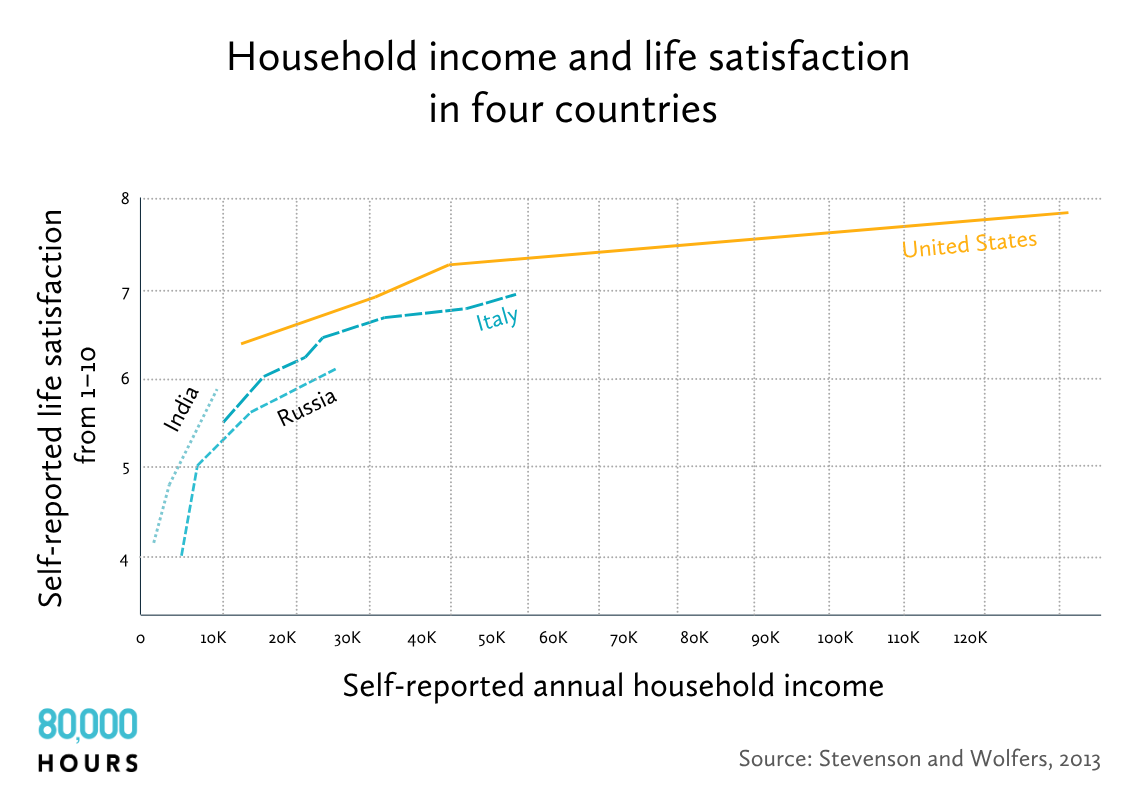
Poor people served by GiveDirectly in Kenya live on about $800 per year.3 This figure is based on how much $800 buys in the US, meaning it already takes account of the fact that money goes further in low-income countries (“purchasing parity“).
Sometimes, people refuse to believe this figure. They say, “if your income were truly $800 per year in the US, it would be impossible to live, and you would die.” And in a sense, that’s right. The people who live on incomes this low do often die as a result.
Over the course of their career, the average US college graduate can expect an income of about $77,000 (in 2023) or $54,500 after tax.4 This means that if someone earning that average level of income were to donate 10%, they could double the annual income of seven people living in extreme poverty each year.
To be a bit more precise, if the relationship between money and wellbeing we described in part one holds, a dollar will do about 68 times more good if you give it to one of the poorest people in Kenya than it would if an average college grad spent it on themselves.5
The impact of this decision can be enormous. Take Grace, a typical recipient of donations from GiveDirectly. She’s a 48-year-old widow who lives with four children in Kenya. When asked what she would do with the money, she said:
Talking about her life in general, she said:
My proudest achievement is that I have managed to educate my son in secondary school. My biggest hardship in life is [that I] lack a proper source of income. My current goals are to build and own a pit latrine and dig a borehole since getting water is a very big problem.
GiveDirectly conducted a randomised controlled trial of their programme and found that recipients saw significant reductions in hunger, stress, and other bad outcomes for years after receiving the transfers. These results add to substantial existing evidence showing that cash transfers have significant benefits.6
How much sacrifice will this involve?
Often when we think of doing good with our careers, we think about paths like teaching or charity work. These roles often pay less than half what you could earn in the private sector and may not align with your preferences. Rather than dedicating 100% of your efforts to one of those paths, giving 10% of your income while doing work you enjoy could be a much smaller sacrifice.
Indeed, as we’ve seen, if you earn over $75,000 as an individual, extra income won’t increase your happiness that much. Doing things that help others, however, including giving to charity, will probably increase your happiness quite a bit.
The reason donations can be so effective is that it’s possible to send your money to the best organisations in the world. Although many charities aren’t effective, the best are. And while GiveDirectly is certainly an effective charity, there are others that are even better.
It’s common to hear charities claim things like “$2 can save a life,” perhaps because $2 is enough to pay for one vaccination. This is technically true in that there’s a small chance it could. But it’s totally misleading — it’s very unlikely that one extra vaccination prevents one fatal case of disease. However, when you vaccinate enough people, saving a life becomes likely.
GiveWell is a leading independent charity evaluator that has spent more than a decade searching for the charity that saves lives most effectively.7 They draw on academic studies, but also make their own, much more sceptical estimates, and vet the organisations they recommend with site visits.
They estimate that their top charities can, on average, save a life with about $3,000. For example, with that sum, London-based NGO Malaria Consortium can provide over 2,000 courses of antimalarial medication, which would protect about 500 children, which, given the prevalence of malaria in those regions, would probably prevent one of them from dying.8 In addition, this provides other benefits that come with not having malaria, such as increased income, which in turn has wider positive effects over time.
With a typical US graduate salary, donating 10% of your income to the Malaria Consortium could therefore save more than two lives every year. That would amount to over 80 lives saved over your career. In the previous section of the guide, we estimated that a typical doctor in clinical medicine saves three lives over their career. This means that by donating 10% of your income, you could achieve over 20 times as much impact on health as you could by becoming a doctor.
These kinds of proven, cost-effective health programmes offer such a good opportunity that even the most vociferous critics of aid have offered few arguments against them.
William Easterly is the author of The White Man’s Burden, perhaps the most famous examination of the ways large-scale, top-down foreign aid has failed to achieve its promise. However, he concludes by calling for governments to:
Put the focus back where it belongs: get the poorest people in the world such obvious goods as the vaccines, the antibiotics, the food supplements, the improved seeds, the fertilizer, the roads . . . This is not making the poor dependent on handouts; it is giving the poorest people the health, nutrition, education and other inputs that raise the payoff to their own efforts to better their lives.
Likewise, Dambisa Moyo is the author of Dead Aid, which argues that most aid is not only inefficient but actively harmful. However, she also emphasises that her argument does not apply to “emergency and charity-based aid” like the essential medical supplies we discuss here.9
That said, we agree there could be even more pressing issues than global health. If you agree too, then the case for donating is even stronger because you can support those even more pressing issues instead. For example, if you think it’s more effective to support systemic change than bottom-up empowerment, you could have an even greater impact by funding those systemic efforts. We’ll come back to which issues might be even more pressing than global health in part five of the guide, or you can read our separate article about how to pick the highest-impact charity.
Wherever you decide to donate, there is huge potential. If everyone in the richest 10% of the world’s population donated 10% of their income, the total sum would add up to $5 trillion per year.10 This would not only be enough to end malaria, but also to double scientific research funding, raise everyone in the world above the $2.15 per day poverty line, provide universal basic education, and still have plenty left to fund a renaissance in the arts, go to Mars… and invest another $1 trillion in mitigating climate change.11
Read more about whether giving 10% will make you happier
How is this possible?
It’s astonishing that we can do so much good while sacrificing so little. But is it too good to be true? Consider one of the most important graphs in economics, the graph of world income:12
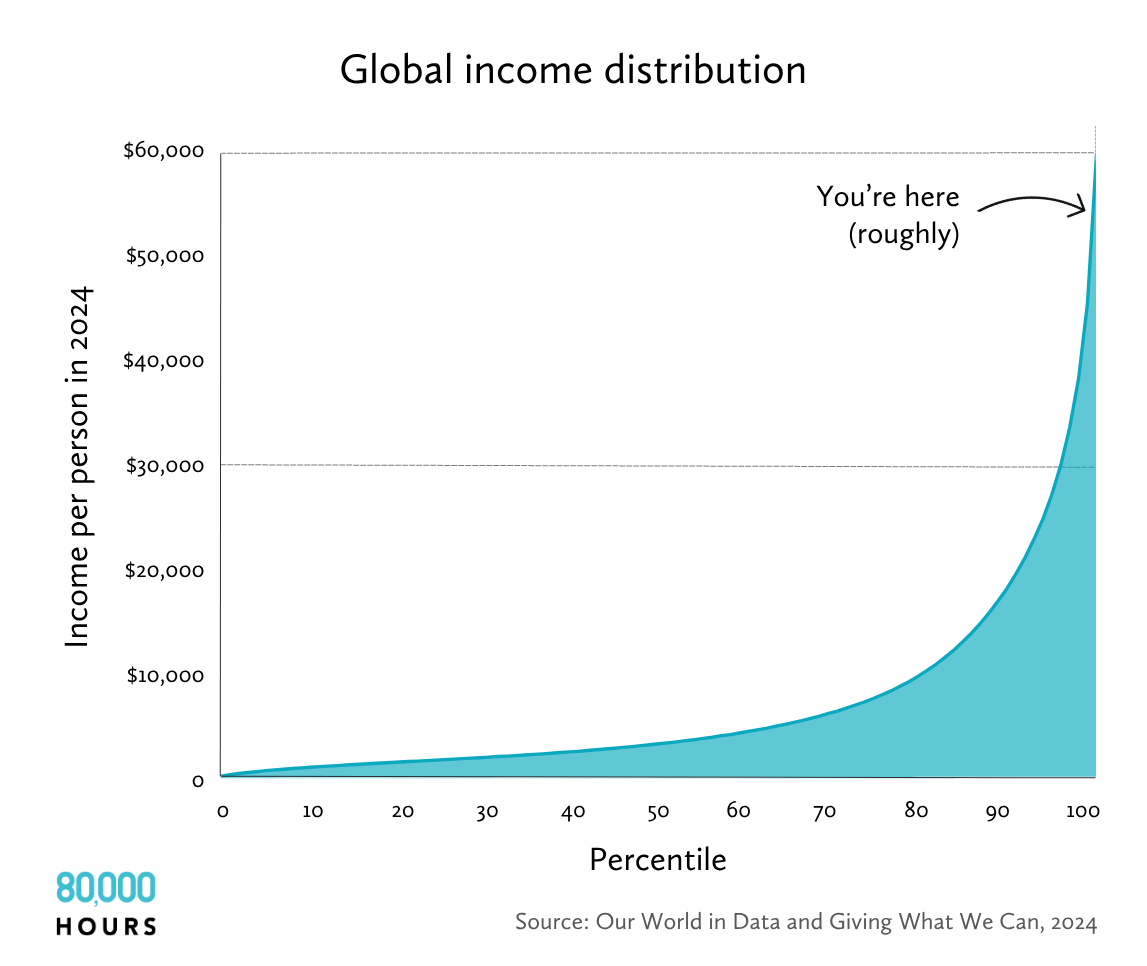
The x-axis shows the percentage of people in the world at each level of income, shown on the y-axis. Income has again been adjusted to indicate how much a dollar will buy in a person’s home country. If the world were completely equal, the line would be horizontal.
Citizens of wealthy countries tend to know they’re rich by global standards, but they don’t usually think of themselves as the richest people in the world — they’re not the bankers, CEOs, or celebrities, after all. But as of 2024, if you earn $70,000 per year after taxes, and don’t have kids, then globally speaking you are the 1%. If you earn over $20,000, then you’re still in the global top 10%.13
Find out how rich you are by using this quick calculator.
These numbers are approximate, but if you’re reading this you’re probably still somewhere in that big spike on the right-hand side of the graph (and perhaps even way off the chart). Most of the world is in the flat bit at the bottom.
There’s no reason to be embarrassed by this fact, but it does emphasise the importance of considering how you can use your good fortune to help others. In a more equal world, we could just focus on helping those immediately around us and making our own lives go well. But in the actual world, we have an enormous opportunity to help people further away with little cost to ourselves — and it would be a shame to squander it.
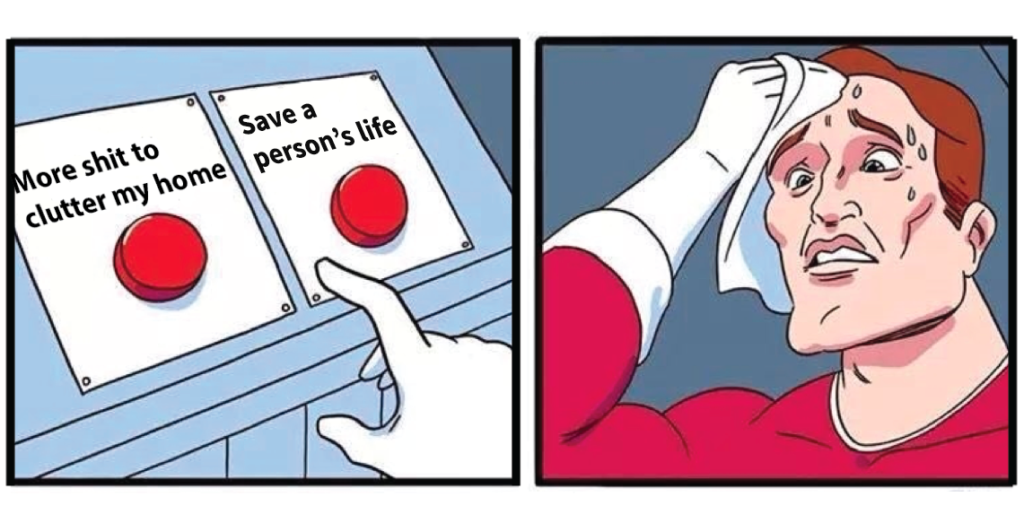
Should you save a person’s life or spend your money on adding more clutter to your home?
Take action right now
Many of the staff at 80,000 Hours, including myself, were persuaded by these arguments and have pledged to give at least 10% of our lifetime income to the world’s most effective charities. We did it through an organisation called Giving What We Can, which was founded by Toby Ord and Will MacAskill.
Giving What We Can enables you to take a public pledge to give 10% of your income to the charities you believe are most effective. You can take the pledge in just a few minutes, and it’s likely to be the most significant thing you can do right now to do more good with your life.
It’s not legally binding, and you get to choose where the money goes. If you’re a student, it only commits you to give 1% until after you graduate. You’ll be joining over 10,000 people who’ve collectively pledged over $1 billion.
The pledge is not for everyone. We’d recommend being cautious if you have significant debt or financial problems, if you’re not sure you can stick to it, or if you’re planning to work in a lower-paid job.
If you’re not quite ready yet, Giving What We Can allows you to take a “trial pledge” to give as little as 1% of your income for any period you choose, letting you see how it goes before making a long-term commitment.
2. Helping through effective advocacy
What about if you don’t want to give money? Just as the lottery of our birthplace can make us rich by global standards, we can also have political influence through blind luck.
Countries with large economies or populations have a disproportionate impact on issues like global trade, migration, climate change, and technology policy. So if you live in a country that’s at least partially democratic, consider advocating for important issues.
We were initially sceptical that one person could make much of a difference through political advocacy — but when we dug into the numbers, we changed our minds.
Let’s take perhaps the simplest example: voting in elections. Several studies have used statistical models to estimate the chances that a single vote could determine the US presidential election. Because the US electoral system is determined at the state level, if you live in a state that strongly favours one candidate, your chance of deciding the outcome is effectively zero. But if you live in a state that’s contested, your chances rise to between one in 10 million and one in a million. That’s quite a bit higher than your chances of winning the lottery.
Remember, the US federal government is big — very big. Let’s imagine one candidate wanted to spend 0.2% more of GDP on foreign aid. That would be about $187 billion of extra foreign aid over their four-year term.14 One millionth of that is $187,000. So if voting takes you an hour, it could be the most important hour — in terms of its expected impact — you’ll spend that year.
You can make a similar argument for other rich countries. While smaller countries have smaller budgets, each vote has more chance of swaying the outcome, so your expected influence ends up about the same. See our full analysis on the impact of voting.
We’ve used the example of voting since it’s quantifiable, but we believe the basic idea — the very small chance of changing a very big thing — applies to other forms of advocacy, such as petitioning your representative, getting out to vote for the right candidate, or going to a town hall meeting — especially if you focus on the most important and more neglected issues.
3. Being a ‘multiplier’ to help others be more effective
Suppose you don’t have any money or influence, and you don’t see a route to getting any. What then?
One option is to try and change that. We cover how to invest in yourself — no matter what job you have — in our article on how to be more successful in any career.
Alternatively, you might know someone else with money, power, or notable skills, and that means you can make a difference by helping them achieve more.
Suppose you come across a high-impact job, but you’re not sure it’s a good fit for your skills. If you can tell someone else about the job, and they take it, that does as much good as if you had taken it yourself — even more if they’re a better fit for it than you.15 This is an example of being a multiplier. By mobilising and enabling others, it’s often possible to do more than you could through just your own efforts.
Likewise, it’s often possible to raise more for charity through fundraising than you can donate yourself. For instance, if you work at a company with a donation-matching scheme, you might be able to encourage other employees to use it.
Maybe you can think of other impactful people in your life and ways you could help them. For instance, if you can save a famous scientist one hour of time by helping them with admin, lab prep, or childcare, that would result in one hour of extra research. What matters is that more good gets done — not that you do it with your own hands.
Here are some additional ways you can become a multiplier:
For whichever global issues you think are most pressing and neglected, you can find ways to share them with others. This is not about preaching, or struggling to convince people. Only share with people you think will find the issue interesting; you probably know some who would. (But look out for accidentally putting people off.)
This is also not just about raising awareness of an issue. Try to identify concrete actions that people can take which might help (like taking a specific job), and spread knowledge of those. Many people are interested in contributing if there’s an opportunity that’s actually effective.
You can do this by talking about the issues with your friends, sharing resources with them, posting links and ideas on social media, or simply by leading by example.
You can also help more indirectly by attempting to uphold important values — like compassion towards others, including animals and future generations, or having an open, honest, scientific mindset towards new evidence.
For example, if you’re interested in effective altruism, then you could help run a local effective altruism group or lead a workplace group. It’s often possible to get several other people interested in having a big impact — doing several times as much good as you might do by yourself.
It’s often possible to raise more for charity through fundraising than you might be able to donate yourself. One easy example is to “donate your birthday.” Or, if you work at a company with a donation-matching scheme, you might be able to encourage other employees to use it.
Anyone can have an impact
So, good news: you don’t need to throw yourself out of a plane to do good. In fact, there are far easier (and safer) ways anyone can have a positive impact, which are also more effective.
Due to our fortunate positions in the world, there’s a lot we can do to make a difference without making significant sacrifices, whatever jobs we end up in. These include:
- Give 10% of your income to effective charities.
- Use your political influence, such as by voting.
- Help others have an impact.
You might like to consider taking the 10% pledge right now. Or take a moment to consider how else you might be able to make a big impact with little sacrifice.
What if you want to make a difference directly through your career? If you can achieve so much with just 10% of your income, then what you could achieve with your entire 80,000 hours over decades could be huge.
That’s what we’ll cover in the next three articles, starting with how to choose a world problem to focus on.
Put into practice
- Could it make sense for you to donate or take the 10% pledge?
Which ideas do you think are most important and neglected? Is there something (non-annoying) you could do to spread them? For example: recommend a podcast to a friend who’d be interested.
Is there a political campaign you could help on a voluntary basis?
Can you think of a person or organisation you think is doing great work? Can you think of any ways you could help them?
What are the best jobs/places to donate/campaigns for making a difference? Can you think of someone else who might be able to take those opportunities?
The upcoming parts of the guide will help you come up with more ideas for how to answer these questions.
Read next: Part 4: How to choose which world problem to focus on
Or see an overview of the whole guide.
Have a greater positive impact with your career
Join our newsletter to receive a free copy of our new career guide, weekly high-impact job opportunities, and updates on our research.
We’ll never share your email, and you can unsubscribe in one click.

Notes and references
- Of the 174 skydivers who were injured, 94% were first-time charity-parachutists. The overall injury rate among charity-parachutists was 11% at an average cost to the health services of £3,751 per casualty. Sixty-three per cent of casualties who were charity-parachutists required hospital admission, representing a serious injury rate of 7% at an average cost of £5,781 per patient. In total, £45,000 was donated to charity, which is £30 per skydiver in the study. Each pound raised for charity cost the National Health Service £13.75 in return.
Lee, C. T., et al. “Parachuting for charity: Is it worth the money? A 5-year audit of parachute injuries in Tayside and the cost to the NHS.” Injury, vol. 30, no. 4, May 1999, pp. 283–287, doi.org/10.1016/S0020-1383(99)00083-2.↩
- This chart only shows correlation, not causation — you can find more detail on causation in our article on whether money makes you happy.
Stevenson, Betsey, and Justin Wolfers. “Subjective well-being and income: Is there any evidence of satiation?” American Economic Review, vol. 103, no. 3, 1 May 2013, pp. 598–604, brookings.edu/~/media/research/files/papers/2013/04/subjective-well-being-income/subjective-well-being-income.pdf.↩
Preliminary results from GiveDirectly’s general equilibrium study indicate that households in the area targeted for that study (in Kenya) are very poor. Endline results from this study in July 2018 found that mean consumption per capita per day in the full population of the control villages was $0.79.
Control group households in Haushofer and Shapiro 2013 had a mean monthly non-durable consumption level of $157.40 USD PPP (Table 1, p. 49). In our [2018] cost-effectiveness model, we use this figure to roughly estimate baseline annual consumption per capita at $286 (nominal USD; see here for more detail). This translates to a daily consumption rate of approximately $0.78 (nominal USD).
GiveWell
To convert $287 per day to a “purchasing power parity” (PPP) figure, we used the World Bank’s record of the nominal KES to USD exchange rate from 2018 to convert this to 29,073.1 Kenyan Shillings.
We then used the World Bank’s PPP conversion factors for 2018, which indicates that 42.55 KES buys the equivalent of $1 in the US. This suggests an effective consumption level of $683.27 in that year.
We then inflation-adjust that figure using the US Consumer Price Index (CPI) from 2018 to January 2023, arriving at a figure of $810–825, depending which months we use.
That’s an equivalent of $2.25, PPP adjusted, per day.This figure is, of course, imprecise. It’s extremely difficult to compare the purchasing power of people living in different countries and circumstances. We discuss some of the problems in our blog post on global income distribution. There are reasons it might be both too low and too high. However, we’d be surprised if it were off by more than a factor of five. Moreover, all the official estimates we’ve seen of the incomes of the poorest billion people agree they are about 10 times poorer than almost everyone living in a rich country, and about 100 times poorer than someone living on an upper-middle-class salary in a rich country.
“GiveDirectly – November 2020 version.” GiveWell, November 2020, givewell.org/charities/give-directly/November-2020-version.↩
- To calculate post-tax income, we plugged $77,000 into the SmartAsset online income tax calculator for someone living in California, which came out at $54,500. This includes federal income tax, FICA, and state tax, resulting in an effective rate of 29%. California generally has higher taxes, so this post-tax income estimate is an underestimate. Calculator accessed 7 September 2025.↩
- If the relationship between income and wellbeing is logarithmic, then doubling someone’s income increases their wellbeing by a constant amount. That means if someone has an income of $54,500 and another has an income of $800, you’d need to increase the first person’s income by $54,500 to increase their wellbeing as much as you would if you increased the second person’s income by $800. $54,500/$800 = 68. We explain why we think the relationship is logarithmic (or perhaps even weaker) in our evidence review on income and happiness.↩
- GiveDirectly has had randomised controlled trials performed on their programmes:
Haushofer, Johannes, and Jeremy Shapiro. “The short-term impact of unconditional cash transfers to the poor: Experimental evidence from Kenya.” The Quarterly Journal of Economics, vol. 131, no. 4, 19 July 2016, pp. 1973–2042, doi.org/10.1093/qje/qjw025.
McIntosh, Craig, and Andrew Zeitlin. “Cash versus kind: Benchmarking a child nutrition program against unconditional cash transfers in Rwanda.” Center for Effective Global Action, University of California, Berkeley, Working Paper Series no. WPS-162, 2021, doi.org/10.26085/C3NC7M.
McIntosh, Craig, and Andrew Zeitlin. “Using household grants to benchmark the cost-effectiveness of a USAID workforce readiness program.” Journal of Development Economics, vol. 157, 29 April 2022, p. 102875, doi.org/10.1016/j.jdeveco.2022.102875.
Egger, Dennis, et al. “General equilibrium effects of cash transfers: Experimental evidence from Kenya.” Econometrica, vol. 90, no. 6, November 2022, pp. 2603–2643, doi.org/10.3982/ecta17945.
There is also a wider body of literature showing benefits from cash transfers:
McGuire, Joel, and Michael Plant. “Cash transfers: Cost-effectiveness analysis.” Happier Lives Institute, October 2021, happierlivesinstitute.org/report/cash-transfers-cost-effectiveness-analysis/.
“Cash transfers.” GiveWell, November 2018, givewell.org/international/technical/programs/cash-transfers.↩
- Coefficient Giving — 80,000 Hours’ biggest funder — was spun out of GiveWell.↩
- This amount is adjusted for compliance and even the risk of displacing other funders. See GiveWell’s estimate of the cost to save a life.
You can also see their in-depth review of Malaria Consortium.
The cost to save a life has varied over time, and between organisations, but has typically been between $3,000 and $5,000.
GiveWell also reported how cost effective it thinks these organisations are compared to GiveDirectly when considering a wider range of effects (such as improvements to education and income), and estimates they are about 10 times more effective.
There’s a lot more to say about how valuable these donations are when we try and consider all the possible effects. You can read more about the philosophical problem of cluelessness. In general, we’d encourage you to consider which global problems you think are most pressing, all things considered (we take a longtermist perspective), and find the best organisations working to address those issues. Read more about how to pick a charity to support.
“How much does it cost to save a life?” GiveWell, April 2024, givewell.org/how-much-does-it-cost-to-save-a-life.
“Malaria Consortium – seasonal malaria chemoprevention.” GiveWell, April 2024, givewell.org/charities/malaria-consortium.↩
- See some other examples of prominent aid sceptics supporting global health here:
Karnofsky, Holden. “The lack of controversy over well-targeted aid.” The GiveWell Blog, 26 July 2016, blog.givewell.org/2015/11/06/the-lack-of-controversy-over-well-targeted-aid/.↩
- The richest 10% of the global population currently takes 52% of global income, PPP-adjusted.
So, if the top 10% give 10%, then that’s 5% of world income. As of 2025, world income is over $100 trillion, so 5% would be around $5 trillion donated.
Chancel, Lucas, et al. World inequality report 2022. World Inequality Lab, 2022, wir2022.wid.world/.
“GDP (current US$).” World Bank Open Data, data.worldbank.org/indicator/NY.GDP.MKTP.CD. Accessed 7 September 2025.↩
- In 2024, the UNU-WIDER (United Nations University World Institute for Development Economics Research) released a paper estimating that ending extreme poverty worldwide would cost around $67 billion per year. This represents roughly $100 per year for each of the 700 million people living in extreme poverty (defined as living on less than $2.15 per day).
The authors of this paper argue that $3.65 per day may be a more meaningful poverty threshold. Most of the world’s extreme poor live in lower-middle income countries where $3.65 is the average poverty line, and people at this income level are more likely to have access to basic healthcare, education, and nutrition than those at the $2.15 line. But even using the $3.65 threshold, ending absolute poverty is estimated to cost around $324 billion per year.
Research and development expenditure as a percentage of GDP was about 2.6% in 2020.
Assuming this proportion has stayed roughly constant, if world GDP is about $96.5 trillion annually, it would cost about $2.5 trillion per year to double global R&D.
Globally, an estimated 244 million children and youth are out of school.
If we suppose it would cost $1,000 to provide education for a single child for one year, then the total cost of universal basic education would be $244 billion annually. For reference, schools in the US spend around $13,000 per person per year.
In 2012, all donations to the arts in the US totalled $13 billion annually. So let’s allocate 10 times that — $130 billion — for funding a renaissance in the arts.
According to Wikipedia, going to Mars has been estimated to cost $500 billion. Though it suggests this is likely an underestimate, we also wouldn’t have to pay for it all in one year, so we’ll go with this figure for our purposes.
Summing all the above with $1 trillion put towards mitigating climate change gets us to just under $4.5 trillion annually, meaning we’d still have nearly $500 billion to spare. So, although all these figures are imprecise, and budgets often blow up, we don’t doubt the basic point that a huge amount of resources would be directed to the most urgent problems.
If this much money was actually given to charity all of a sudden, it would take time for the economy to adapt. Corrupt leaders might try to extract it from their citizens and there could be other unpredictable effects on geopolitics, currency values, and elsewhere. It certainly wouldn’t be straightforward to figure out how to use these resources effectively. However, these figures make clear that there is the potential for enormous gains from greater and more effective charitable giving.
Global Education Monitoring Report Team and UNESCO Institute for Statistics. New estimation confirms out-of-school population is growing in Sub-Saharan Africa. UNESCO, Factsheet 62/Policy Paper 48, 2022, unesdoc.unesco.org/ark:/48223/pf0000382577/PDF/382577eng.pdf.multi.
Hanson, Melanie. “U.S. public education spending statistics.” Education Data Initiative, 8 February 2025, educationdata.org/public-education-spending-statistics.
“How the United States funds the arts.” National Endowment for the Arts, November 2012, arts.gov/impact/research/publications/how-united-states-funds-arts
“Research and development expenditure (% of GDP).” World Bank Open Data, data.worldbank.org/indicator/GB.XPD.RSDV.GD.ZS.
Sumner, Andy, and Aried Anshory Yusuf. New estimates of the cost of ending poverty and its global distribution. UNU-WIDER, July 2024, reliefweb.int/report/world/unu-wider-working-paper-new-estimates-cost-ending-poverty-and-its-global-distribution.↩
- For a detailed discussion of the origins and accuracy of this graph see our blog post on global income distribution.
The data for this graph was originally compiled by Giving What We Can for their How Rich Am I? calculator. First, we took Our World in Data’s global distribution of income. Our World In Data in turn drew on the World Bank’s Poverty and Inequality Platform (PIP). PIP relies on national surveys conducted by individual countries. The national surveys aren’t necessarily comparable. For example, richer countries tend to measure income (how much money someone earns), while poorer countries tend to measure consumption (the number of goods and services someone consumes in a year). These aren’t necessarily comparable: for example, a retiree might buy a lot of goods and services without earning any money. The World Bank tries to make the surveys as comparable as possible, but they still measure somewhat different things in different countries.
Many goods are cheaper in poor countries than in rich countries, so maintaining a particular standard of living requires less money in poorer countries. To account for this, the World Bank adjusts the data for Purchasing Power Parity (PPP). Many of the global poor are subsistence farmers who don’t sell goods or services for money. If someone is a subsistence farmer, their income or consumption is the market value of the goods they produce for themselves.
You can learn more about the assumptions made by the Poverty and Inequality Platform by reading the methodology handbook.
Our World in Data’s latest data is from 2021. To put the data in 2024 dollars, we multiplied it by the inflation rate from 2021–2024 as measured by the Consumer Price Index (CPI).
When making these calculations, we drew on Giving What We Can’s work for their How Rich Am I? calculator.
Arriagada, Pablo. “Global distribution – Giving What We Can.” Our World in Data notebooks, commit 76598f5, 2025. GitHub, github.com/owid/notebooks/tree/main/PabloArriagada/global_distribution_giving_what_we_can.
World Bank. Poverty and inequality platform methodology handbook. Edition 2025-09, 2025, datanalytics.worldbank.org/PIP-Methodology/.↩
- “How rich am I?” Giving What We Can, givingwhatwecan.org/how-rich-am-i?income=70000&countryCode=USA&numAdults=1&numChildren=0.↩
- According to the World Bank, US GDP was about $23.3 trillion in 2021, 0.2% of that is $47 billion. Over a four-year term, that’s $187 billion.
“GDP (current US$): United States.” World Bank Open Data, data.worldbank.org/indicator/NY.GDP.MKTP.CD?locations=US.↩
- Though it also depends on the impact they would have had otherwise.↩