Promoting positive values
Problem profile by Arden Koehler · Published September 2022





In this episode of 80k After Hours, Rob Wiblin interviews Kuhan Jeyapragasan about effective altruism university groups.
From 2015 to 2020, Kuhan did an undergrad and then a master’s in maths and computer science at Stanford — and did a lot to organise and improve the EA group on campus.
Rob and Kuhan cover:
Who this episode is for:
Who this episode isn’t for:
Get this episode by subscribing to our more experimental podcast on the world’s most pressing problems and how to solve them: type ’80k After Hours’ into your podcasting app. Or read the transcript below.
Producer: Keiran Harris
Audio mastering: Ryan Kessler
Transcriptions: Katy Moore
“Gershwin – Rhapsody in Blue, original 1924 version” by Jason Weinberger is licensed under creative commons

People working on suffering risks or s-risks attempt to reduce the risk of something causing vastly more suffering than has existed on Earth so far. We think research to work out how to mitigate these risks might be particularly important. You may also be able to do important work by building this field, which is currently highly neglected — with fewer than 50 people working on this worldwide.


Effective altruism, in a slogan, aims to ‘do the most good.’ Utilitarianism, in a slogan, says we should act to ‘produce the greatest good for the greatest number.’ It’s clear enough why utilitarians should be interested in the project of effective altruism. But what about the many people who reject utilitarianism?
Today’s guest, Andreas Mogensen — senior research fellow at Oxford University’s Global Priorities Institute — does reject utilitarianism, but as he explains, this does little to dampen his enthusiasm for effective altruism.
Andreas leans towards ‘deontological’ or rule-based theories of ethics, rather than ‘consequentialist’ theories like utilitarianism which look exclusively at the effects of a person’s actions.
Like most people involved in effective altruism, he parts ways with utilitarianism in rejecting its maximal level of demandingness, the idea that the ends justify the means, and the notion that the only moral reason for action is to benefit everyone in the world considered impartially.
However, Andreas believes any plausible theory of morality must give some weight to the harms and benefits we provide to other people. If we can improve a stranger’s wellbeing enormously at negligible cost to ourselves and without violating any other moral prohibition, that must be at minimum a praiseworthy thing to do.
In a world as full of preventable suffering as our own, this simple ‘principle of beneficence’ is probably the only premise one needs to grant for the effective altruist project of identifying the most impactful ways to help others to be of great moral interest and importance.
As an illustrative example Andreas refers to the Giving What We Can pledge to donate 10% of one’s income to the most impactful charities available, a pledge he took in 2009. Many effective altruism enthusiasts have taken such a pledge, while others spend their careers trying to figure out the most cost-effective places pledgers can give, where they’ll get the biggest ‘bang for buck’.
For someone living in a world as unequal as our own, this pledge at a very minimum gives an upper-middle class person in a rich country the chance to transfer money to someone living on about 1% as much as they do. The benefit an extremely poor recipient receives from the money is likely far more than the donor could get spending it on themselves.
What arguments could a non-utilitarian moral theory mount against such giving?
Perhaps it could interfere with the achievement of other important moral goals? In response to this Andreas notes that alleviating the suffering of people in severe poverty is an important goal that should compete with alternatives. And furthermore, giving 10% is not so much that it likely disrupts one’s ability to, for instance, care for oneself or one’s family, or participate in domestic politics.
Perhaps it involves the violation of important moral prohibitions, such as those on stealing or lying? In response Andreas points out that the activities advocated by effective altruism researchers almost never violate such prohibitions — and if a few do, one can simply rule out those options and choose among the rest.
Many approaches to morality will say it’s permissible not to give away 10% of your income to help others as effectively as is possible. But if they will almost all regard it as praiseworthy to benefit others without giving up something else of equivalent moral value, then Andreas argues they should be enthusiastic about effective altruism as an intellectual and practical project nonetheless.
In this conversation, Andreas and Rob discuss how robust the above line of argument is, and also cover:
Get this episode by subscribing to our podcast on the world’s most pressing problems and how to solve them: type ‘80,000 Hours’ into your podcasting app. Or read the transcript below.
Producer: Keiran Harris
Audio mastering: Ben Cordell and Beppe Rådvik
Transcriptions: Katy Moore


In this episode of 80k After Hours, Rob Wiblin interviews Andrés Jiménez Zorrilla about the Shrimp Welfare Project, which he cofounded in 2021. It’s the first project in the world focused on shrimp welfare specifically and now has six full-time staff.
They cover:
Who this episode is for:
Who this episode isn’t for:
Get this episode by subscribing to our more experimental podcast on the world’s most pressing problems and how to solve them: type ’80k After Hours’ into your podcasting app. Or read the transcript below.
Producer: Keiran Harris
Audio mastering: Ben Cordell and Ryan Kessler
Transcriptions: Katy Moore
“Gershwin – Rhapsody in Blue, original 1924 version” by Jason Weinberger is licensed under creative commons


At 5:29 AM on July 16, 1945, deep in the Jornada del Muerto desert in New Mexico, the Manhattan Project carried out the world’s first successful test of a nuclear weapon.
From that moment, we’ve had the technological capacity to wipe out humanity.
But if you asked someone in 1945 to predict exactly how this risk would play out, they would almost certainly have got it wrong. They may have thought there would have been more widespread use of nuclear weapons in World War II. They certainly would not have predicted the fall of the USSR 45 years later. Current experts are concerned about India–Pakistan nuclear conflict and North Korean state action, but 1945 was before even the partition of India or the Korean War.
That is to say, you’d have real difficulty predicting anything about how nuclear weapons would be used. It would have been even harder to make these predictions in 1933, when Leo Szilard first realised that a nuclear chain reaction of immense power could be possible, without any concrete idea of what these weapons would look like.
Despite this difficulty, you wouldn’t be wrong to be concerned.
In our problem profile on AI, we describe a very general way in which advancing AI could go wrong. But there are lots of specifics we can’t know much about at this point.
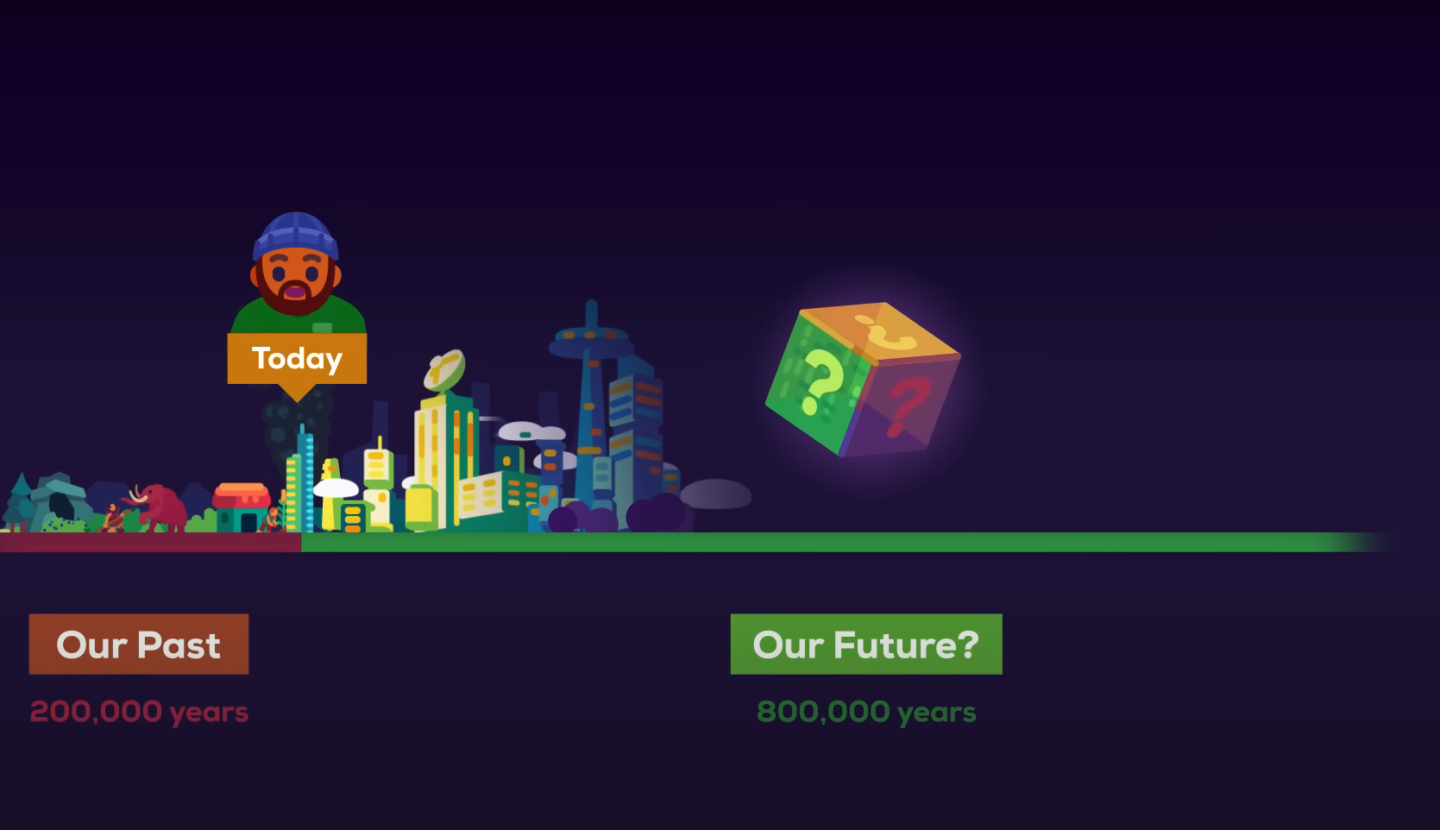
This is the simple four-step argument for ‘longtermism’ put forward in What We Owe The Future, the latest book from today’s guest — University of Oxford philosopher and cofounder of the effective altruism community, Will MacAskill.
From one point of view this idea is common sense. We work on breakthroughs to treat cancer or end use of fossil fuels not just for people alive today, but because we hope such scientific advances will help our children, grandchildren, and great-grandchildren as well.
Some who take this longtermist idea seriously work to develop broad-spectrum vaccines they hope will safeguard humanity against the sorts of extremely deadly pandemics that could permanently throw civilisation off track — the sort of project few could argue is not worthwhile.
But Will is upfront that longtermism is also counterintuitive. To start with, he’s willing to contemplate timescales far beyond what’s typically discussed:
If we last as long as a typical mammal species, that’s another 700,000 years. If we last until the Earth is no longer habitable, that’s hundreds of millions of years. If we manage one day to take to the stars and build a civilisation there, we could live for hundreds of trillions of years. […] Future people [could] outnumber us a thousand or a million or a trillion to one.
A natural objection to thinking millions of years ahead is that it’s hard enough to take actions that have positive effects that persist for hundreds of years, let alone “indefinitely.” It doesn’t matter how important something might be if you can’t predictably change it.
This is one reason, among others, that Will was initially sceptical of longtermism and took years to come around. He preferred to focus on ending poverty and preventable diseases in ways he could directly see were working.
But over seven years he gradually changed his mind, and in What We Owe The Future, Will argues that in fact there are clear ways we might act now that could benefit not just a few but all future generations.
He highlights two effects that could be very enduring: “…reducing risks of extinction of human beings or of the collapse of civilisation, and ensuring that the values and ideas that guide future society are better ones rather than worse.”
The idea that preventing human extinction would have long-lasting impacts is pretty intuitive. If we entirely disappear, we aren’t coming back.
But the idea that we can shape human values — not just for our age, but for all ages — is a surprising one that Will has come to more recently.
In the book, he argues that what people value is far more fragile and historically contingent than it might first seem. For instance, today it feels like the abolition of slavery was an inevitable part of the arc of history. But Will lays out that the best research on the topic suggests otherwise.
For thousands of years, almost everyone — from philosophers to slaves themselves — regarded slavery as acceptable in principle. At the time the British Empire ended its participation in the slave trade, the industry was booming and earning enormous profits. It’s estimated that abolition cost Britain 2% of its GDP for 50 years.
So why did it happen? The global abolition movement seems to have originated within the peculiar culture of the Quakers, who were the first to argue slavery was unacceptable in all cases and campaign for its elimination, gradually convincing those around them with both Enlightenment and Christian arguments. If a few such moral pioneers had fallen off their horses at the wrong time, maybe the abolition movement never would have gotten off the ground and slavery would remain widespread today.
If moral progress really is so contingent, and bad ideas can persist almost without end, it raises the stakes for moral debate today. If we don’t eliminate a bad practice now, it may be with us forever. In today’s in-depth conversation, we discuss the possibility of a harmful moral ‘lock-in’ as well as:
Get this episode by subscribing to our podcast on the world’s most pressing problems and how to solve them: type ‘80,000 Hours’ into your podcasting app. Or read the transcript below.
Producer: Keiran Harris
Audio mastering: Ben Cordell
Transcriptions: Katy Moore
Is transformative AI coming sooner than we thought?
It seems like it probably is, which would mean that work to ensure this transformation goes well (rather than disastrously) is even more urgent than we thought.
In the last six months, there have been some shocking AI advances:
This caused the live forecast on Metaculus for when “artificial general intelligence” will arrive to plunge — the median declined 15 years, from 2055 to 2040.
You might think this was due to random people on the internet over-updating on salient evidence, but if you put greater weight on the forecasters who have made the most accurate forecasts in the past, the decline was still 11 years.
Last year, Jacob Steinhardt commissioned professional forecasters to make a five-year forecast on three AI capabilities benchmarks. His initial impression was that the forecasts were aggressive, but one year in, actual progress was ahead of predictions on all three benchmarks.
Particularly shocking were the results on a benchmark of difficult high school maths problems. The state-of-the-art model leapt from a score of 7% to 50% in just one year — more than five years of predicted progress. (And these questions were hard — e.g.

After a frenetic level of commentary during February and March, the war in Ukraine has faded into the background of our news coverage. But with the benefit of time we’re in a much stronger position to understand what happened, why, whether there are broader lessons to take away, and how the conflict might be ended. And the conflict appears far from over.
So today, we are returning to speak a second time with Samuel Charap — one of the US’s foremost experts on Russia’s relationship with former Soviet states, and coauthor of the 2017 book Everyone Loses: The Ukraine Crisis and the Ruinous Contest for Post-Soviet Eurasia.
As Sam lays out, Russia controls much of Ukraine’s east and south, and seems to be preparing to politically incorporate that territory into Russia itself later in the year. At the same time, Ukraine is gearing up for a counteroffensive before defensive positions become dug in over winter.
Each day the war continues it takes a toll on ordinary Ukrainians, contributes to a global food shortage, and leaves the US and Russia unable to coordinate on any other issues and at an elevated risk of direct conflict.
In today’s brisk conversation, Rob and Sam cover the following topics:
Get this episode by subscribing to our podcast on the world’s most pressing problems and how to solve them: type ‘80,000 Hours’ into your podcasting app. Or read the transcript below.
Producer: Keiran Harris
Audio mastering: Ben Cordell
Transcriptions: Katy Moore

Both the risks and benefits of advances in atomically precise manufacturing seem like they might be significant, and there is currently little effort to shape the trajectory of this technology. However, there is also relatively little investment going into developing atomically precise manufacturing, which reduces the urgency of the issue.

80,000 Hours
80,000 Hours provides research and support to help people switch into careers that effectively tackle the world’s most pressing problems.
We’ve had over 8 million visitors to our website, and more than 3,000 people have told us that they’ve significantly changed their career plans due to our work. We’re also the largest single source of people getting involved in the effective altruism community, according to the most recent EA Survey.
The internal systems team
This role is on the internal systems team, which is here to build the organisation and systems that support 80,000 Hours to achieve its mission.
We oversee 80,000 Hours’ office, tech systems, organisation-wide metrics and impact evaluation, as well as HR, recruiting, finances, and much of our fundraising.
Currently, we have four full-time staff, some part-time staff, and receive support from the Centre for Effective Altruism (our fiscal sponsor).
The role
As 80,000 Hours’ Head of Operations, you would:

Applications for this position are now closed.
We’re looking for a new marketer to help us expand our readership and scale up our marketing channels.
We’d like to support the person in this role to take on more responsibility over time as we expand our marketing team.
80,000 Hours provides free research and support to help people find careers tackling the world’s most pressing problems.
We’ve had over 8 million visitors to our website, and more than 3,000 people have told us that they’ve significantly changed their career plans due to our work. We’re also the largest single source of people getting involved in the effective altruism community, according to the most recent EA Survey.
Even so, about 90% of US college graduates have never heard of effective altruism, and we estimate that just 0.5% of students at top colleges are highly engaged in EA. As a marketer with 80,000 Hours, you would help us achieve our goal of reaching all students and recent graduates who might be interested in our work. We anticipate that the right person in this role could help us grow our readership to 5–10 times its current size, and lead to hundreds or thousands of additional people pursuing high-impact careers.
We’re looking for a marketing generalist who will:

Wind back 1,000 years and the moral landscape looks very different to today. Most farming societies thought slavery was natural and unobjectionable, premarital sex was an abomination, women should obey their husbands, and commoners should obey their monarchs.
Wind back 10,000 years and things look very different again. Most hunter-gatherer groups thought men who got too big for their britches needed to be put in their place rather than obeyed, and lifelong monogamy could hardly be expected of men or women.
Why such big systematic changes — and why these changes specifically?
That’s the question best-selling historian Ian Morris takes up in his book, Foragers, Farmers, and Fossil Fuels: How Human Values Evolve. Ian has spent his academic life studying long-term history, trying to explain the big-picture changes that play out over hundreds or thousands of years.
There are a number of possible explanations one could offer for the wide-ranging shifts in opinion on the ‘right’ way to live. Maybe the natural sciences progressed and people realised their previous ideas were mistaken? Perhaps a few persuasive advocates turned the course of history with their revolutionary arguments? Maybe everyone just got nicer?
In Foragers, Farmers and Fossil Fuels Ian presents a provocative alternative: human culture gradually evolves towards whatever system of organisation allows a society to harvest the most energy, and we then conclude that system is the most virtuous one. Egalitarian values helped hunter-gatherers hunt and gather effectively. Once farming was developed, hierarchy proved to be the social structure that produced the most grain (and best repelled nomadic raiders). And in the modern era, democracy and individuality have proven to be more productive ways to collect and exploit fossil fuels.
On this theory, it’s technology that drives moral values much more than moral philosophy. Individuals can try to persist with deeply held values that limit economic growth, but they risk being rendered irrelevant as more productive peers in their own society accrue wealth and power. And societies that fail to move with the times risk being conquered by more pragmatic neighbours that adapt to new technologies and grow in population and military strength.
There are many objections one could raise to this theory, many of which we put to Ian in this interview. But the question is a highly consequential one: if we want to guess what goals our descendants will pursue hundreds of years from now, it would be helpful to have a theory for why our ancestors mostly thought one thing, while we mostly think another.
Big though it is, the driver of human values is only one of several major questions Ian has tackled through his career.
In Why the West Rules—For Now, he set out to understand why the Industrial Revolution happened in England and Europe went on to dominate much of the rest of the world, rather than industrialisation kicking off somewhere else like China, with China going on to establish colonies in Europe. (In a word: geography.)
In War! What is it Good For?, he tried to explain why it is that violent conflicts often lead to longer lives and higher incomes (i.e. wars build empires which suppress interpersonal violence internally), while other times they have the exact opposite effect (i.e. advances in military technology allow nomads to raid and pull apart these empires).
In today’s episode, we discuss all of Ian’s major books, taking on topics such as:
Get this episode by subscribing to our podcast on the world’s most pressing problems and how to solve them: type ‘80,000 Hours’ into your podcasting app. Or read the transcript below.
Producer: Keiran Harris
Audio mastering: Ben Cordell
Transcriptions: Katy Moore

On January 1, 2015, physicist Max Tegmark gave up something most of us love to do: complain about things without ever trying to fix them.
That “put up or shut up” New Year’s resolution led to the first Puerto Rico conference and Open Letter on Artificial Intelligence — milestones for researchers taking the safe development of highly capable AI systems seriously.
Max’s primary work has been cosmology research at MIT, but his energetic and freewheeling nature has led him into so many other projects that you would be forgiven for forgetting it. In the 2010s he wrote two best-selling books, Our Mathematical Universe: My Quest for the Ultimate Nature of Reality, and Life 3.0: Being Human in the Age of Artificial Intelligence, and in 2014 founded a non-profit, the Future of Life Institute, which works to reduce all sorts of threats to humanity’s future including nuclear war, synthetic biology, and AI.
Max has complained about many other things over the years, from killer robots to the impact of social media algorithms on the news we consume. True to his ‘put up or shut up’ resolution, he and his team went on to produce a video on so-called ‘Slaughterbots’ which attracted millions of views, and develop a podcast and website called ‘Improve The News’ to help readers separate facts from spin.
But given the stunning recent advances in capabilities — from OpenAI’s DALL-E to DeepMind’s Gato — AI itself remains top of his mind.
You can now give an AI system like GPT-3 the text: “I’m going to go to this mountain with the faces on it. What is the capital of the state to the east of the state that that’s in?” And it gives the correct answer (Saint Paul, Minnesota) — something most AI researchers would have said was impossible without fundamental breakthroughs just seven years ago.
So back at MIT, he now leads a research group dedicated to what he calls “intelligible intelligence.” At the moment, AI systems are basically giant black boxes that magically do wildly impressive things. But for us to trust these systems, we need to understand them.
He says that training a black box that does something smart needs to just be stage one in a bigger process. Stage two is: “How do we get the knowledge out and put it in a safer system?”
His favourite MIT project so far involved taking a bunch of data from the 100 most complicated or famous physics equations, creating an Excel spreadsheet with each of the variables and the results, and saying to the computer, “OK, here’s the data. Can you figure out what the formula is?”
For general formulas, this is really hard. About 400 years ago, Johannes Kepler managed to get hold of the data that Tycho Brahe had gathered regarding how the planets move around the solar system. Kepler spent four years staring at the data until he figured out what the data meant: that planets orbit in an ellipse.
Max’s team’s code was able to discover that in just an hour.
Today’s conversation starts off giving a broad overview of the key questions about artificial intelligence: What’s the potential? What are the threats? How might this story play out? What should we be doing to prepare?
Rob and Max then move on to recent advances in capabilities and alignment, the mood we should have, and possible ways we might misunderstand the problem.
They then spend roughly the last third talking about Max’s current big passion: improving the news we consume — where Rob has a few reservations.
They also cover:
Get this episode by subscribing to our podcast on the world’s most pressing problems and how to solve them: type ‘80,000 Hours’ into your podcasting app. Or read the transcript below.
Producer: Keiran Harris
Audio mastering: Ben Cordell
Transcriptions: Katy Moore

There is (sometimes) such a thing as a free lunch
You live in a world where most people, most of the time, think of things as categorical, rather than continuous. People either agree with you or they don’t. Food is healthy or unhealthy. Your career is ‘good for the world,’ or it’s neutral, or maybe even it’s bad — but it’s only the category that matters, not the size of the benefit or harm. Ideas are wrong, or they are right. Predictions end up confirmed or falsified.
In my view, one of the central ideas of effective altruism is the realisation that ‘doing good’ is not such a binary. That as well as it mattering that we help others at all, it matters how much we help. That helping more is better than helping less, and helping a lot more is a lot better.
For me, this is also a useful framing for thinking rationally. Here, rather than ‘goodness,’ the continuous quantity is truth. The central realisation is that ideas are not simply true or false; they are all flawed attempts to model reality, and just how flawed is up for grabs. If we’re wrong, our response should not be to give up, but to try to be less wrong.
When you realise something is continuous that most people are treating as binary,

If a business has spent $100 million developing a product, it’s a fair bet that they don’t want it stolen in two seconds and uploaded to the web where anyone can use it for free.
This problem exists in extreme form for AI companies. These days, the electricity and equipment required to train cutting-edge machine learning models that generate uncanny human text and images can cost tens or hundreds of millions of dollars. But once trained, such models may be only a few gigabytes in size and run just fine on ordinary laptops.
Today’s guest, the computer scientist and polymath Nova DasSarma, works on computer and information security for the AI company Anthropic with the security team. One of her jobs is to stop hackers exfiltrating Anthropic’s incredibly expensive intellectual property, as recently happened to Nvidia. As she explains, given models’ small size, the need to store such models on internet-connected servers, and the poor state of computer security in general, this is a serious challenge.
The worries aren’t purely commercial though. This problem looms especially large for the growing number of people who expect that in coming decades we’ll develop so-called artificial ‘general’ intelligence systems that can learn and apply a wide range of skills all at once, and thereby have a transformative effect on society.
If aligned with the goals of their owners, such general AI models could operate like a team of super-skilled assistants, going out and doing whatever wonderful (or malicious) things are asked of them. This might represent a huge leap forward for humanity, though the transition to a very different new economy and power structure would have to be handled delicately.
If unaligned with the goals of their owners or humanity as a whole, such broadly capable models would naturally ‘go rogue,’ breaking their way into additional computer systems to grab more computing power — all the better to pursue their goals and make sure they can’t be shut off.
As Nova explains, in either case, we don’t want such models disseminated all over the world before we’ve confirmed they are deeply safe and law-abiding, and have figured out how to integrate them peacefully into society. In the first scenario, premature mass deployment would be risky and destabilising. In the second scenario, it could be catastrophic — perhaps even leading to human extinction if such general AI systems turn out to be able to self-improve rapidly rather than slowly, something we can only speculate on at this point.
If highly capable general AI systems are coming in the next 10 or 20 years, Nova may be flying below the radar with one of the most important jobs in the world.
We’ll soon need the ability to ‘sandbox’ (i.e. contain) models with a wide range of superhuman capabilities, including the ability to learn new skills, for a period of careful testing and limited deployment — preventing the model from breaking out, and criminals from breaking in. Nova and her colleagues are trying to figure out how to do this, but as this episode reveals, even the state of the art is nowhere near good enough.
In today’s conversation, Rob and Nova cover:
Get this episode by subscribing to our podcast on the world’s most pressing problems and how to solve them: type ‘80,000 Hours’ into your podcasting app. Or read the transcript below.
Producer: Keiran Harris
Audio mastering: Ben Cordell and Beppe Rådvik
Transcriptions: Katy Moore