#132 – Nova DasSarma on why information security may be critical to the safe development of AI systems

If a business has spent $100 million developing a product, it’s a fair bet that they don’t want it stolen in two seconds and uploaded to the web where anyone can use it for free.

This problem exists in extreme form for AI companies. These days, the electricity and equipment required to train cutting-edge machine learning models that generate uncanny human text and images can cost tens or hundreds of millions of dollars. But once trained, such models may be only a few gigabytes in size and run just fine on ordinary laptops.

Today’s guest, the computer scientist and polymath Nova DasSarma, works on computer and information security for the AI company Anthropic with the security team. One of her jobs is to stop hackers exfiltrating Anthropic’s incredibly expensive intellectual property, as recently happened to Nvidia. As she explains, given models’ small size, the need to store such models on internet-connected servers, and the poor state of computer security in general, this is a serious challenge.

The worries aren’t purely commercial though. This problem looms especially large for the growing number of people who expect that in coming decades we’ll develop so-called artificial ‘general’ intelligence systems that can learn and apply a wide range of skills all at once, and thereby have a transformative effect on society.

If aligned with the goals of their owners, such general AI models could operate like a team of super-skilled assistants, going out and doing whatever wonderful (or malicious) things are asked of them. This might represent a huge leap forward for humanity, though the transition to a very different new economy and power structure would have to be handled delicately.


Continue reading →

The case for reducing existential risks

In 1939, Einstein wrote to Roosevelt:

It may be possible to set up a nuclear chain reaction in a large mass of uranium…and it is conceivable — though much less certain — that extremely powerful bombs of a new type may thus be constructed.

Just a few years later, these bombs were created. In little more than a decade, enough had been produced that, for the first time in history, a handful of decision-makers could destroy civilisation.

Humanity had entered a new age, in which we faced not only existential risks from our natural environment, but also the possibility that we might be able to extinguish ourselves.

In this new age, what should be our biggest priority as a civilisation? Improving technology? Helping the poor? Changing the political system?

Here’s a suggestion that’s not so often discussed: our first priority should be to survive.

So long as civilisation continues to exist, we’ll have the chance to solve all our other problems, and have a far better future. But if we go extinct, that’s it.

Why isn’t this priority more discussed? Here’s one reason: many people don’t yet appreciate the change in situation, and so don’t think our future is at risk.

Social science researcher Spencer Greenberg surveyed Americans on their estimate of the chances of human extinction within 50 years. The results found that many think the chances are extremely low,

Continue reading →

#131 – Lewis Dartnell on getting humanity to bounce back faster in a post-apocalyptic world

“We’re leaving these 16 contestants on an island with nothing but what they can scavenge from an abandoned factory and apartment block. Over the next 365 days, they’ll try to rebuild as much of civilisation as they can — from glass, to lenses, to microscopes. This is: The Knowledge!”

If you were a contestant on such a TV show, you’d love to have a guide to how basic things you currently take for granted are done — how to grow potatoes, fire bricks, turn wood to charcoal, find acids and alkalis, and so on.

Today’s guest Lewis Dartnell has gone as far compiling this information as anyone has with his bestselling book The Knowledge: How to Rebuild Civilization in the Aftermath of a Cataclysm.

But in the aftermath of a nuclear war or incredibly deadly pandemic that kills most people, many of the ways we do things today will be impossible — and even some of the things people did in the past, like collect coal from the surface of the Earth, will be impossible the second time around.

As Lewis points out, there’s “no point telling this band of survivors how to make something ultra-efficient or ultra-useful or ultra-capable if it’s just too damned complicated to build in the first place. You have to start small and then level up, pull yourself up by your own bootstraps.”

So it might sound good to tell people to build solar panels — they’re a wonderful way of generating electricity. But the photovoltaic cells we use today need pure silicon, and nanoscale manufacturing — essentially the same technology as microchips used in a computer — so actually making solar panels would be incredibly difficult.

Continue reading →

Let’s get serious about preventing the next pandemic

I recently argued that it’s time for our community to be more ambitious.

And when it comes to preventing pandemics, it’s starting to happen.

Andrew Snyder-Beattie is a programme officer at Open Philanthropy, a foundation which has more than $1 billion available to fund big pandemic-prevent projects. He and Ethan Alley (co-CEO at Alvea) recently wrote an exciting list of projects they’d like to see get founded, including:

  • An international early detection centre
  • Actually good PPE
  • Rapid and broad-spectrum antivirals and vaccines
  • A bioweapons watchdog
  • Self-sterilising buildings
  • Refuges

One of these ideas is already happening. Alvea aims to produce a cheap, flexible vaccine platform using a new type of vaccine (DNA vaccines), starting with an Omicron-specific shot. In two months, they hired 35 people and started preclinical trials.

The above are technical solutions, which make it possible for a relatively small number of people to make a significant difference to the problem. But policy change is also an important angle.

Guarding Against Pandemics was an effort to lobby the US government for $30 billion in funding for pandemic prevention. Unfortunately the relevant bill didn’t pass, but the sum at stake made it clearly worth trying.

Efforts in the UK might be more successful —

Continue reading →

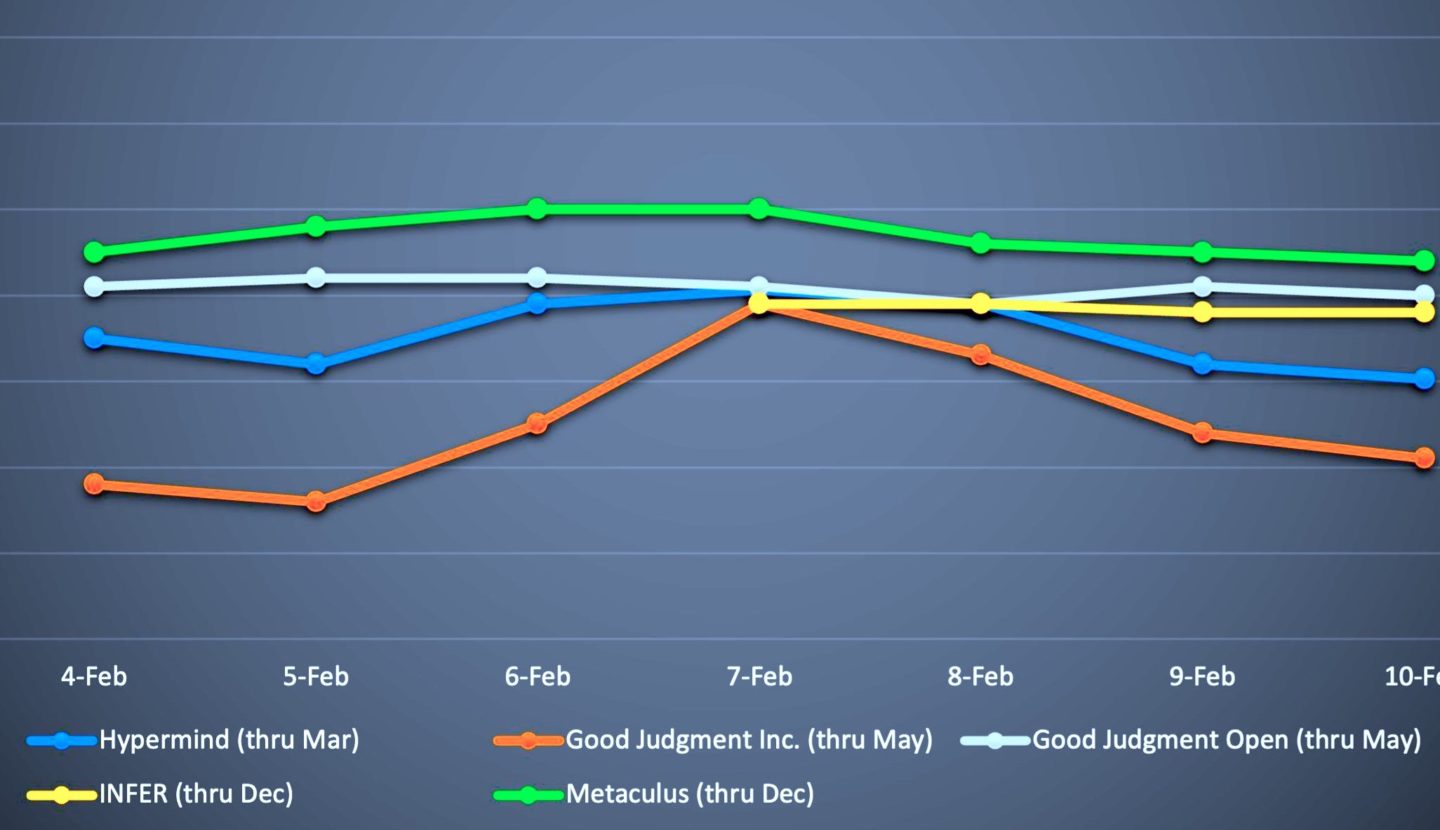
Clay Graubard and Robert de Neufville on forecasting the war in Ukraine

In this episode of 80k After Hours, Rob Wiblin interviews Clay Graubard and Robert de Neufville about forecasting the war between Russia and Ukraine.

They cover:

  • Their early predictions for the war
  • The performance of the Russian military
  • The risk of use of nuclear weapons
  • The most interesting remaining topics on Russia and Ukraine
  • General lessons we can take from the war
  • The evolution of the forecasting space
  • What Robert and Clay were reading back in February
  • Forecasters vs. subject matter experts
  • Ways to get involved with the forecasting community
  • Impressive past predictions
  • And more

Who this episode is for:

  • People interested in forecasting
  • People interested in the war in Ukraine
  • People who prefer to know how likely they are to die in a nuclear war

Who this episode isn’t for:

  • People who’d hate it if a friend said they were 65% likely to come out for drinks
  • People who’d prefer if their death from nuclear war was a total surprise

Continue reading →

#130 – Will MacAskill on balancing frugality with ambition, whether you need longtermism, and mental health under pressure

Imagine you lead a nonprofit that operates on a shoestring budget. Staff are paid minimum wage, lunch is bread and hummus, and you’re all bunched up on a few tables in a basement office.

But over a few years, your cause attracts some major new donors. Your funding jumps a thousandfold, from $100,000 a year to $100,000,000 a year. You’re the same group of people committed to making sacrifices for the cause — but these days, rather than cutting costs, the right thing to do seems to be to spend serious money and get things done ASAP.

You suddenly have the opportunity to make more progress than ever before, but as well as excitement about this, you have worries about the impacts that large amounts of funding can have.

This is roughly the situation faced by today’s guest Will MacAskill — University of Oxford philosopher, author of the forthcoming book What We Owe The Future, and founding figure in the effective altruism movement.

Years ago, Will pledged to give away more than 50% of his income over his life, and was already donating 10% back when he was a student with next to no income. Since then, the coalition he founded has been super successful at attracting the interest of donors who collectively want to give away billions in the way Will and his colleagues were proposing.

While surely a huge success, it brings with it risks that he’s never had to consider before:

  • Will and his colleagues might try to spend a lot of money trying to get more things done more quickly — but actually just waste it.
  • Being seen as profligate could strike onlookers as selfish and disreputable.
  • Folks might start pretending to agree with their agenda just to get grants.
  • People working on nearby issues that are less flush with funding may end up resentful.
  • People might lose their focus on helping others as they get seduced by the prospect of earning a nice living.
  • Mediocre projects might find it too easy to get funding, even when the people involved would be better off radically changing their strategy, or shutting down and launching something else entirely.

Continue reading →

Climate change

Climate change is going to significantly and negatively impact the world. Its impacts on the poorest people in our society and our planet’s biodiversity are cause for particular concern. Looking at the worst possible scenarios, it could be an important factor that increases existential threats from other sources, like great power conflicts, nuclear war, or pandemics. But because the worst potential consequences seem to run through those other sources, and these other risks seem larger and more neglected, we think most readers can have a greater impact in expectation working directly on one of these other risks.

We think your personal carbon footprint is much less important than what you do for work, and that some ways of making a difference on climate change are likely to be much more effective than others. In particular, you could use your career to help develop technology or advocate for policy that would reduce our current emissions, or research technology that could remove carbon from the atmosphere in the future.

Continue reading →

Effective altruism and the current funding situation

This post gives an overview of how I’m thinking about the “funding in EA” issue, building on many conversations. Although I’m involved with a number of organisations in EA, this post is written in my personal capacity. You might also want to see my EAG talk which has a related theme, though with different emphases. For helpful comments, I thank Abie Rohrig, Asya Bergal, Claire Zabel, Eirin Evjen, Julia Wise, Ketan Ramakrishnan, Leopold Aschenbrenner, Matt Wage, Max Daniel, Nick Beckstead, Stephen Clare, and Toby Ord.

Main points

  • EA is in a very different funding situation than it was when it was founded. This is both an enormous responsibility and an incredible opportunity.
  • It means the norms and culture that made sense at EA’s founding will have to adapt. It’s good that there’s now a serious conversation about this.
  • There are two ways we could fail to respond correctly:
    • By commission: we damage, unnecessarily, the aspects of EA culture that make it valuable; we support harmful projects; or we just spend most of our money in a way that’s below-the-bar.
    • By omission: we aren’t ambitious enough, and fail to make full use of the opportunities we now have available to us. Failure by omission is much less salient than failure by commission, but it’s no less real, and may be more likely.
  • Though it’s hard, we need to inhabit both modes of mind at once.

Continue reading →

#129 – Dr James Tibenderana on the state of the art in malaria control and elimination

The good news is deaths from malaria have been cut by a third since 2005. The bad news is it still causes 250 million cases and 600,000 deaths a year, mostly among young children in sub-Saharan Africa.

We already have dirt-cheap ways to prevent and treat malaria, and the fraction of the Earth’s surface where the disease exists at all has been halved since 1900. So why is it such a persistent problem in some places, even rebounding 15% since 2019?

That’s one of many questions I put to today’s guest, James Tibenderana — doctor, medical researcher, and technical director at a major global health nonprofit known as Malaria Consortium. James studies the cutting edge of malaria control and treatment in order to optimise how Malaria Consortium spends £100 million a year across countries like Uganda, Nigeria, and Chad.

In sub-Saharan Africa, where 90% of malaria deaths occur, the infection is spread by a few dozen species of mosquito that are ideally suited to the local climatic conditions and have thus been impossible to eliminate so far.

And as James explains, while COVID-19 may have an ‘R’ (reproduction number) of 5, in some situations malaria has a reproduction number in the 1,000s. A single person with malaria can pass the parasite to hundreds of mosquitoes, which themselves each go on to bite dozens of people each, allowing cases to quickly explode.

The nets and antimalarial drugs Malaria Consortium distributes have been highly effective where distributed, but there are tens of millions of young children who are yet to be covered simply due to a lack of funding.

Continue reading →

Leadership change at 80,000 Hours

Hi readers!

We’ve decided for Howie to become CEO and for me to become President of 80,000 Hours.

After ten years in the role, I’d become less excited about overseeing several aspects of the organisation’s on-going operation. We asked the board to investigate, and their recommendation was that Howie Lempel is the best person to take the org to its next level of scale.

In the President role I hope I’ll be able to focus on my most valuable contributions – providing advice on org strategy & the website, writing, and helping with outreach – and won’t have set responsibilities.

I also have a growing list of other projects in effective altruism that I’m excited to explore.

Howie and I expect the transition to be smooth – in part because Howie is already doing several parts of the role as Chief of Staff. We intend for Howie to officially become CEO this week, and to complete the transfer in about a month.

I’m excited to explore this new role and for 80,000 Hours to continue growing and getting the next generation working on the world’s most pressing problems.

Ben

Note from Howie:

Hi everyone,

I’m really looking forward to taking on this new role and leading 80,000 Hours as we continue to grow.

I’m going to send an initial update on our plans as part of our post-Q2 email update.

Continue reading →

#128 – Chris Blattman on the five reasons wars happen

In nature, animals roar and bare their teeth to intimidate adversaries — but one side usually backs down, and real fights are rare. The wisdom of evolution is that the risk of violence is just too great.

Which might make one wonder: if war is so destructive, why does it happen? The question may sound naïve, but in fact it represents a deep puzzle. If a war will cost trillions and kill tens of thousands, it should be easy for either side to make a peace offer that both they and their opponents prefer to actually fighting it out.

The conundrum of how humans can engage in incredibly costly and protracted conflicts has occupied academics across the social sciences for years. In today’s episode, we speak with economist Chris Blattman about his new book, Why We Fight: The Roots of War and the Paths to Peace, which summarises what they think they’ve learned.

Chris’s first point is that while organised violence may feel like it’s all around us, it’s actually very rare in humans, just as it is with other animals. Across the world, hundreds of groups dislike one another — but knowing the cost of war, they prefer to simply loathe one another in peace.

In order to understand what’s wrong with a sick patient, a doctor needs to know what a healthy person looks like. And to understand war, social scientists need to study all the wars that could have happened but didn’t — so they can see what a healthy society looks like and what’s missing in the places where war does take hold.

Continue reading →

My experience with imposter syndrome — and how to (partly) overcome it

I’ve felt like an imposter since my first year of university.

I was accepted to the university that I believed was well out of my league — my ‘stretch’ school. I’d gotten good grades in high school, but I’d never seen myself as especially smart: I wasn’t selected for gifted programmes in elementary school like some of my friends were, and my standardised test scores were in the bottom half of those attending my university.

I was pretty confident I got into the university because of some fluke in the system (my top hypothesis was that I was admitted as part of an affirmative action initiative) — and that belief stayed with me (and was amplified) during the decade that followed.

Throughout that decade, there was evidence that I really was good at my work at different points, but I could always come up with an explanation for why the evidence was unreliable.

For example, as an undergraduate, I was the only first-year student in my biology department to get a research internship at the Mayo Clinic — one of the most prestigious biomedical institutions in the US. But I felt I only got the internship because I’d met the right person at the right time, and tricked them into thinking I was smarter than I was by saying smart-sounding things.

Likewise, during my final year of university, I was given an award for being the top performer in my sociology department.

Continue reading →

Open position: writer

About the 80,000 Hours web team

80,000 Hours provides free research and support to help people find careers tackling the world’s most pressing problems.

We’ve had over 8 million visitors to our website (with over 100,000 hours of reading time per year), and more than 3,000 people have told us that they’ve significantly changed their career plans due to our work. We’re also the largest single source of people getting involved in the effective altruism community, according to the most recent EA Community Survey.

Our articles are read by thousands, and are among the most important ways we help people shift their careers towards higher-impact options.

The role

As a writer, you would:

  • Research, outline, and write new articles for the 80,000 Hours website — e.g. new career reviews.
  • Rewrite or update older articles with information and resources — e.g. about rapidly evolving global problems.
  • Generate ideas for new pieces.
  • Talk to experts and readers to help prioritise our new articles and updates.
  • Generally help grow the impact of the site.

Some of the types of pieces you could work on include:

Continue reading →