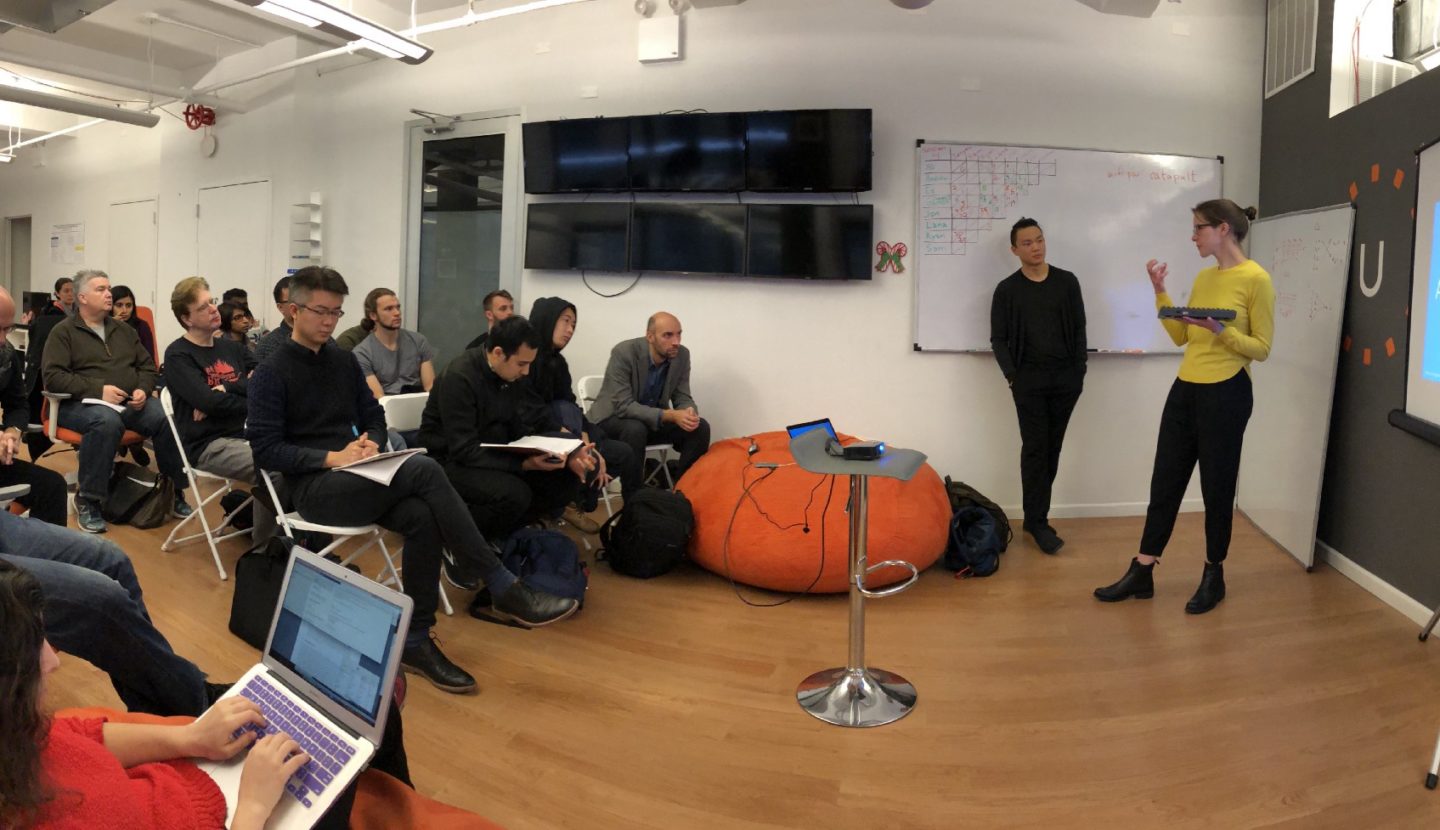
Rob Wiblin on human nature, new technology, and living a happy, healthy & ethical life

Today we cross-posted to our podcast feed some interviews Rob did recently on two other podcasts — Mission Daily (from 2m) and The Good Life (from 1h13m).

Some of the content will be familiar to regular listeners or readers — but if you’re at all interested in Rob’s personal thoughts, there should be quite a lot of new material to make listening worthwhile.

The first interview is with Chad Grills. They focused largely on new technologies and existential risks, but also discuss topics like:

  • Why Rob is wary of fiction
  • Egalitarianism in the evolution of hunter gatherers
  • How to stop social media screwing with politics
  • Careers in government versus business

The second interview is with Prof Andrew Leigh — the Shadow Assistant Treasurer in Australia. This one gets into more personal topics than Rob usually covers, like:

  • What advice would he give to his teenage self?
  • Which person has most shaped his view of living an ethical life?
  • His approach to giving to the homeless
  • What does he do to maximise his own happiness?

Get this episode by subscribing to our podcast on the world’s most pressing problems and how to solve them: type 80,000 Hours into your podcasting app.

The 80,000 Hours Podcast is produced by Keiran Harris.

Continue reading →

Recap: why do some organisations say their recent hires are worth so much?

Our 2018 survey found that for a second year, a significant fraction of organisations reported that they’d want to be compensated hundreds of thousands or sometimes millions of dollars for the loss of a recent hire for three years.

There was some debate last October about whether those figures could be accurate, why they were so high, and what they mean. In the current post, I outline some rough notes summarising the different explanations for why people in the survey estimated that the value of recent hires might be high, though I don’t seek firm conclusions about which considerations are playing the biggest role.

In short, we consider four explanations:

  1. The estimates might be wrong.
  2. There might be large differences in the value-add of different hires.
  3. The organisations might be able to fundraise easily.
  4. Retaining a recent hire allows the organisation to avoid running a hiring process.

Overall, we take the figures as evidence that leaders of the effective altruism community, when surveyed, think the value-add of recent hires at these organisations is very high — plausibly more valuable than donating six figures (or possible even more) per year to the same organisations. However, we do not think the precise numbers are a reliable answer to decision-relevant questions for job seekers, funders, or potential employers. We think it’s likely that mistakes are driving up these estimates. Even ignoring the high probability of mistakes,

Continue reading →

80,000 Hours Annual Review – December 2018

benjamin todd 80000 hours

This annual review summarises our annual impact evaluation, and outlines our progress, plans, weaknesses and fundraising needs. It’s supplemented by a more detailed document that acts as a (less polished) appendix adding more detail to each section. Both documents were initially prepared in Dec 2018. We delayed their release until we heard back from some of our largest donors so that other stakeholders would be fully informed about our funding situation before we asked for their support. Except where otherwise stated, we haven’t updated the review with data from 2019 so empirical claims are generally “as of December 2018.” You can also see a glossary of key terms used in the reviews. You can find our previous evaluations here.

What does 80,000 Hours do?

80,000 Hours aims to solve the most pressing skill bottlenecks in the world’s most pressing problems.

We do this by carrying out research to identify the careers that best solve these problems, and using this research to provide free online content and in-person support. Our work is especially aimed at helping talented graduates aged 20-35 enter higher-impact careers.

The content aims to attract people who might be able to solve these bottlenecks and help them find new high-impact options. The in-person support aims to identify promising people and help them enter paths that are a good fit for them by providing advice, introductions and placements into specific positions.

Currently,

Continue reading →

Career advice I wish I’d been given when I was young

Note: A reader who prefers to remain anonymous — but whose career we think did a lot of good — passed us this list of advice which they were grateful to have received, or wish they’d been given when they were younger.

We thought it was very interesting, including where it doesn’t line up exactly with our usual views, and so are publishing it here with their permission.

The advice is targeted towards people sympathetic to the principles of effective altruism, especially those with an interest in public policy careers, but we think much of it is more broadly useful.

  1. Don’t focus too much on long-term plans. Focus on interesting projects and you’ll build a resumé that stands out — take on multiple part-time consultancies and volunteer projects in parallel to quickly build it out. Back in my 30s, most of the things on my resumé were projects that involved 10% of my time each, and about half of them didn’t pay me any money. Those projects sounded fancy and helped me to get good full-time jobs later on.
  2. Find good thinkers and cold-call the ones you most admire. Many years ago I was lucky that people like Peter Singer, Peter Unger, John Broome, and Derek Parfit were kind enough to respond to my letters. (Any readers who are famous should take the time to respond to strangers’

Continue reading →

#57 – Tom Kalil on how to have a big impact in government & huge organisations, based on 16 years’ experience in the White House

You’re 29 years old, and you’ve just been given a job in the White House. How do you quickly figure out how the US Executive Branch behemoth actually works, so that you can have as much impact as possible – before you quit or get kicked out?

That was the challenge put in front of Tom Kalil in 1993.

He had enough success to last a full 16 years inside the Clinton and Obama administrations, working to foster the development of the internet, then nanotechnology, and then cutting-edge brain modelling, among other things.

But not everyone figures out how to move the needle. In today’s interview, Tom shares his experience with how to increase your chances of getting an influential role in government, and how to make the most of the opportunity if you get in.

He believes that Congressional gridlock leads people to greatly underestimate how much the Executive Branch can and does do on its own every day. Decisions by individuals change how billions of dollars are spent; regulations are enforced, and then suddenly they aren’t; and a single sentence in the State of the Union can get civil servants to pay attention to a topic that would otherwise go ignored.

Over years at the White House Office of Science and Technology Policy, ‘Team Kalil’ built up a white board of principles. For example, ‘the schedule is your friend’: setting a meeting date with the President can force people to finish something, where they otherwise might procrastinate.

Or ‘talk to who owns the paper’. People would wonder how Tom could get so many lines into the President’s speeches. The answer was “figure out who’s writing the speech, find them with the document, and tell them to add the line.” Obvious, but not something most were doing.

Continue reading →

#56 – Animals in the wild often suffer a great deal. We ask Persis Eskander what — if anything — should we do about that

Elephants in chains at travelling circuses; pregnant pigs trapped in coffin-sized crates at factory farms; deers living in the wild. We should welcome the last as a pleasant break from the horror, right?

Maybe, but maybe not. While we tend to have a romanticised view of nature, life in the wild includes a range of extremely negative experiences.

Most animals are hunted by predators, and constantly have to remain vigilant lest they be killed, and perhaps experience the terror of being eaten alive. Resource competition often leads to chronic hunger or starvation. Their diseases and injuries are never treated. In winter wild animals freeze to death and in droughts they die of heat or thirst.

There are fewer than 20 people in the world dedicating their lives to researching these problems.

But according to Persis Eskander, researcher at Open Philanthropy, if we sum up the negative experiences of all wild animals, their sheer number – trillions to quintillions, depending on which you count – could make the scale of the problem larger than most other near-term concerns.

Persis urges us to recognise that nature isn’t inherently good or bad, but rather the result of an amoral evolutionary process. For those that can’t survive the brutal indifference of their environment, life is often a series of bad experiences, followed by an even worse death.

But should we actually intervene? How do we know what animals are sentient? How often do animals really feel hunger, cold, fear, happiness, satisfaction, boredom, and intense agony? Are there long-term technologies that could some day allow us to massively improve wild animal welfare?

Continue reading →

#55 – Mark Lutter on trying to end poverty by founding well-governed ‘charter’ cities, ft Tamara Winter

Governance matters. Policy change quickly took China from famine to fortune; Singapore from swamps to skyscrapers; and Hong Kong from fishing village to financial centre. Unfortunately, many governments are hard to reform and — to put it mildly — it’s not easy to found a new country.

This has prompted poverty-fighters and political dreamers to look for creative ways to get new and better ‘pseudo-countries’ off the ground. The poor could then voluntarily migrate to in search of security and prosperity. And innovators would be free to experiment with new political and legal systems without having to impose their ideas on existing jurisdictions.

The ‘seasteading movement’ imagined founding new self-governing cities on the sea, but obvious challenges have kept that one on the drawing board. Nobel Prize winner and World Bank President Paul Romer suggested ‘charter cities’, where a host country would volunteer for another country with better legal institutions to effectively govern some of its territory. But that idea too ran aground for political, practical and personal reasons.

Now Dr Mark Lutter and Tamara Winter, of The Center for Innovative Governance Research (CIGR), are reviving the idea of ‘charter cities’, with some modifications. Gone is the idea of transferring sovereignty. Instead these cities would look more like the ‘special economic zones’ that worked miracles for Taiwan and China among others. But rather than keep the rest of the country’s rules with a few pieces removed, they hope to start from scratch, opting in to the laws they want to keep, in order to leap forward to “best practices in commercial law.”

Continue reading →

#54 – Askell, Brundage & Clark on whether policy has a hope of keeping up with AI advances

Dactyl is an AI system that can manipulate objects with a human-like robot hand. OpenAI Five is an AI system that can defeat humans at the video game Dota 2. The strange thing is they were both developed using the same general-purpose reinforcement learning algorithm.

How is this possible and what does it show?

In today’s interview Jack Clark, Policy Director at OpenAI, explains that from a computational perspective using a hand and playing Dota 2 are remarkably similar problems.

A robot hand needs to hold an object, move its fingers, and rotate it to the desired position. In Dota 2 you control a team of several different people, moving them around a map to attack an enemy.

Your hand has 20 or 30 different joints to move. The number of main actions in Dota 2 is 10 to 20, as you move your characters around a map.

When you’re rotating an objecting in your hand, you sense its friction, but you don’t directly perceive the entire shape of the object. In Dota 2, you’re unable to see the entire map and perceive what’s there by moving around — metaphorically ‘touching’ the space.

Read our new in-depth article on becoming an AI policy specialist: The case for building expertise to work on US AI policy, and how to do it

This is true of many apparently distinct problems in life. Compressing different sensory inputs down to a fundamental computational problem which we know how to solve only requires the right general purpose software.

Continue reading →

Find your highest impact role: 104 new vacancies in our February 2019 job board updates

Our job board continues to get big updates each 2 week, and now lists 235 vacancies, with 104 additional opportunities in the last month.

If you’re actively looking for a new role, we recommend checking out the job board regularly – when a great opening comes up, you’ll want to maximise your time to prepare.

The job board is a curated list of the most promising positions to apply for that we’re currently aware of. They’re all high-impact opportunities at organisations that are working on some of the world’s most pressing problems:

Check out the job board →

They’re demanding positions, but if you’re a good fit for one of them, it could be your best opportunity to have an impact.

If you apply for one of these jobs, or intend to, please do let us know.

A few highlights from the last month

Continue reading →

#53 – Kelsey Piper on whether journalists have room to write about important things

“Politics. Business. Opinion. Science. Sports. Animal welfare. Existential risks.” Is this a plausible future lineup for major news outlets?

Funded by the Rockefeller Foundation and given very little editorial direction, Vox’s Future Perfect aspires to be more or less that.

Competition in the news business creates pressure to write quick pieces on topical political issues that can drive lots of clicks with just a few hours’ work.

But according to Kelsey Piper, staff writer for this new section on Vox’s website focused on effective altruist themes, Future Perfect’s goal is to run in the opposite direction and make room for more substantive coverage that’s not tied to the news cycle.

They hope that in the long-term, talented writers from other outlets across the political spectrum, can also be attracted to tackle these topics.

Some skeptics of the project have questioned whether this general coverage of global catastrophic risks actually helps reduce them.

Kelsey responds: if you decide to dedicate your life to AI safety research, what’s the likely reaction from your family and friends? Do they think of you as someone about to join “that weird Silicon Valley apocalypse thing”? Or do they, having read about the issues widely, simply think “Oh, yeah. That seems important. I’m glad you’re working on it.”

Kelsey believes that really matters, and is determined by broader coverage of these kinds of topics.

If that’s right, is journalism a plausible pathway for doing the most good with your career, or did Kelsey just get particularly lucky? After all, journalism is a shrinking industry without an obvious revenue model to fund many writers looking into the world’s most pressing problems.

Continue reading →

#52 – Glen Weyl on radical institutional reforms that make capitalism & democracy work better, and how to get them

Imagine you were put in charge of planning out a country’s economy – determining who should work where and what they should make – without prices. You would surely struggle to collect all the information you need about what people want and who can most efficiently make it from an office building in the capital city.

Pro-market economists love to wax rhapsodic about the capacity of markets to pull together the valuable local information spread across all of society and solve this so-called ‘knowledge problem’.

But when it comes to politics and voting – which also aim to aggregate the preferences and knowledge found in millions of individuals – the enthusiasm for finding clever institutional designs turns to skepticism.

Today’s guest, freewheeling economist Glen Weyl, won’t have it, and is on a warpath to reform liberal democratic institutions in order to save them. Just last year he wrote Radical Markets: Uprooting Capitalism and Democracy for a Just Society with Eric Posner, but he has already moved on, saying “in the 6 months since the book came out I’ve made more intellectual progress than in the whole 10 years before that.”

He believes we desperately need more efficient, equitable and decentralised ways to organise society that take advantage of what each person knows, and his research agenda has already made some breakthroughs.

Despite a background in the best economics departments in the world – Harvard, Princeton, Yale and the University of Chicago – he is too worried for the future to sit in his office writing papers. Instead he has left the academy to try to inspire a social movement, RadicalxChange, with a vision of social reform as expansive as his own. (You can sign up for their conference in March here.)

Continue reading →

#51 – Martin Gurri on the revolt of the public & crisis of authority in the information age

Politics in rich countries seems to be going nuts. What’s the explanation? Rising inequality? The decline of manufacturing jobs? Excessive immigration?

Martin Gurri spent decades as a CIA analyst and in his 2014 book The Revolt of The Public and the Crisis of Authority in the New Millennium, predicted political turbulence for an entirely different reason: new communication technologies were flipping the balance of power between the public and traditional authorities.

In 1959 the President could control the narrative by leaning on his friends at four TV stations, who felt it was proper to present the nation’s leader in a positive light, no matter their flaws. Today, it’s impossible to prevent someone from broadcasting any grievance online, whether it’s a contrarian insight or an insane conspiracy theory.

According to Gurri, trust in society’s institutions – police, journalists, scientists and more – has been undermined by constant criticism from outsiders, and exposed to a cacophony of conflicting opinions on every issue the public takes fewer truths for granted. We are now free to see our leaders as the flawed human beings they always have been, and are not amused.

Suspicious they are being betrayed by elites, the public can also use technology to coordinate spontaneously and express its anger. Keen to ‘throw the bastards out’ – protesters take to the streets, united by what they don’t like, but without a shared agenda for how to move forward or the institutional infrastructure to figure out how to fix things. Some popular movements have come to view any attempt to exercise power over others as suspect.

Continue reading →

#50 – We could feed all eight billion people through a nuclear winter. David Denkenberger is working to make it practical.

If a nuclear winter or asteroid impact blocked the sun for years, our inability to grow food would result in billions dying of starvation, right? According to Dr David Denkenberger, co-author of Feeding Everyone No Matter What: no. If he’s to be believed, nobody need starve at all.

Even without the sun, David sees the Earth as a bountiful food source. Mushrooms farmed on decaying wood. Bacteria fed with natural gas. Fish and mussels supported by sudden upwelling of ocean nutrients – and many more.

Dr Denkenberger is an Assistant Professor at the University of Alaska Fairbanks, and he’s out to spread the word that while a nuclear winter might be horrible, experts have been mistaken to assume that mass starvation is an inevitability. In fact, he says, the only thing that would prevent us from feeding the world is insufficient preparation.

Not content to just write a book pointing this out, David has gone on to found a growing nonprofit – the Alliance to Feed the Earth in Disasters – to brace the world to feed everyone come what may. He expects that today 10% of people would find enough food to survive a massive disaster. In principle, if we did everything right, nobody need go hungry. But being more realistic about how much we’re likely to invest, David hopes a plan to inform people ahead of time would save 30%, and a decent research and development scheme 80%.

According to David’s published cost-benefit analyses, work on this problem may be able to save lives, in expectation, for under $100 each, making it an incredible investment.

Continue reading →

Find your highest impact role: 77 new vacancies in our December job board updates

Thanks to the sterling work of Maria Gutierrez, our job board continues to get big updates each 2 week, and now lists 169 vacancies, with 77 additional opportunities in the last month.

If you’re actively looking for a new role, we recommend checking out the job board regularly – when a great opening comes up, you’ll want to maximise your time to prepare.

The job board is a curated list of the most promising positions to apply for that we’re currently aware of. They’re all high-impact opportunities at organisations that are working on some of the world’s most pressing problems:

Check out the job board →

They’re demanding positions, but if you’re a good fit for one of them, it could be your best opportunity to have an impact.

If you apply for one of these jobs, or intend to, please do let us know.

A few highlights from the last month

Continue reading →

#49 – Rachel Glennerster on a year’s worth of education for under a dollar and other ‘best buys’ in development

If I told you it’s possible to deliver an extra year of ideal primary-level education for 30 cents, would you believe me? Hopefully not – the claim is absurd on its face.

But it may be true nonetheless. The very best education interventions are phenomenally cost-effective, but they’re not the kinds of things you’d expect, says this week’s guest, Dr Rachel Glennerster.

She’s Chief Economist at the UK’s foreign aid agency DFID, and used to run J-PAL, the world-famous anti-poverty research centre based at MIT’s Economics Department, where she studied the impact of a wide range of approaches to improving education, health, and political institutions. According to Glennerster:

“…when we looked at the cost effectiveness of education programs, there were a ton of zeros, and there were a ton of zeros on the things that we spend most of our money on. So more teachers, more books, more inputs, like smaller class sizes – at least in the developing world – seem to have no impact, and that’s where most government money gets spent.”

“But measurements for the top ones – the most cost effective programs – say they deliver 460 LAYS per £100 spent ($US130). LAYS are Learning-Adjusted Years of Schooling. Each one is the equivalent of the best possible year of education you can have – Singapore-level.”

“…the two programs that come out as spectacularly effective… well, the first is just rearranging kids in a class.”

“You have to test the kids, so that you can put the kids who are performing at grade two level in the grade two class, and the kids who are performing at grade four level in the grade four class, even if they’re different ages – and they learn so much better. So that’s why it’s so phenomenally cost effective because, it really doesn’t cost anything.”

Continue reading →

A simple checklist for overcoming life and career setbacks

At 80,000 Hours we focus a lot on developing ambitious plans to dramatically improve the world.

Something we haven’t written so much about is how to overcome the challenges – heartbreak, rejection, failure, illness, grief, conflict and more – that are sure to arise as we attempt to follow through on those plans, and which risk throwing us off course.

We don’t have particular expertise on this topic, but I wanted to share an approach that me and some friends have found useful, and which might help you as well.

When bad things happen in life, the thoughts we then have about them have a big impact on how much they harm us. Even where we can’t avoid the direct suffering inflicted by a problem, we can at least avoid hurting ourselves further, by ruminating about it and getting trapped in a cycle of negative thoughts.

In the case of the minor annoyances we face every day, maintaining our equanimity can almost entirely eliminate the harm they cause us. And even when we face serious adversity, ensuring we think about it the right way can limit the damage, and save us from falling into depression or another negative spiral. (Though this list isn’t really suitable for seriously traumatic events.)

To help myself with this, I’ve made a checklist of questions I try to work through when something unpleasant happens, in order to reframe the situation and get over it as quickly as possible.

Continue reading →

#48 – Brian Christian on computer science algorithms that tackle fundamental and universal problems — and whether they can help us live better in practice

Ever felt that you were so busy you spent all your time paralysed trying to figure out where to start, and couldn’t get much done? Computer scientists have a term for this – thrashing – and it’s a common reason our computers freeze up. The solution, for people as well as laptops, is to ‘work dumber’: pick something at random and finish it, without wasting time thinking about the bigger picture.

Ever wonder why people reply more if you ask them for a meeting at 2pm on Tuesday, than if you offer to talk at whatever happens to be the most convenient time in the next month? The first requires a two-second check of the calendar; the latter implicitly asks them to solve a vexing optimisation problem.

What about estimating the probability of something you can’t model, and which has never happened before? Math has got your back: the likelihood is no higher than 1 in the number of times it hasn’t happened, plus one. So if 5 people have tried a new drug and survived, the chance of the next one dying is at most 1 in 6.

Bestselling author Brian Christian studied computer science, and in the book Algorithms to Live By he’s out to find the lessons it can offer for a better life. In addition to the above he looks into when to quit your job, when to marry, the best way to sell your house, how long to spend on a difficult decision, and how much randomness to inject into your life.

Continue reading →

Think twice before talking about ‘talent gaps’ — clarifying nine misconceptions

After pushing the idea of ‘talent gaps’ in 2015, we’ve noticed increasing confusion about the term.

This is partly our fault. So, here’s a quick list of common misconceptions about talent gaps and how they can be fixed. This is all pretty rough and we’re still refining our own views, but we hope this might start to clarify this issue, while we work on better explaining the idea in our key content.

1. Problem areas are constrained by specific skills, not ‘talent’

Problem areas are rarely generically ‘talent constrained’. They’re instead constrained by specific skills and abilities. It’s nearly always clearer to talk about the specific needs of the field, ideally down to the level of specific profiles of people, rather than talent and funding in general.

For instance, work to positively shape the development of AI is highly constrained by the following:

  • ML researchers, especially those able to do field-defining work, who are interested in and understand AI safety, the alignment problem, and other issues relevant to the long-term development of AI.
  • People skilled in operations, especially those able to run nonprofits with under 50 people or academic institutes, and who are interested in and understand issues related to the long-term development of AI.
  • Strategy and policy researchers able to do disentanglement research in pre-paradigmatic fields.
  • People with the policy expertise and career capital to work in influential government positions who are also knowledgeable about and dedicated to the issue.

Continue reading →

#47 – PhD or programming? Fast paths into aligning AI as a machine learning engineer, according to ML engineers Catherine Olsson & Daniel Ziegler

After dropping out of his ML PhD at Stanford, Daniel Ziegler needed to decide what to do next. He’d always enjoyed building stuff and wanted to help shape the development of AI, so he thought a research engineering position at an org dedicated to aligning AI with human interests could be his best option.

He decided to apply to OpenAI, spent 6 weeks preparing for the interview, and actually landed the job. His PhD, by contrast, might have taken 6 years. Daniel thinks this highly accelerated career path may be possible for many others.

On today’s episode Daniel is joined by Catherine Olsson, who has also worked at OpenAI, and left her computational neuroscience PhD to become a research engineer at Google Brain. They share this piece of advice for those interested in this career path: just dive in. If you’re trying to get good at something, just start doing that thing, and figure out that way what’s necessary to be able to do it well.

To go with this episode, Catherine has even written a simple step-by-step guide to help others copy her and Daniel’s success.

Daniel thinks the key for him was nailing the job interview.

OpenAI needed him to be able to demonstrate the ability to do the kind of stuff he’d be working on day-to-day. So his approach was to take a list of 50 key deep reinforcement learning papers, read one or two a day, and pick a handful to actually reproduce. He spent a bunch of time coding in Python and TensorFlow, sometimes 12 hours a day, trying to debug and tune things until they were actually working.

Continue reading →

ML engineering for AI safety & robustness: a Google Brain engineer’s guide to entering the field

Technical AI safety is a multifaceted area of research, with many sub-questions in areas such as reward learning, robustness, and interpretability. These will all need to be answered in order to make sure AI development will go well for humanity as systems become more and more powerful.

Not all of these questions are best tackled with abstract mathematics research; some can be approached with concrete coding experiments and machine learning (ML) prototypes. As a result, some AI safety research teams are looking to hire a growing number of Software Engineers and ML Research Engineers.

Additionally, some research teams that may not think of themselves as focussed on ‘AI Safety’ per se, nonetheless work on related problems like verification of neural nets or learning from human feedback, and are often hiring engineers.

Note that this guide was written in November 2018 to complement an in-depth conversation on the 80,000 Hours Podcast with Catherine Olsson and Daniel Ziegler on how to transition from computer science and software engineering in general into ML engineering, with a focus on alignment and safety. If you like this guide, we’d strongly encourage you to check out the podcast episode where we discuss some of the instructions here, and other relevant advice.

What are the necessary qualifications for these positions?

Software Engineering: Some engineering roles on AI safety teams do not require ML experience. You might already be prepared to apply to these positions if you have the following qualifications:

  • BSc/BEng degree in computer science or another technical field (or comparable experience)
  • Strong knowledge of software engineering (as a benchmark: could pass a Google software engineering interview)
  • Interest in working on AI safety
  • (usually) Willingness to move to London or the San Francisco Bay Area

If you’re a software engineer with an interest in these roles,

Continue reading →