#106 – Cal Newport on an industrial revolution for office work
If you wanted to start a university department from scratch, and attract as many superstar researchers as possible, what’s the most attractive perk you could offer?
How about just not needing an email address?
According to today’s guest, Cal Newport — computer science professor and best-selling author of A World Without Email — it should seem obscene and absurd for a world-renowned vaccine researcher with decades of experience to spend a third of their time fielding requests from HR, building management, finance, and on and on. Yet with offices organised the way they are today, nothing could feel more natural.
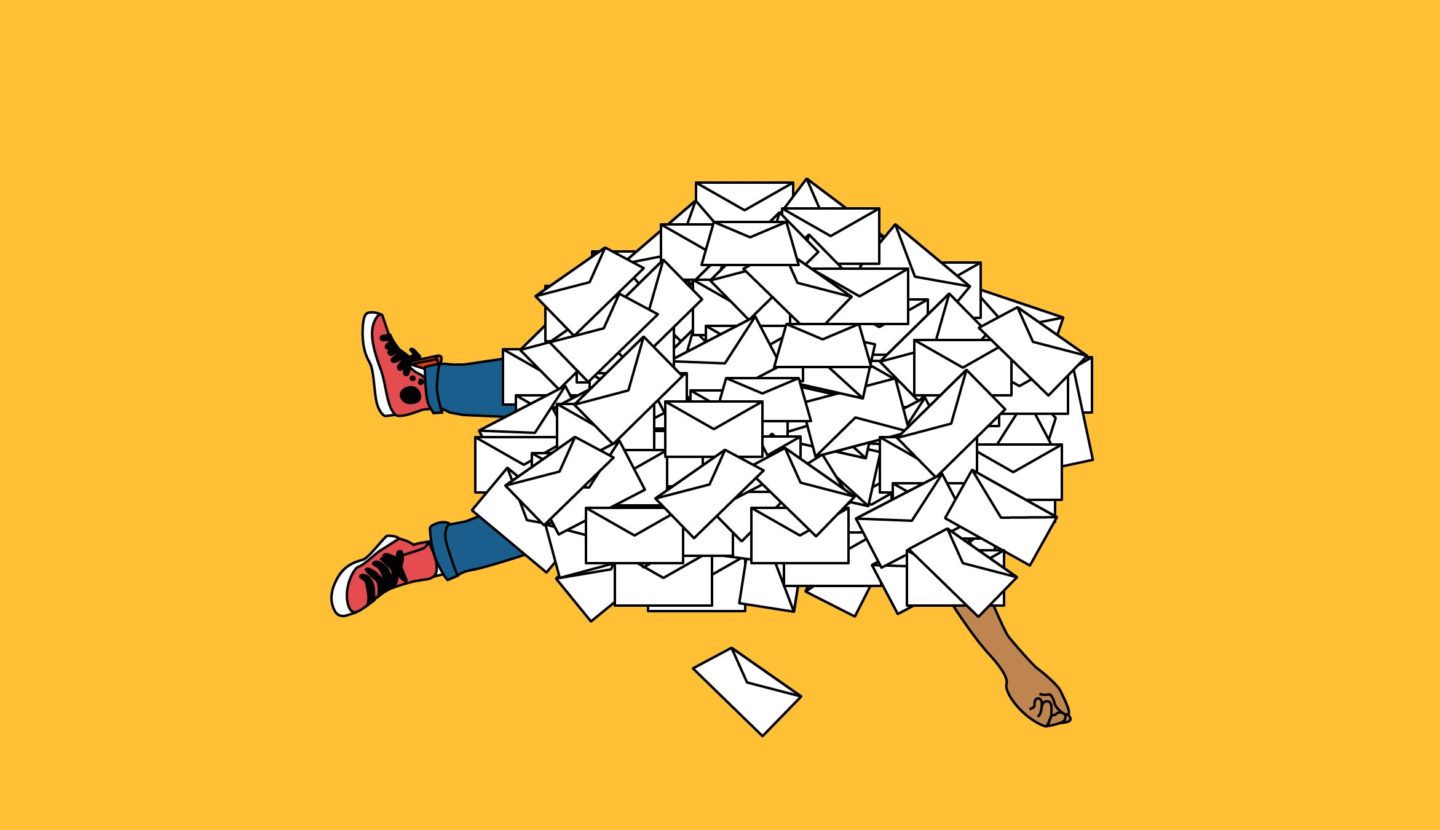
But this isn’t just a problem at the elite level — it affects almost all of us. A typical U.S. office worker checks their email 80 times a day, or once every six minutes. Data analysis by RescueTime found that a third of users checked email or Slack every three minutes or more, averaged over a full work day.
Each time that happens our focus is broken, killing our momentum on the knowledge work we’re supposedly paid to do.
When we lament how much email and chat have reduced our focus, increased our anxiety and made our days a buzz of frenetic activity, we most naturally blame ‘weakness of will’. If only we had the discipline to check Slack and email once a day, all would be well — or so the story goes.
Cal believes that line of thinking fundamentally misunderstands how we got to a place where knowledge workers can rarely find more than five consecutive minutes to spend doing just one thing.
Since the Industrial Revolution, a combination of technology and better organization have allowed the manufacturing industry to produce a hundred-fold as much with the same number of people.
Cal says that by comparison, it’s not clear that specialised knowledge workers like scientists, authors, or senior managers are any more productive than they were 50 years ago. If the knowledge sector could achieve even a tiny fraction of what manufacturing has, and find a way to coordinate its work that raised productivity by just 1%, that would generate on the order of $100 billion globally each year.
On Cal’s account, those opportunities are staring us in the face. Modern factories operated by top firms are structured with painstaking care and two centuries of accumulated experience to ensure staff can get the greatest amount possible done.
By contrast, most knowledge work today operates with no deliberate structure at all. Instead of carefully constructed processes to get the most out of each person, we just hand out tasks and leave people to organise themselves organically in whatever way feels easiest to them.
Since the 1990s, when everyone got an email address and most lost their assistants, that lack of direction has led to what Cal calls the ‘hyperactive hive mind’: everyone sends emails and chats to everyone else, all throughout the day, whenever they need anything.
Rather than strategic thinkers, managers work as human switchboards, answering and forwarding dozens of emails on any and every topic to keep the system from seizing up.
Finding a time for four people to meet might mean an eight-email thread. Annoying enough! But each of those four has to keep checking in to make sure the thread is progressing, and answer any new questions that come up. So in aggregate those four might interrupt their train of thought and check their email 20, 30 or even 40 times in the process of coordinating a single meeting.
Cal points out that this is so normal we don’t even think of it as a way of organising work, but it is: it’s what happens when management does nothing to enable teams to decide on a better way of coordinating themselves. And if any individual tries to opt out and focus on one thing for an entire day, they’re throwing a wrench in the ‘hyperactive hive mind’, which explains why calls for individual discipline have done so little to fix the problem.
A few industries have made progress taming the ‘hyperactive hive mind’. Cal points to tech support ticketing systems, which throttle correspondence and keep engineers focused on one problem at a time until they can’t get any further, at which point that problem is parked and they’re given a single new problem to work on next.
He also points to ‘extreme programming’, a system in which two software engineers sit side-by-side in front of one computer and together write code to solve a specific problem for their entire work day. As they work, those software engineers have no email account and no phone number. All incoming and outgoing communication with the rest of the world is run through a dedicated liaison officer so they can maintain 100% focus. Usually after six hours of real actual work they need to go home and rest.
But on Cal’s telling, in this interview and in A World Without Email, this barely scratches the surface of the improvements that are possible within knowledge work. And reining in the hyperactive hive mind won’t just help people do higher quality work, it will free them from the 24/7 anxiety that there’s someone somewhere they haven’t gotten back to.
In this interview Cal and Rob cover that, as well as:
- Is the hyperactive hive-mind really one of the world’s most pressing problems?
- The historical origins of the ‘hyperactive hive-mind’
- The harm caused by attention switching
- Who’s working to solve the problem and how
- Why it took more than a century to come up with the ‘assembly line’ method for factory organisation
- Cal’s top productivity advice for high school students, university students, and early-career employees
- And much more
Get this episode by subscribing to our podcast on the world’s most pressing problems and how to solve them: type 80,000 Hours into your podcasting app. Or read the transcript below.
Producer: Keiran Harris
Audio mastering: Ben Cordell
Transcriptions: Sofia Davis-Fogel