Review of program performance May 2015

Summary

In this report, which is part of our annual review, we review how our programs performed over the last year (ending April 2015).

The key metric we use to measure the performance of our programs is “significant plan changes”. A significant plan change is when someone tells us that they probably changed the career path they were going to follow because of us.

This year, the number of plan changes caused by our online guide rose from about 1.3 per month at the start of 2014 to about 6.5 per month – 400% growth. The rate of newsletter sign ups per month through the website – our key engagement metric – also grew 1600%.

Due to a shift in focus, we coached about a third as many people in 2014 as we had in 2013, and spent less time per person. As a result, significant plan changes caused by coaching declined from 21 in 2013 to 3 in 2014. They picked up again in early 2015 as we increased time spent coaching.

In total to date, we’ve now recorded 188 significant plan changes, up from 107 at the time of our last evaluation in April 2014. We estimate we’re adding about 10 per month at the margin (6.5 from guide, 2 from other (mainly community) and the remainder from coaching), up from 2 per month near the start of 2014.

The average cost per plan change has been decreasing,

Continue reading →

Can you have more impact working in a foundation than earning to give?

Photo credit: Flickr – Refracted Moments

Key points

  • Working to improve grants at a foundation could well be more effective in terms of the impact of the money moved than earning to give. Which is better will usually come down to how good your personal opportunities are to make money, or get a job at a large foundation working on an important cause.
  • If you know of a cause area or organisation that is many times more effective than what any foundations you could work at would make grants to, then earning to give is likely to be better.
  • There are other issues, like the impact on your long-term career trajectory, that you have to consider as well as the direct impact of the money you move.

As soon as we thought of the idea of earning to give, we started thinking of ways to beat it. One idea that was floated in the very early days of 80,000 Hours was working in a foundation to allocate grants to more effective causes and organisations. Since a foundations grantmaker might allocate tens of millions of funding, far more than they could earn, maybe they could have a greater impact this way?

In this post, we provide a model for comparing the impact of foundations grantmaking and earning to give, which some people may find useful for specific scenarios where they have more info on the inputs.

Continue reading →

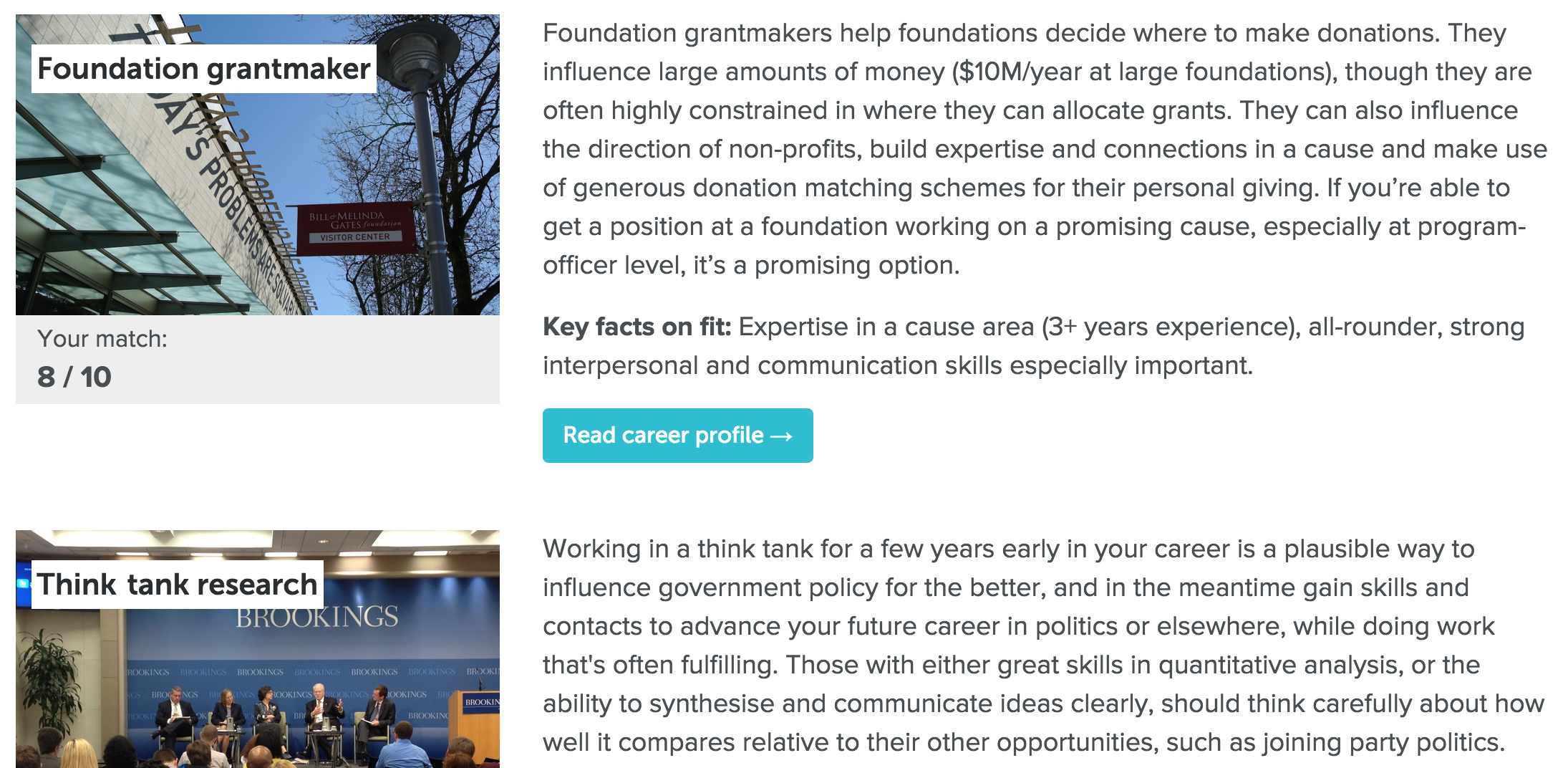
Foundation grantmaker

Foundation grantmakers help foundations decide where to make donations. They influence large amounts of money ($10M/year at large foundations), though they are often highly constrained in where they can allocate grants. They can also influence the direction of nonprofits, build expertise and connections in a cause and make use of generous donation matching schemes for their personal giving. If you’re able to get a position at a foundation working on a promising cause, especially at program-officer level, it’s a promising option.

Continue reading →

‘Replaceability’ isn’t as important as you might think (or we’ve suggested)

mJNoza3
Often if you turn down a skilled job, the role simply won’t be filled at all because there’s no suitable substitute available. For this and other reasons we don’t place as much weight as we used to on the idea of ‘replaceability’.

When we started 80,000 Hours, one of the key ideas we presented was the replaceability argument:

Suppose you become a surgeon and perform 100 life saving operations. Naively it seems like your impact is to save 100 people’s lives. If you hadn’t taken the job, however, someone else likely would have taken it instead. So your true (counterfactual) impact is less than the good you do directly.

I still think this is a good argument, but I’m not sure how relevant it is when comparing real career options.

In particular, I see the argument often being used incorrectly in the following two ways:

  1. Ignoring direct harm: Suppose you’re considering taking a job that some people think is harmful (e.g. certain parts of the financial sector) in order to donate, do advocacy or build skills. You reason “if I don’t take the job, someone else will instead, so the potential harm I’ll do directly doesn’t matter”.

  2. Ignoring direct impact: Suppose you’re considering working at a high-impact nonprofit. You reason “if I don’t take the job, someone else will instead, so I won’t have much impact.”

I disagree with both of these claims in most circumstances. Why?

Continue reading →

Update: how many extra donations have we caused?

One way 80,000 Hours has an impact is by increasing the amount our users donate to high-impact charities. As part of our annual review, we did a quick update to the figures from our last review. The process we used wasn’t as thorough as we would have liked, but provides some encouraging evidence of our impact.

What we did

We identified the largest donors we know of who (i) have made significant plan changes according to our definition and (ii) say they intend to earn to give.

We asked them the following questions via email:

  • How much have you donated over the last three years?
  • How much do you expect to donate over the next three years?
  • Where to?
  • How much of this is attributable to 80,000 Hours? (meaning what wouldn’t have been given if 80,000 Hours didn’t exist).
  • How much have you pledged to give as part of GWWC or otherwise?

For those people who responded last year, we asked for an extra year of data. You can see the answers and case studies from last year’s review in the appendix here.

We received responses from all ten people asked. Each intends to give to whichever charities they believe to be highest-impact (in practice, this mostly means effective altruist organisations or charities recommended by GiveWell or Giving What We Can).

Continue reading →

Is wealth inequality so extreme that it’s OK to be a ruthless trader?

U.S._Distribution_of_Wealth,_2007Wealth inequality globally is incredibly high. Perversely, this can be an argument in favour of working in finance.

Many people are concerned that ‘earning to give‘ in the financial industry is overall harmful for the world, even if you give away most of your income to outstanding charities.

To figure out if this is true, we have been researching the size of the harms, and benefits, caused by finance. (Though please note 80,000 Hours is not just about earning to give and in fact we think it’s the best path for only a small share of our readers.)

One of the concerns we’ve investigated is that certain parts of quantitative finance are a socially-useless competition between traders that only changes who gets some amount of income, not that someone gets it. I think this is the case, but the incredible amount of inequality in the world makes this argument against working in finance fairly weak.

If you are working in ‘low-latency arbitrage’, make a random clever trade on a stock exchange and beat some other trader to a profit by 1 millisecond, whose pocket is this money coming from? A poor African farmer? No, they have no wealth to take. A middle class American family? It’s possible, but most of their wealth, if they have any, is probably in their house or bank account.

We don’t have perfect figures here, but looking at reasonable estimates,

Continue reading →

LinkedIn finds the most common ways in and out of every career

We recently wrote a career profile on medicine which said that one of the most common exit opportunities for physicians was into academia. How exactly did we know that?

LinkedIn has mined their enormous dataset to find the most frequent career transitions for people from a huge range of different professions. It turns out that the most frequent transfer for a physician or surgeon is to become a university professor, presumably studying or teaching medicine itself. Most roles have several common options.

Screen Shot 2015-07-21 at 9.53.13 pm

I strongly recommend playing around with it and reading their analysis. It turns out that ‘sales’ is a huge skill area and one of the most common next steps for people from a very wide range of professions. Almost every business needs some people to work on sales!

You can use this both to see what your natural next career moves are, and figure out what indirect paths you can use to get into a particular different position you have in mind. It doesn’t do the reverse lookup itself yet, so you’ll need to guess which options are most likely to lead you into the one you want.

We’ll be incorporating the wisdom of this tool into our career profiles as we update them.

The broad skill groupings they classified seemed to me to be:

  • Sales, hospitality and logistics (blue)
  • Health and education (red)
  • Information technology (pink)
  • Practical trades,

Continue reading →

Systemic change becomes non-systemic change and vice versa

As you might have heard, there is an active debate among the 80,000 Hours community about the effectiveness of attempts to change societal systems – such as laws, institutions or social norms – versus so-called “non-systemic” approaches, such as funding health treatments directly, or becoming a teacher.

Sometimes these debates become quite heated.

To put my cards on the table, I lean towards systemic change being a more promising approach, at least given my skills. Hence, I’ve studied public policy and worked in a Government think tank myself. I also see one of the major long-run impacts of 80,000 Hours to be changing social norms about how people think about how they spend their working life.

But I find it hard to get too passionate with those who lean the other way. One reason for this was well explained in a comment by my friend Catriona Mackay:

I think that people on the whole are biased towards against non-systemic change (i.e if you did a survey asking whether it’s best to treat the causes or the symptoms of poverty, almost everyone would answer ’causes’, even if there were strong evidence that both were effective in terms of increasing net well-being), and so it’s likely that non-systemic causes are more underfunded, so I can contribute more.

On the other hand, I think that scaling up proven health solutions and cash grants and so on are also ways of contributing to systemic/revolutionary change.

Continue reading →

We’ve caused 188 significant plan changes

The results of our annual impact survey are in, so we can give an update on the number of significant plan changes we’ve caused as of the end of April 2014.

“Significant plan change” is the key metric we use to track our impact. See a definition.

Results of the annual impact survey

The survey was open from November 2014 to early March this year. We promoted it throughout February, on our newsletter, our blog and social media as well as in-person. To encourage responses, we offered a $200 prize to one randomly selected respondent.

This resulted in 218 responses, of which 85 people answered “yes” to the following question:

“Has your engagement with 80,000 Hours caused you to significantly change your career plans?”

How many of the people who said “yes” count as having made significant plan changes according to our criteria?

First, we removed 13 people who were already captured last year (though worth noting is that five of these people seem to have made a second significant shift in plans due to us).

Second, we removed a further 18 people who didn’t seem to make our criteria. The main reason was that they didn’t list a specific shift in plans, and instead listed an intention to shift in the future or only gave a very vague response. It’s likely that some of these people would count as significant plan changes if we asked for more detail,

Continue reading →

New definition of a significant plan change

We’re changing how we define “significant plan changes”.

The “significant plan change” is the key metric we track month-to-month to measure our impact.

It’s related to our total impact as follows:

(Number of significant plan changes) multiplied by (the value of the average significant plan change)

We evaluate the value of a significant plan change once every year or two (see our last evaluation). This means the more difficult judgement calls concerning our impact (such as whether plan changes are really improvements, and the extent to which they would have been caused by other groups anyway) are isolated into a separate evaluation process that we perform less frequently.

Our new definition for a significant plan change is:

A sig plan change =df Someone tells us that 80,000 Hours caused them to change the career path they intend to pursue, in a way that they think increases their lifetime impact.

In practice, this means:

  • They fill out one of our surveys saying “yes” to “has your engagement with 80,000 Hours caused you to significantly change your career plans?”
  • They tell us what path they changed from and what path they now intend to pursue.
  • They tell us what sort of engagement with us caused the change (e.g. reading an article vs. coaching vs. speaking to someone in our community).
  • They believe this will result in greater impact (rather than just higher job satisfaction or other benefits).

Continue reading →

If you want to save lives, should you study medicine? Probably not.

About 1 in 200 people become doctors, many of them because they want to cure the sick and generally make the world a better place. Are they making the right decision?

To help answer that question, we’ve produced an exploratory career profile on medical careers.

The conclusion of our research is that most people skilled enough to make it in a field as challenging as medicine could have a bigger social impact through an alternative career.

The best research suggests that doctors do much less to improve the health of their patients than you might naturally expect. Health is more determined by lifestyle factors, and most of the treatments that work particularly well could be delivered with a smaller number of doctors than already work in the UK or USA.

However, medicine is high earning and highly fulfilling, and we expect there are more promising opportunities to help others through biomedical research, public health, health policy and (e.g. hospital) management.

Overall, we think going to medical school would be the best way to have a social impact only if someone felt they were a significantly better fit for medicine than the other options we recommend.

Dr Greg Lewis, a practicing physician in the UK, wrote most of the career profile.

Key findings

  • Having more physicians in the developed world has a surprisingly small impact on the health of recipients.

Continue reading →

Disagreeing about what’s effective isn’t disagreeing with effective altruism

WCO_011

Lately I have had the uncanny experience of reading supposed ‘rebuttals’ of effective altruism that just say a bunch of things that I and most of my colleagues agree with. As we are some of the most involved people in the effective altruism movement, this is strange to say the least.

What is going on here is that effective altruism is both a narrow core idea, and a bunch of associated ideas. Some of these associated ideas happen to be widely held by people who describe themselves as effective altruists – others don’t even meet that standard.

What is the core idea?

  • Effective altruism is the use of evidence and analysis to take actions that help others as much as possible.

Many of my colleagues would want to add here that you ‘should’ use evidence and reason to help others as much as possible. But there is no consensus on whether engaging in ‘effective altruism’ is a moral duty, or just something we should be enthusiastic about because we care about others.

What about the associated ideas? I could listed dozens, but some are:

  • It’s highly effective to give to GiveWell recommended charities;
  • Randomised controlled trials are a great way to figure out what works in development;
  • Animal welfare is an important thing to worry about;

Continue reading →

Get the chance to save the world with this one weird trick

one-weird-trick2When I was an undergraduate I came to fully understand the depth of the world’s problems: tens of billions of animals were suffering in factory farms, humanity faced the risk of catastrophic nuclear war, billions continue to live in horrendous poverty, and that was just the start. I wanted to solve these problems, but when I tried to take concrete steps I mostly felt powerless and frustrated.

I was right to feel powerless. As an undergraduate there was relatively little I could do to directly solve anything.

I had no income to give; no insights that hadn’t been had; and no platform from which to ask people to change their behaviour. I really didn’t want the world to be incinerated in a nuclear apocalypse, but – fortunately – nuclear security policy isn’t set by random Australian undergraduates who happen to think they know what’s best.

Luckily for most of us, this powerlessness need only be a temporary, if unpleasant, condition.

If you are a high school student or undergraduate frustrated about your limited influence in the world, there’s one thing you need to be working to get.

With it comes the ability to change things.

Some younger people manage to get a lot of it very quickly, but the majority of us will have the most of it between 40 and 60, so you need to keep a long-term view.

A lot of our advice for young people is geared towards helping them accumulate more of it.

Continue reading →

What people miss about career capital: exceptional achievements

Pooja Chandrashekar is a good demonstration that sometimes the best way to show people you can achieve amazing things is just to achieve amazing things. (Photo by J. Lawler Duggan/For The Washington Post)

When we talk about “career capital” it seems people first imagine “brand name” jobs e.g. working at Google, McKinsey, or getting a credential like a law degree or graduate study at a prestigious university. And it’s true these paths all boost your career capital. But I think there’s another important component of career capital that’s often neglected.

A big part of having really strong career capital is having eye-catching, valuable achievements. Eye-catching achievements make you stand out, another form of credential. Standing out helps you to meet successful people, building your connections. The process of getting exceptional achievements usually involves pushing yourself too, so it correlates with learning strong skills. Overall, striving for eye-catching achievements seems at least as important as gaining prestige or conventional credentials – so if you only focus on the latter you could be making a mistake.

One example to illustrate (but of course not prove!) the point: Pooja Chandraskekar, who this year was one of the few students in the world to be admitted to all the Ivy League Universities. Among much else, she developed a mobile app that predicts whether a person has Parkinson’s disease with 96% accuracy. She needed these achievements to make her stand out among all the other people who have “ticked the boxes”

Continue reading →

Medical careers

Medicine is a highly paid and highly satisfying career. However, working in medicine has a modest direct impact, and relative to the cost and time required for medical training, it has mediocre ‘exit opportunities’ to other career paths, and provides little platform for advocacy. It is also highly competitive.

Our view is that the people likely to succeed at medical school admission could have a greater impact outside medicine. We therefore recommend those contemplating medical school consider other opportunities instead. Within medicine, we believe the highest impact opportunities lie in the fields of (in order) biomedical research, public health and health policy, and healthcare management.

Continue reading →

Defining ‘Earning to Give’

We’ve found there’s sometimes been confusion about what ‘earning to give’ means. Here’s our working definition.

You’re earning to give if and only if:

  1. You deliberately pursue a career that is high-earning (given your options) in order to do good through your donations AND
  2. You donate a very significant proportion of your earnings, where for someone earning more than the average in rich countries, ‘very significant’ means at least 20% of income.

As with all the technical terms the effective altruism community has introduced, we should worry about how the meaning of that term might change over time as it gets more widely used. For ‘earning to give’ I think the biggest concern is that the qualifying bar for % donations goes down: I think someone who’s in a high-earning career but only giving 2% shouldn’t count as ‘earning to give,’ but I can foresee scenarios in which people start using the term that way. Of course, for someone who is not able to take a very high-earning career, the bar for % donations should be lower.

Sometimes I hear ‘earning to give’ to be used almost synonymously with ‘donating’: I think, though, that it’s more useful to keep the concept of ‘earning to give’ focused on a specific career strategy, rather than simply donating in whatever career you’re already in.

Continue reading →

Pursuing fame in art and entertainment

While there is the potential for huge earnings, advocacy power and direct impact, the odds are stacked against even very talented individuals. A very large number of people attempt to achieve success in the arts for reasons unrelated to its social impact, making it unlikely to be a neglected area. For most people, a career in arts and entertainment is unlikely to be the path with the highest potential to do good, so we suggest you consider your other options first.

However, as with all careers, if you think you could be truly exceptional and fulfilled within this career, but not in others, you should strongly consider it.

Continue reading →

Think tank research

Working in a think tank for a few years early in your career is a plausible way to influence government policy for the better, and in the meantime gain skills and contacts to advance your future career in politics or elsewhere, while doing work that’s often fulfilling.

Those with either great skills in quantitative analysis, or the ability to synthesize and communicate ideas clearly, should think carefully about how well it compares relative to their other opportunities, such as joining party politics.

Continue reading →

Actuarial science

Actuarial science could be a good option for someone who wants to earn to give, has strong quantitative skills, and values security and work-life balance.

However, someone capable of pursuing an actuarial career should also consider quantitative finance, which offers higher expected earnings, spending a few years in management consulting, which offers superior flexibility and prestige, or training for data science, which offers more flexibility and opportunity for direct impact.

Continue reading →