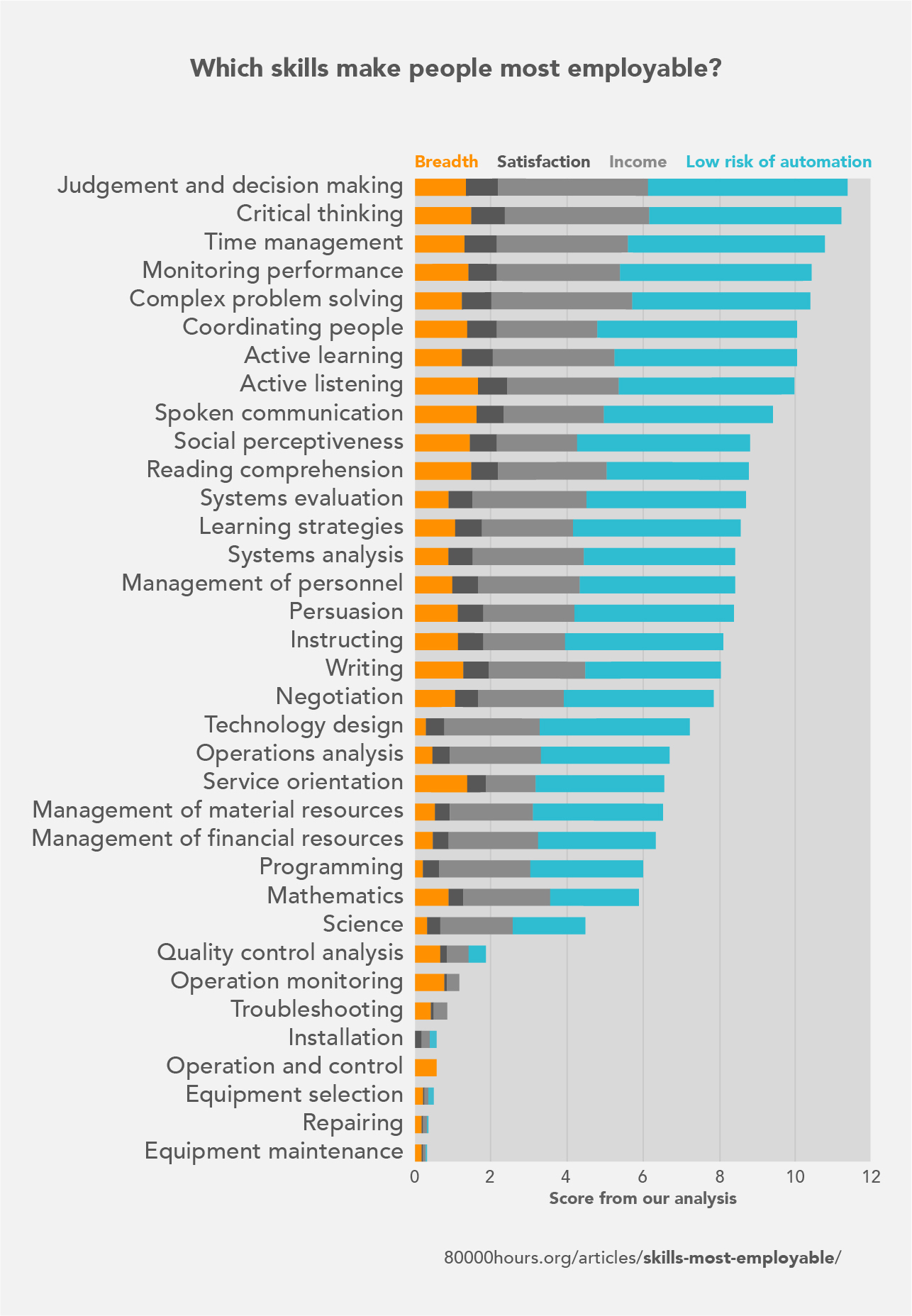
These skills make you most employable. Coding isn’t one — can that be right?

Which skills make people most employable?

Which job skills will make you most employable?

Most data-driven analyses of this question that you might see in the media only look at which skills boost income or help you get a job.

But this isn’t all that matters. A skill could be highly paid, but only useful in a narrow range of jobs, giving you few options if you change your mind about what to do. A skill could also be highly paid right now, but at risk of being automated in the long-term. And ultimately people care about job satisfaction, and that is not much increased by higher income.

We teamed up with Tee Ponsukcharoen, a Fellow from Insight Data Science, to try to make a better analysis. As well as looking at income, we rated skills on satisfaction, risk of automation, and breadth of applicability.

The results were surprising. People assume that advancing technology means that coding and other STEM skills will be most valuable in the future. But our analysis found the opposite. Rather, the skills that gain the most from changing technology are social, analytical and management skills.

In the rest of the article, we explain our analysis, explore other relevant data, and come to a conclusion on which skills to learn (spoiler: don’t drop out of your coding course just yet!).

If you’d like to get more research like this in your inbox once a month,

Continue reading →

Is it fair to say that most social programmes don’t work?

Image courtesy of A&ETV Beyond Scared Straight. Learn more about the effectiveness of Scared Straight.

Lots of government and charity programmes aim to improve education, health, unemployment and so on. How many of these efforts work?

The vast majority of social programs and services have not yet been rigorously evaluated, and…of those that have been rigorously evaluated, most (perhaps 75% or more), including those backed by expert opinion and less-rigorous studies, turn out to produce small or no effects, and, in some cases negative effects.

This estimate was made by David Anderson in 2008 on GiveWell’s blog. At that time, he was Assistant Director of the Coalition for Evidence-Based Policy.

This has become a widely-quoted estimate, especially in the effective altruism community, and often gets simplified to “most social programmes don’t work”. But the estimate is almost ten years old, so we decided to investigate further. We spoke to Anderson again, as well as Eva Vivalt, the founder of AidGrade, and Danielle Mason, the Head of Research at the Education Endowment Foundation.

We concluded that the original estimate is reasonable, but that there are many important complications. It seems misleading to say that “most social programmes don’t work” without further clarification, but it’s true that by focusing on evidence-based methods you can have a significantly greater impact.

We’ll go through the estimates made by Anderson, Vivalt and Mason in turn,

Continue reading →

#3 – Dario Amodei on OpenAI and how AI will change the world for good and ill

Just two years ago OpenAI didn’t exist. It’s now among the most elite groups of machine learning researchers. They’re trying to make an AI that’s smarter than humans and have $1b at their disposal.

Even stranger for a Silicon Valley start-up, it’s not a business, but rather a nonprofit founded by Elon Musk and Sam Altman among others, to ensure the benefits of AI are distributed broadly to all of society.

I did a long interview with one of its first machine learning researchers, Dr Dario Amodei, to learn about:

  • OpenAI’s latest plans and research progress.
  • His paper Concrete Problems in AI Safety, which outlines five specific ways machine learning algorithms can act in dangerous ways their designers don’t intend – something OpenAI has to work to avoid.
  • How listeners can best go about pursuing a career in machine learning and AI development themselves.

Continue reading →

Which professions are paid too much given their value to society?

Many jobs have spillover effects on the rest of society. For instance, the value of new treatments discovered by biomedical researchers is far greater than what they or their employers get paid, so they have positive spillovers. Other jobs have negative spillovers, such as those that generate pollution.

A forthcoming paper, by economists at UPenn and Yale, reports a survey of the economic literature on these spillover benefits for the 11 highest-earning professions.

There’s very little literature, so all these estimates are very, very uncertain, and should be not be taken literally. But it’s interesting reading – it represents a survey of what economists think they know about this topic, and it’s surprisingly little.

Here are the bottom lines – see more detail on the estimates below. (Note that we already discussed an older version of this paper, but the estimates have been updated since then.)

We calculated mean income for 2005 in an earlier article. We increased income by 30% to account for nominal wage growth since then.

The paper uses the expressions spillover and ‘externality’. An ‘externality’ is a technical term for a ‘cost or benefit that affects a party who did not choose to incur that cost or benefit.’ The authors of the paper call it an ‘externality’ when someone who buys a service does (or does not) benefit after taking account of the cost of purchasing it.

Continue reading →

#2 – David Spiegelhalter on risk, statistics, and improving the public understanding of science

My colleague Jess Whittlestone and I spoke with Prof David Spiegelhalter, the Winton Professor of the Public Understanding of Risk at the University of Cambridge.

Prof Spiegelhalter tries to help people prioritise and respond to the many hazards we face, like getting cancer or dying in a car crash. To make the vagaries of life more intuitive he has had to invent concepts like the microlife, or a 30-minute change in life expectancy. He’s regularly in the UK media explaining the numbers that appear in the news, trying to assist both ordinary people and politicians to make sensible decisions based in the best evidence available.

We wanted to learn whether he thought a lifetime of work communicating science had actually had much impact on the world, and what advice he might have for people planning their careers today.

Continue reading →

Machine Learning PhDs

A machine learning PhD catapults you into a field of critical importance for humanity’s future. You can use the skills you gain to help positively shape the development of artificial intelligence, apply machine learning techniques to other pressing global problems, or, as a fall-back, earn money and donate it to highly effective charities. It’s open to people who have studied a quantitative subject, even if they haven’t done computer science before.

Continue reading →

Working at effective altruist organisations

Working at effective altruist organisations lets you work on some of the most urgent global problems, alongside colleagues who want to do as much good as possible. If you’re a highly self-motivated individual who cares deeply about the ideas of effective altruism, we think it’s one of the highest-impact things you can do with your career.

[Note that this page was written in 2017 and has not been fully updated since then. We still endorse the main takeaways but some specifics may be out of date.]

Continue reading →

The Schwarzman Scholarship: An exciting opportunity to learn more about China and get a Masters in Global Affairs

Co-authored with Helen Toner.

In general, living in a foreign country – for example, by studying there – is a great way to learn about the country, its language, people, and culture.

There’s one country in particular we think it would be very valuable for some of our readers to become knowledgable about: China. It’s the world’s largest country by population, and gets closer every year to being the largest global economy too. On the international stage, China is the probably world’s second most influential country. Its influence in economic, geopolitical, and cultural terms looks set to continue to grow throughout the course of the 21st century.

All of this means that China is likely to play a larger and larger role in all kinds of areas, including topics we care a great deal about, like factory farming, pandemic preparedness, preserving international peace and cooperation, and AI research. Being familiar with China is likely to provide unique and high-value opportunities to people working in those areas. What’s more, there aren’t yet many westerners with deep (or even passing) familiarity with China, which suggests that now is an especially valuable time to be learning more.

If you’d like to become knowledgable about China, there is a promising new way to do that: the Schwarzman Scholarship program.

Modelled on the Rhodes Scholarship, the Schwarzman Scholarship is targeted at high achieving students from around the world with an interest in leadership,

Continue reading →

Guide to working in AI policy and strategy

Written by Miles Brundage a researcher who works on AI policy at the University of Oxford’s Future of Humanity Institute, with help from the 80,000 Hours team and others acknowledged below.

Why we wrote this

80,000 Hours’ research suggests that one of the highest-impact opportunities to improve the world may be by positively shaping the development of artificial intelligence. The issue is large in scale and neglected by most people. Recent experience suggests it’s possible to make steady progress in reducing the risks. See our profile of the problem for further explanation of why we believe this.

The last few years have seen dramatic growth in the number of people doing technical research to figure out how we can safely program an artificial general intelligence, and we have a guide for people who are considering doing this kind of work.

There is another topic that is just as important and has become relatively more neglected: improving AI policy and strategy. This includes questions like how can we avoid a dangerous arms race to develop powerful AI systems; how can the benefits of advanced AI systems be widely distributed; and how open should AI research be? If we handle these issues badly, it could lead to disaster, even if we can solve the technical challenges associated with controlling a machine intelligence.

We need answers to AI policy and strategy questions urgently because i) implementing solutions could take a long time,

Continue reading →

#1 – Miles Brundage on the world’s desperate need for AI strategists and policy experts

If a smarter-than-human AI system were developed, who would decide when it was safe to deploy? How can we discourage organisations from deploying such a technology prematurely to avoid being beaten to the post by a competitor? Should we expect the world’s top militaries to try to use AI systems for strategic advantage – and if so, do we need an international treaty to prevent an arms race?

Questions like this are the domain of AI policy experts.

We recently launched a detailed guide to pursuing careers in AI policy and strategy, put together by Miles Brundage at the University of Oxford’s Future of Humanity Institute.

It complements our article outlining the importance of positively shaping artificial intelligence and a podcast with Dr Dario Amodei of OpenAI on more technical artificial intelligence safety work which builds on this one. If you are considering a career in artificial intelligence safety, they’re all essential reading.

I interviewed Miles to ask remaining questions I had after he finished his career guide. We discuss the main career paths; what to study; where to apply; how to get started; what topics are most in need of research; and what progress has been made in the field so far.

Continue reading →

How much do hedge fund traders earn?

Hedge fund trading may be the highest paying job in the world, so to learn more, we spoke with a former manager at one of the world’s leading hedge funds. They gave us the following information, which allowed us to make a rough estimate of the typical earnings of hedge fund traders.

We also ran this document past several other people in the industry and asked them to point out mistakes.

We found that junior traders typically earn $300k – $3m per year, and it’s possible to reach these roles in 4 – 8 years. Senior portfolio managers can easily earn over $10m per year, though average earnings are probably lower. Read on for the details.

How do hedge funds make money and how is it shared among the employees?

Hedge funds trade in financial markets on behalf of clients in exchange for annual fees, and a cut of the profits. They’re similar to mutual funds but face fewer restrictions on what they can invest in, and can only be used by accredited investors.

The revenue of a hedge fund comes from the fees on the assets it manages. The typical fund charges a fee of 2% of assets under management per year, plus a performance fee. The performance fee is typically 20% of any returns it makes for the clients over and above the 2% base fee. So, if a fund makes 10% returns in a year,

Continue reading →

Most people report believing it’s incredibly cheap to save lives in the developing world

One way that people can have a social impact with their career is to donate money to effective charities. We mention this path in our career guide, suggesting that people donate to evidence-backed charities such as the Against Malaria Foundation, which is estimated by GiveWell to save the lives of children in the developing world for around $7,500 [Update: now $2,300 as of 2020].

Alyssa Vance told me that many people may see this as highly ineffective relatively to their optimistic expectations about how much it costs to improve the lives of people. I thought the reverse would be true – folks would be skeptical that charities in the developing world were effective at all. Fortunately Amazon Mechanical Turk makes it straightforward to survey public opinion at a low cost, so there was no need for us to sit around speculating. I suggested a survey on this question to someone in the effective altruism community with a lot of experience using Mechanical Turk – Spencer Greenberg of Clearer Thinking – and he went ahead and conducted one in just a few hours.

You can work through the survey people took yourself here and we’ve put the data and some details about the method in a footnote. The results clearly vindicated Alyssa:

It turns out that most Americans believe a child can be prevented from dying of preventable diseases for very little –

Continue reading →

Should you wait to make a difference?

If you’re committed to making a difference with your career, you may well find that there is a tension between doing good now and laying the groundwork for doing good later.

For example:

  • Next year, you have two choices. You could work for an effective charity, making an immediate difference to its beneficiaries. Or you could go to graduate school and build up your career capital, (hopefully) allowing you to have a larger impact later.
  • Alternatively, say you have a substantial sum of money. You could give it today, or you could invest it, allow it to grow, and then give the larger amount later.

How can you go about deciding between these options? Here we present a summary of our findings. The full research has been published by Oxford University’s Global Priorities Project.

Summary of our findings

Now vs Later flowchart

Summary: should you donate money now or later?

First, focus on saving enough to live for at least six months with no income, then start saving a reasonable amount for retirement (typical advice is 15% of income) and paying down any high interest rate debt. During this period, aim to give 1% so you stay engaged with giving and keep learning about which charities are most effective.

After that, whether to give now or later depends on a couple of factors.

Continue reading →

What should you look for in a job? Introducing our framework.

How can you compare two career options in terms of how satisfying and high-impact they’ll be?

It can seem near impossible to make comparisons like this, and it’s true that it’s hard. But we think it’s still possible to make a lot of progress.

In this article, we show how to break the comparison down into four factors. These form our career framework – the key ingredients of a fulfilling and high-impact career.

Why we chose these factors is more fully explained in our career guide. We’ve used this framework to analyse hundreds of real career decisions, and think it captures most of the important factors. However, it’s a work-in-progress, and we could see ourselves changing the emphasis of the framework over time.

How can we compare different careers?
Short-term impact

Let’s start by considering your impact only in the short-term. We can break it into two components:

  1. Role impact – the extent to which the role gives you opportunities to have a large social impact.
  2. Personal fit – the extent to which you will be able to take advantage of these opportunities, which largely boils down to how good you’ll be in the role.

We think these two factors roughly multiply, i.e. if you’re twice as good at the role, then your overall impact will be twice as high.

This applies whatever you think social impact consists of,

Continue reading →

4 biases to avoid in career decisions

Over the last couple of decades, a large and growing body of research has emerged which shows that our decisions are far from rational. We did a survey of this research to find out what it means for your career decisions.

It turns out that we likely don’t know as much as we think we do, are overconfident, tend to think too narrowly and continue with paths that are no longer best for us. We need to be more sceptical of our decisions than we might be inclined to be; find ways to broaden our options; and take a more systematic and evidence-based approach to career choice.

In what follows, we summarise the main sources of irrational bias and outline what you can do about them.

1. Thinking narrowly

We often think too narrowly when considering what options are available to us, and what’s important in comparing them.

What’s the evidence for this?

There’s evidence that in decision making, we “narrow frame” in two ways: first, we think too narrowly about what options are available to us. Second, we think too narrowly about what our objectives are in comparing those options. This is supported both by direct studies, and by the existence of more general biases: the availability heuristic, causing us to focus on options that are readily available; anchoring, a tendency to overweight the first piece of information given;

Continue reading →

How accurately does anyone know the global distribution of income?

World income distributionHow much should you believe the numbers in figures like this?

People in the effective altruism community often refer to the global income distribution to make various points:

  • The richest people in the world are many times richer than the poor.
  • People earning professional salaries in countries like the US are usually in the top 5% of global earnings and fairly often in the top 1%. This gives them a disproportionate ability to improve the world.
  • Many people in the world live in serious absolute poverty, surviving on as little as one hundredth the income of the upper-middle class in the US.

Measuring the global income distribution is very difficult and experts who attempt to do so end up with different results. However, these core points are supported by every attempt to measure the global income distribution that we’ve seen so far.

The rest of this post will discuss the global income distribution data we’ve referred to, the uncertainty inherent in that data, and why we believe our bottom lines hold up anyway.

Will MacAskill had a striking illustration of global individual income distribution in his book Doing Good Better, that has ended up in many other articles online, including our own career guide:


The data in this graph was put together back in 2012 using an approach suggested by Branko Milanovic,

Continue reading →

Allied health professional

Do you want to work in health, but don’t fancy nursing or medical school? Meet the ‘Allied Health Professions’. These are the people who helped your sister overcome her stutter (speech pathologists), prescribed your friend their glasses (optometrists), and took the x-ray that time you stubbed your toe so hard you thought you’d broken it (diagnostic radiographers).

The allied health professions give you the high job satisfaction of helping patients and will continue to be in demand as the population ages. The training pathways are shorter and less competitive than for medical doctors, and compared to most nurses you’ll have more say over how to treat your patients — plus the pay is often better, sometimes over $100 000 per year. The downsides are that the skills you build aren’t very helpful outside your profession, the best paying options still require up to 8 years at university, and as with any health career in the developed world it’s hard to have a large direct impact.

Overall, this is a reasonable option for earning to give, especially if you want an agreeable work schedule, could work in the US or Australia, and can get into the more highly paid professions like dentistry and optometry. Just keep in mind that the big investment in training required for this narrow career path means it’s especially worthwhile for you to explore your options before studying to become a health professional.

Continue reading →

What skills are effective altruist organisations short of? Results from our survey.

Note we’ve replaced this survey with one that’s more comprehensive and up-to-date.

In August 2016, we surveyed 16 organisations in the effective altruism community about their hiring needs, and to what extent they are constrained by talent compared to funding.

What follows is a summary of the results, grouped by question asked. You can see the list of organisations surveyed in the footnotes.

Note that since the survey was carried out over six months ago, some of the information may no longer be up to date. We intend to repeat the survey in August 2017, and will report back on how the situation has changed.

What types of talent does your organisation need?

Here are the options provided on the survey, along with the number of organisations which stated that they were looking to hire people for these roles:

(Note that this table is not weighted by budget or team size, although we do not expect that this would materially affect the results.)

In open feedback, several respondents also mentioned that the community is most in need of specialist researchers rather than generalist researchers. Some other skill sets which were not included as options, but which were mentioned more than twice in the open feedback include:

  1. Economists, in 3 cases.
  2. Math and AI researchers, in 2 cases.
  3. Policy experts, in 2 cases.

Continue reading →

Some further resources on high-impact careers

Career exploration illustrated by an old map

Below is a list of books, essays and resources which we have found helpful in drawing up our career guide, and which we hope will help if you’d like to go into more detail.

Enjoying your job and altruism

Stumbling Upon Happiness, by Prof. Dan Gilbert, outlines the science of measuring happiness, and explains why we’re so bad at judging what will make us happy.

Flourish, by Prof. Martin Seligman, is a survey of the findings of positive psychology from the last couple of decades, by the founder of the field. A bit rambly (compared to his excellent earlier work), but full of fascinating ideas and examples.

The How of Happiness, by Sonja Lyubomirsky, about the best ways to implement the findings of positive psychology to become a little happier each day.

Give and Take, by Prof. Adam Grant, outlines the evidence that having an altruistic mindset can make you more successful, so long as you avoid burnout. It then goes on to explain how you can avoid burnout.

Altruism, by Matthieu Ricard, makes a detailed argument that it’s best both for yourself and the world if you focus on helping others.

Giving Without Sacrifice, by Andreas Mogensen, which explores whether giving 10% of your income to charity will make you happier.

Continue reading →